The role of the estimator has evolved far beyond producing a single number and has become a more strategic function within the business. While accuracy in quantities and costs is still critical, today’s estimating teams are expected to move faster, manage greater complexity, and deliver insights that inform bidding strategy, risk management, and downstream decisions.
That shift makes technology adoption more important than ever. Manual takeoffs, spreadsheet‑driven estimates, and disconnected workflows slow teams down and limit their ability to add value. Modern estimating software, especially solutions built with automation and connectivity at the core, help link estimates to takeoff, bidding, and execution while freeing estimators from repetitive work. This allows teams to focus on what matters most: confidence, accuracy, and informed decision‑making at every stage of the project lifecycle.
This shift is exactly where Forma Estimate comes in. Built within the Autodesk Forma industry cloud, it reflects Autodesk’s investment in connected preconstruction and a more integrated way of working.
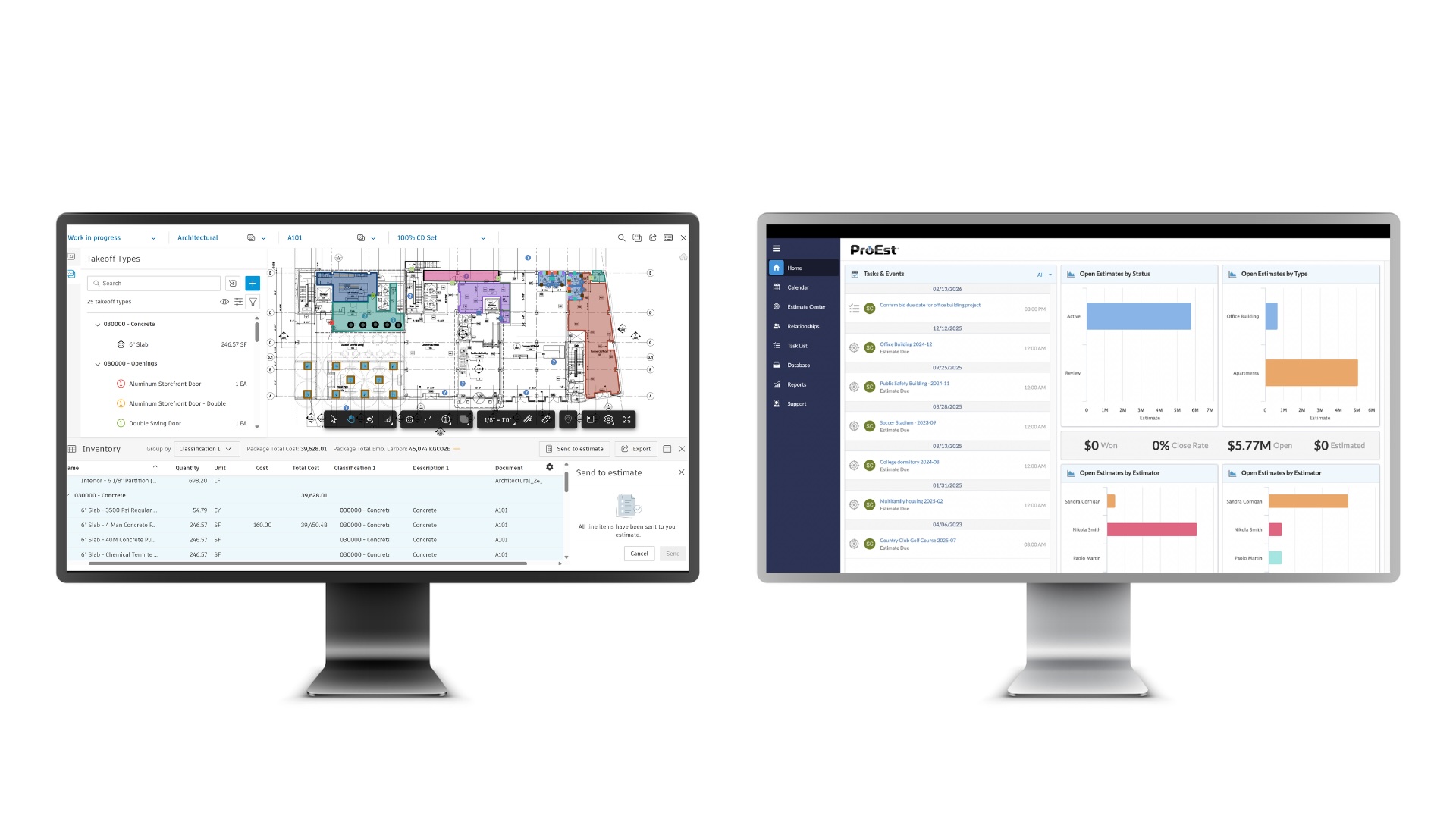
To be clear: Forma Estimate doesn’t replace ProEst. Instead, Autodesk now offers two estimating solutions that serve different needs. One optimizes depth and configurability. The other optimizes connectivity and workflow integration.
Understanding these two solutions is important if you’re evaluating where your estimating process needs to go next.
If you’re evaluating both tools, this quick overview will help you understand where each one stands.
ProEst is an established estimating solution with a mature feature set, and it continues to be supported and is available as part of the Forma for Preconstruction Bundle. Teams rely on ProEst for its deep estimating functionality and highly customizable workflows.
ProEst also offers advanced data and automation capabilities which makes it easier to handle complex projects, detailed breakdowns, and highly specific reporting needs.
Forma Estimate is a cloud-based estimating solution built directly within Autodesk Forma.
It’s designed for connected preconstruction workflows and integrates natively with tools like Forma Data Management and Forma Takeoff.
It’s also available as part of the Forma for Preconstruction Bundle.
A key distinction between ProEst and Forma Estimate is how each solution approaches estimating. ProEst is built to maximize flexibility and control within the tool, while Forma Estimate is built to keep estimating connected to takeoff, bidding, and beyond.
ProEst is built for teams that want control over every part of the estimating process. It has a mature feature set and gives estimators the flexibility to shape workflows, outputs, and cost models to match their operating practices.
Key capabilities include:
This is where ProEst stands out. It gives teams deep functionality and the ability to fine-tune estimating down to a very granular level.
Forma Estimate is built for teams that want estimating to stay connected to everything else in preconstruction. Estimate allows you to connect to both 2D and 3D takeoff quantities to power your estimates, by bringing takeoff and estimating into one environment so data stays aligned from the start.
Here’s what that looks like in practice:
ProEst optimizes estimating within the estimating environment, with deep functionality and purpose-built integrations. Forma Estimate optimizes estimating within a connected preconstruction lifecycle, where data flows across workflows without friction.
If you’re comparing Forma Estimate vs. ProEst, you’ll want to evaluate each solution through the lens of your workflows, data strategy, and integration needs. Consider the following.
Both tools support reporting, but they take very different approaches.
How each solution handles cost data is another key difference.
The integration strategy reflects each tool’s overall approach.
No matter which tool you decide to use—i.e., Forma Estimate or ProEst—chances are, other team members will be using them with you. When it comes to collaboration, here’s how these tools compare.
Forma Estimate is cloud-native by design, which makes real-time collaboration the default, not an add-on. Teams can work off the same data at the same time without worrying about version control or disconnected files.
Here’s what that enables:
The result is a more aligned preconstruction process, where teams spend less time chasing updates and more time making decisions.
ProEst has moved fully to the cloud, but its strength is still rooted in estimating depth. It’s a strong fit for teams that:
While collaboration is supported, it’s not as tightly embedded across the full preconstruction workflow.
As estimating becomes more collaborative and time-sensitive, the way teams work is shifting.
Teams working across multiple locations or coordinating closely with takeoff, bidding, and preconstruction stakeholders will likely place greater value on connected platforms and real-time workflows. If this sounds like you and the people you work with, then Forma Estimate is an excellent fit.
On the other hand, teams that prioritize control, customization, and depth within estimating may still lean toward tools like ProEst.
In most cases, the decision comes down to this: Do you need the most powerful estimating tool, or do you need estimating to be tightly connected to everything around it?
Choosing between ProEst and Forma Estimate starts with understanding your team’s needs. Think about how you build estimates, manage data, and connect with the rest of your workflow.
Modern estimating goes beyond just producing a number. It’s about connecting risk, qualification, takeoff, bid management, and handoff.
This is the direction Autodesk is moving with Forma.
The goal is a unified platform that connects the full project lifecycle, from design to preconstruction to build.
Instead of working across disconnected tools, teams operate within a connected data ecosystem where information flows from one phase to the next without getting lost or duplicated.
At the preconstruction level, that means bringing together:
With the Bidding tool now available in beta for certain subscriptions, Autodesk is bringing proven workflows from BuildingConnected directly into Forma. Teams can manage bidding and subcontractor prequalification in the same environment where they handle takeoffs and estimates.
What makes this meaningful is that teams don’t have to change how they manage bids or recreate data. The workflows they already rely on are now connected to estimating and takeoff.
In practice, that means:
The result is a more unified preconstruction experience where teams spend less time moving information between systems and more time making informed decisions.
This is the bigger shift behind Forma. Not just better tools, but a more connected way to manage preconstruction from start to finish.
ProEst is built for customization and estimating depth. Forma Estimate is built for connectivity and workflow alignment. Choosing between them comes down to your team’s priorities, whether that’s advanced customization or a more connected preconstruction process. Both solutions are part of Autodesk’s bigger vision.
Want to see how it all fits together? Explore the Forma for Preconstruction Bundle.