Reality capture has always been a fascinating part of construction. And what's exciting is how fast the tech keeps moving. With new advancements in AI and visual intelligence, teams can understand job sites better and make decisions with a lot more confidence.
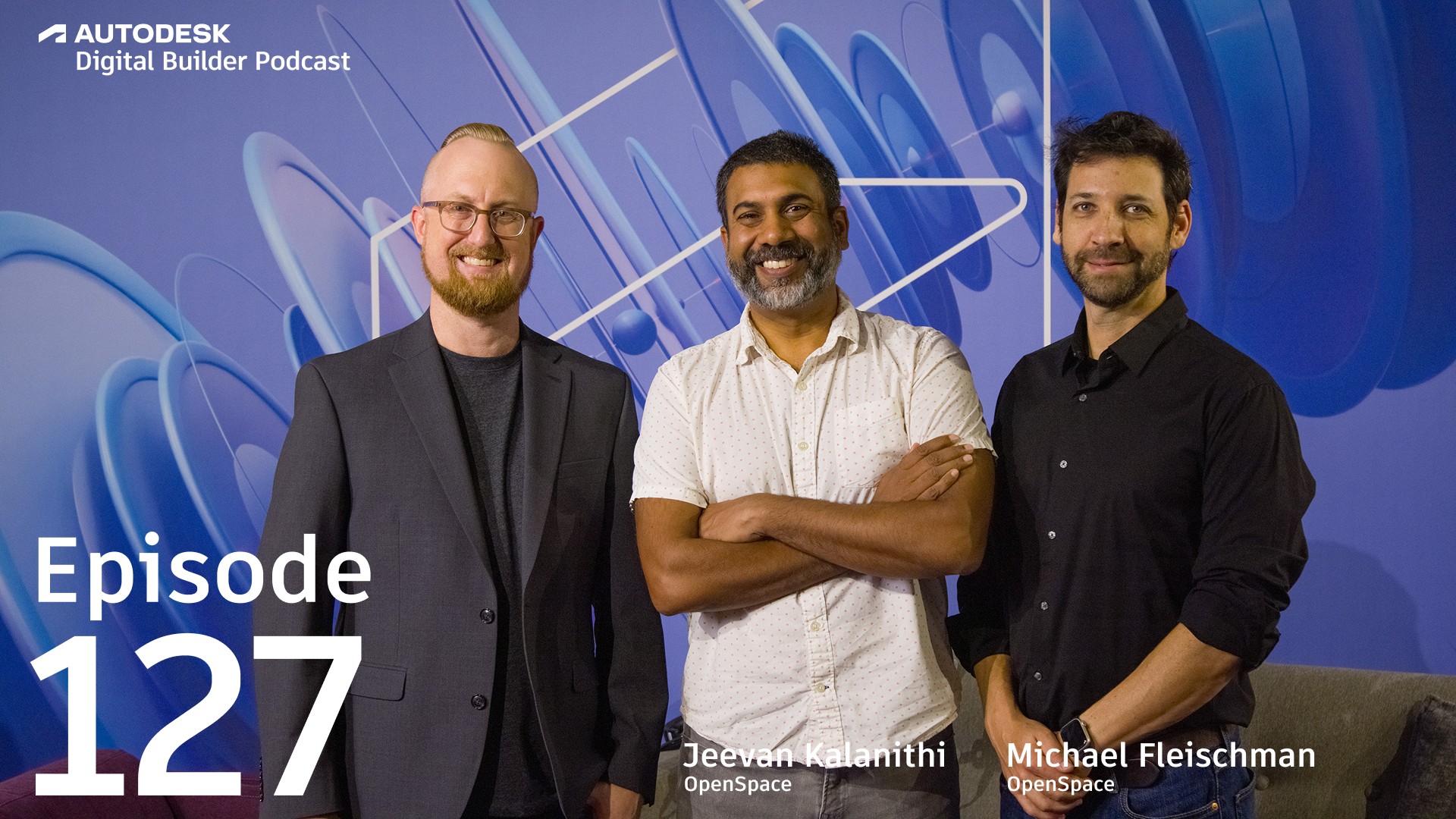
With that, I recently sat down with Jeevan Kalanithi and Michael Fleischman, co-founders of OpenSpace, a visual intelligence platform for builders. We unpack all things reality capture and explore how the technology has evolved. We also touch on how teams can use it not only to document projects but also to strengthen decisions across the entire build.
We discuss:
For the longest time, reality capture has primarily focused on technologies such as 3D laser scanning, photogrammetry, and 360-degree cameras. And while these tools are still critical today, we're stepping into a new phase where the capture is only the starting point, and the real value comes from what you can do with the data.
Jeevan describes it as the "three chapters of reality capture."
The first chapter is all about using laser scanners to collect information in the field. From there, the industry moved to the second chapter, where cameras made it possible to capture what was happening on site at far lower cost and with much greater frequency.
"That was around the time we started OpenSpace, and teams could say, 'Hey, you could get what's really going on out there with much cheaper technology like cameras, and it could be really comprehensive.'"
He continues, "And now I think we're entering chapter three, which is about visual intelligence. The basic idea is that it's easier to run a lot of things out in the field if you're oriented around images and their location, rather than documents and words. After all, builders work in real reality, and that's the currency for making good decisions."
Michael, for his part, is excited about seeing reality capture merge with technologies like AI.
"We often talk about two mega trends," he says. "Spatial computing, which shows up in robotics and self-driving cars, and then generative AI." The magic, he explains, is in how the two complement each other.
"It's incredible to see how those interact with each other, and how we can bring them into one unified framework. We often call that spatial AI, and it's been a big focus for us, particularly as we've transitioned into this visual intelligence platform."
According to Michael, building the right product for the job site starts with making the field a "first-class citizen in the tech stack."
For him, some of the most essential things in construction are "having timely access and knowing exactly what's going on in the field at any point in time."
The OpenSpace team recognized this early, and they built a tool that is intuitive to use, particularly in the field.
"We wanted to make sure our experiences were loved by superintendents and PEs. And the way we did that is by really focusing on simplicity," remarks Jeevan.
The real value of reality capture goes beyond the "capture" component. It's what takes place after you've collected the data and see the state of the job site. The decisions you make are shaped by the clarity and accuracy of what you're looking at.
"We have this mantra of allowing our customers to make better decisions faster," says Jeevan.
To do that, users need something everyone can look at and instantly recognize as the truth, with no room for dispute.
Jeevan explains that trust is built right into the philosophy behind OpenSpace. "A picture really is worth a thousand words," he says. When teams are looking at a located image, there's no arguing about what was there or what happened.
Early on, he recalls a superintendent calling him and saying, "OpenSpace really saved my rear end." They had a conflict with a trade partner, and the issue disappeared the moment they pulled up the photo. "We had a picture that showed what was going on, and it wasn't a conflict anymore."
Beyond resolving disagreements, having solid reality capture data also reduces risk in your projects.
An insurance firm studied companies using OpenSpace and found their claims frequency was "way, way lower."
It makes sense. When you can see what's happening, you can fix issues before they turn into claims. Insurers now underwrite that lower risk, which can reduce policy costs and make projects more profitable.
Technology is evolving to a point where teams have real visibility into the field instead of relying only on memory or walk-throughs. Decisions that used to take a bit of gut feeling and experience-based insight can now be backed by data that shows what's actually happening on site.
The question is whether that creates tension. Should teams really choose between decades of field experience vs. the data coming from new tools?
For Michael, there's no choice to make because both sides work together.
"I don't really think of it as a conflict. For me, it's not so much about technology replacing gut feeling or experience; rather, it's about technology enhancing that experience."
He likens it to giving people superpowers.
"It's more Iron Man than Terminator in terms of what technology is doing. It's like an exoskeleton giving the workers these superpowers—whether it's letting them have total recall so they can remember everything they've seen on a job site or teleportation, where they can be in more than one place at a time."
So if you're worried about robots taking over the job site, don't be. The future looks a lot more "Marvel" than dystopian.
As AI and spatial data mature, Michael says the biggest unlock is bringing it all directly to the job site. "What brings it together for the field is mobile," he explains.
When AI starts merging with the spatial data OpenSpace already captures, it opens the door for a lot more to happen on a phone. His team has been focused on that shift over the past year, and many of the features they're rolling out now reflect that work.
And, as with any conversation about AI, we also touch on off-the-shelf tools like ChatGPT. These tools, when used in low-stakes situations like, say, getting restaurant ideas, can be inconsistent and still be fine. But construction doesn't have that luxury. There's real money and safety on the line.
Because of that, OpenSpace builds frameworks that make AI tools safer and more reliable for the field. Much of that comes down to spatial information. One example is their new AI auto-location technology. It can locate users anywhere on a job site, even inside buildings where GPS can't reach. That location data helps stabilize AI outputs and gives teams context the moment they need it.
That's just one example of how OpenSpace pairs AI with spatial awareness to make the tech useful in the field.
Looking ahead, Michael sees even more potential as AI becomes aware of where people are on a job site and can act on that in real time.
One example? AI agents. He describes agents as "semi-autonomous digital assistants," basically the next evolution of a chatbot that can work in the background. What gets interesting is when you combine agents with AI auto-location so the system maintains "a spatial awareness of where the user is as they move about a job site."
Put together, you get spatial AI agents that can give context-aware alerts, help navigate large BIM models, and support workers with the right information at the right moment.
Jeevan is also bullish about AI agents, saying that they could help solve one of the biggest challenges in construction today: the labor shortage. He points out that the industry leans on a tremendous amount of knowledge held in the heads of seasoned supers and foremen. "There's so much information in super-experienced people's brains," he says.
If AI agents can capture even a slice of that knowledge and guide newer team members, then you start increasing productivity across the board. And over time, those younger workers can level up faster and "be as awesome as that experienced superintendent."
Digital Builder is hosted by me, Eric Thomas. Remember, new episodes of Digital Builder go live every week. Listen to the Digital Builder Podcast on: