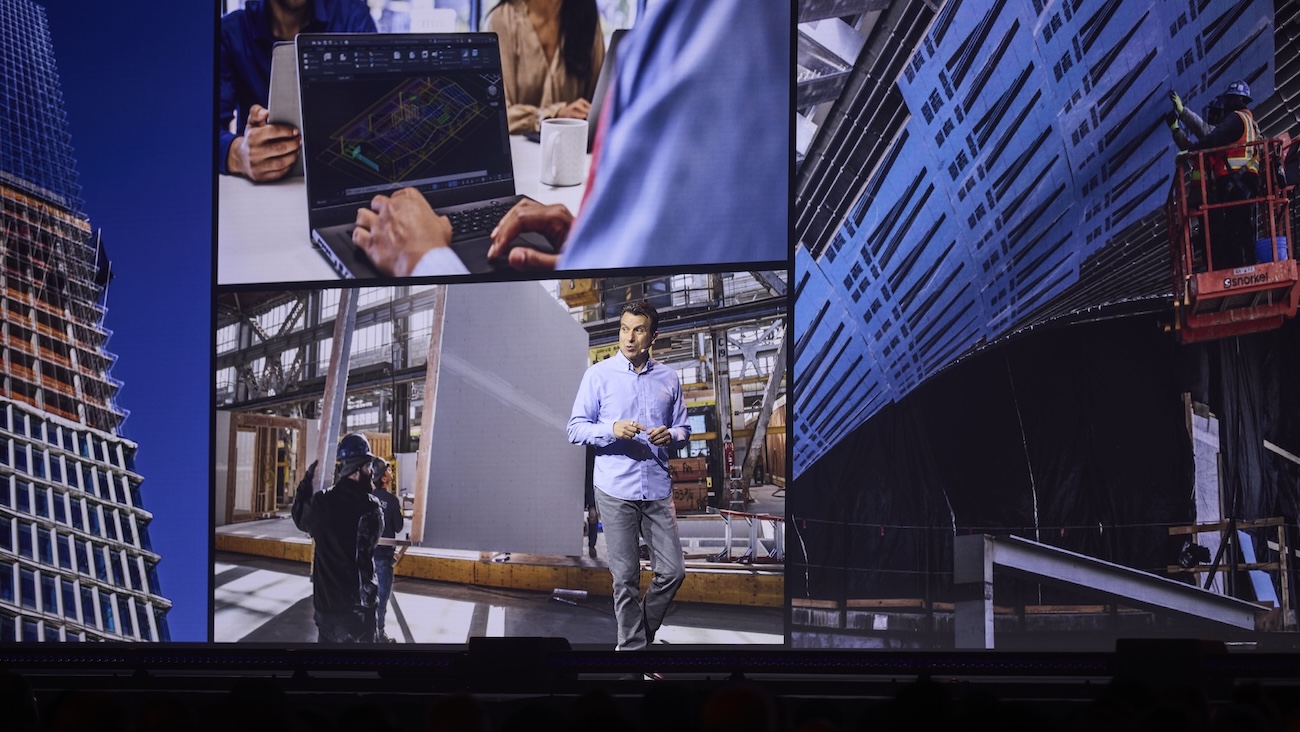
Autodesk University (AU) 2025: The Design & Make Conference has officially kicked off in the lively and musical city of Nashville, TN. From the moment the doors opened, Day 1 set the stage for an inspiring week of sessions, fresh experiences, and vibrant meetups with a keynote address from Autodesk President and CEO, Andrew Anagnost.
Let’s explore some of the top takeaways from the General Session for architecture, engineering, construction, and operations (AECO) professionals.
If you missed the General Session but want to watch it on demand, view here.
You can also read more extensively about our releases on Autodesk News.
Here’s the TL;DR on the keynote announcements for AECO. Scroll below to learn more.
Autodesk Forma: A New Era for AECO
New AECO Tools and Capabilities
Customer Impact
Andrew opened the General Session with a bold message: we are living in consequential times. He acknowledged and emphasized with the rising pressures that AECO firms face, including labor shortages, strained supply chains, and rising demand for building.
He emphasized how Autodesk’s AI-native platforms are designed to help professionals “make more with less,” delivering better outcomes with fewer resources even in challenging and evolving times.
“We want you to make more housing, more resilient infrastructure, more factories, and more stories—more efficiently, more cost-effectively, and with better outcomes for everyone.” – Andrew Anagnost, President and CEO, Autodesk
Andrew’s message was clear: the future is here, and Autodesk is ready to help you live it. He urged attendees to embrace the shift toward cloud-connected, AI-native workflows that adapt in real-time to evolving end-to-end project needs. This isn’t just about improving productivity, it’s about reimagining how entire design and building ecosystems collaborate around a shared, living source of truth. With AI and automation at the core, Autodesk is laying the groundwork for a new era of design and construction that is faster, smarter, and more resilient–unlocking unlimited capacity.
One of the most exciting announcements for the design and construction audience was the evolution of Autodesk Forma into the first comprehensive AECO industry cloud. Forma now integrates directly with Autodesk Construction Cloud (ACC), bridging the gap between design and construction workflows.
Several other major product updates were introduced in the General Session to support this vision:
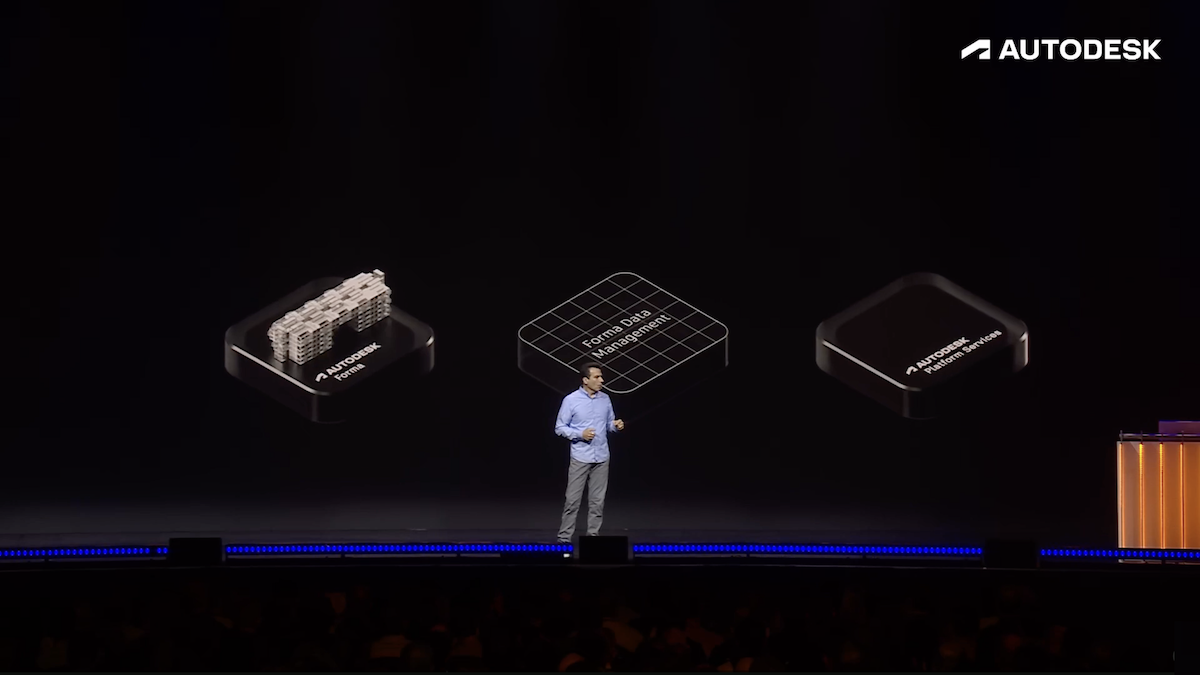
The session featured a walkthrough of a full end-to-end workflow using Forma. It began with an “architect” launching a sustainable multifamily housing project. The site was created using standard terrain data enriched by expanded Esri ArcGIS extensions, showcasing how partners are extending Forma’s capabilities across the AECO Technology Partner Ecosystem.
They first used Forma Board, a digital whiteboard tightly integrated with Forma Data Management, to collaborate in real-time and arrive at optimal design solutions. During the detailed design phase, Forma Building Design enabled continuous monitoring of real-time analysis.
The demo team then bravely showcased pre-beta software live on stage, emphasizing Autodesk’s commitment to transparency and innovation. As the first official Forma Connected Client, Revit was demonstrated through live analysis of adjacent buildings. Cloud-based simulations ran in the background without interrupting design workflows, highlighting the power of connected data and the seamless bridge between desktop and cloud environments.
Autodesk’s General Session made it clear: AI has moved beyond buzzword to a true strategic imperative for AECO firms. At Autodesk, artificial intelligence is being woven into every layer of the design and construction lifecycle not just to automate tasks, but to unlock entirely new ways of working.
The session introduced Autodesk Assistant, an AI-powered tool now coming to Revit, AutoCAD, and Civil 3D. It was used to automate tasks like generating sheets and retrieving relevant information, and even drafted emails to trade partners based on project insights to save time and improve coordination.
Autodesk Assistant has been available for Autodesk Construction Cloud for some time now. Just this month, a new beta enables users to ask Assistant natural language questions about expanded project data RFIs, submittals, change orders, schedule tasks, issues, or specifications and get instant, context-rich responses.
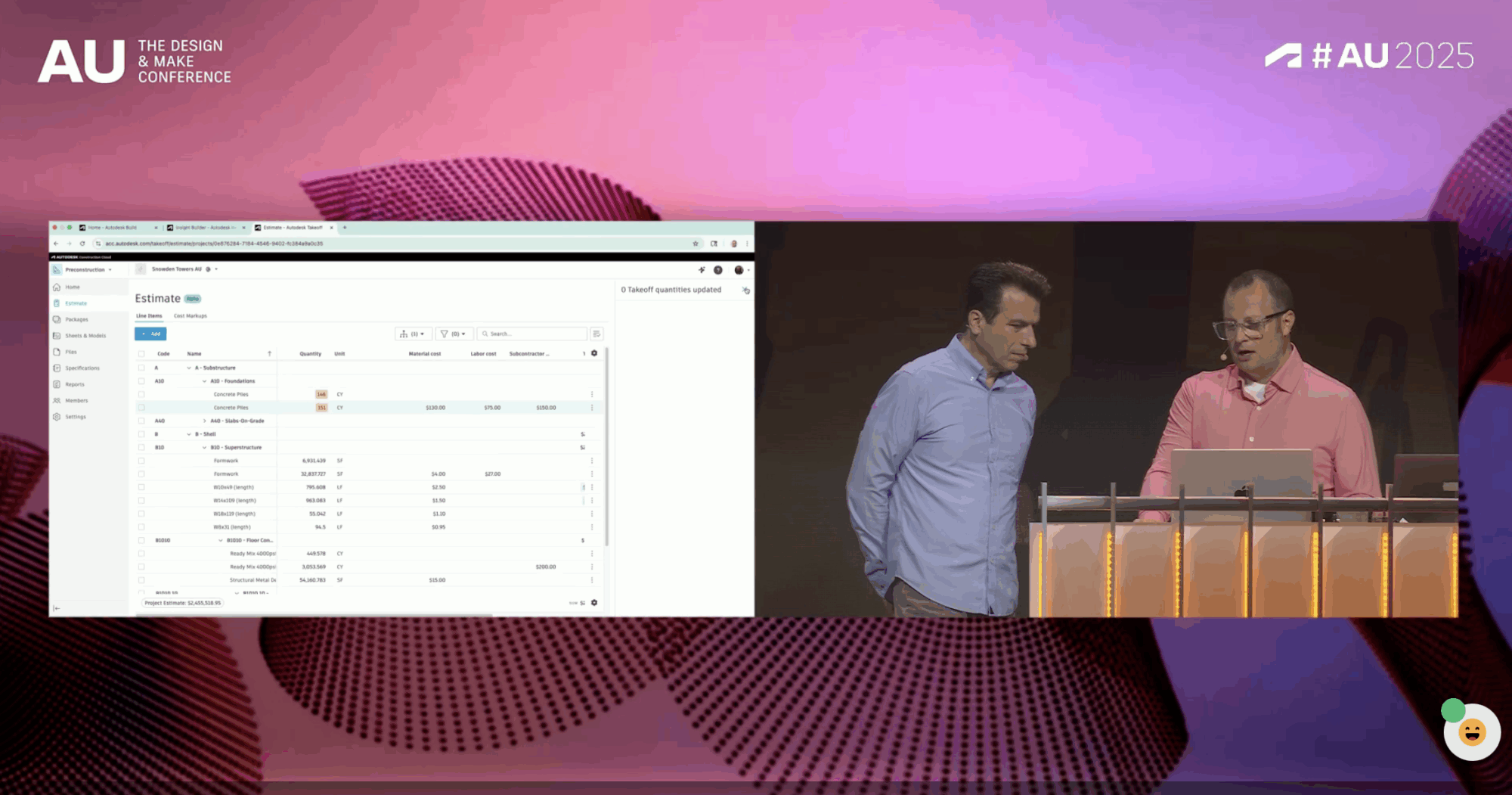
Autodesk Estimate was another highlight, empowering preconstruction teams to make faster, more informed decisions. In the demo, the “estimator” updated concrete pricing based on a recent call to Nashville Ready Mix, showcasing how market volatility can be quickly accounted for in planning and budgeting.
Designed to streamline your preconstruction workflows, this new solution links 2D and 3D takeoff quantities directly to your estimate, helping you estimate faster, collaborate better, and win more work with less manual effort and more confidence.
Cloud-based estimating is coming to Autodesk Construction Cloud – Stay in the loop:
As the project moved from preconstruction to build, Autodesk showcased new mobile tools designed for field teams. The mobile app now allows users to capture progress photos, daily logs, and more with ease. One standout feature is an upcoming AI-powered capability that lets users simply take a photo of an issue and Autodesk AI will automatically populate the necessary fields, signficantly speeding up documentation that traditionally would have been manual and error-prone.
Meanwhile, project managers can access tailored insights from the data captured on-site, enabling real-time risk analysis and more informed decision-making.
In the demo, the team showcased custom dashboards built from scratch to track cost, quality, safety, and schedule tailored to specific personas across the field and office. Once created, deploying them is as simple as selecting the project and role, whether estimator or superintendent, and publishing directly through Project Home. The ability to customize and share dashboards by role and workflow empowers teams to stay on track while wearing many hats, literally and figuratively.
The project then transitioned into operations using Tandem Insights, where AI was used to identify and summarize data about a heat recovery unit. The facility manager accessed performance metrics, warranties, manuals, and spatial context—all in one dashboard—moving from reactive to proactive management. This intuitive environment allowed teams to prioritize work orders and navigate building systems with clarity and precision.
While the live demos powerfully illustrated how Autodesk Forma connects workflows across design, preconstruction, construction, and operations, it was the real-world application that truly grounded the vision.
A standout case study video was shown in the General Session featuring the team at Denver International Airport, who are leveraging Autodesk Construction Cloud as part of Forma to coordinate across hundreds of contractors and thousands of team members. Their use of Tandem to unify Revit and facility models exemplifies how cloud-based collaboration is transforming complex infrastructure projects.
Brendan Dillon, Digital Facilities & Infrastructure Director at the airport, came out with Andrew to speak to how digital transformation has enabled the coordination of over 300 active projects simultaneously, something previously deemed impossible.
“Airports have always been laboratories for the future. Now they’re laboratories for the most advanced design and construction technologies.” – Brendan Dillon, Digital Facilities & Infrastructure Director, Denver International Airport
By embracing Autodesk’s cloud tools, the airport team can now identify issues before they arise, streamline communication across departments, and maintain a single source of truth for all project data. Brendan emphasized the importance of having internal champions for innovation and the value of sharing institutional knowledge with other public sector organizations. The airport’s story is a compelling example of how technology can unlock capacity, reduce risk, and drive smarter decision-making at scale.
AU 2025 Day 1 set the tone for a transformative week. The General Session wasn’t just a showcase of new tools—it was a call to action. Autodesk is building the future of AECO, and the message to customers was clear: you have the power to shape what comes next.
As the General Session came to a close, Andrew left attendees with a powerful message: the future of design and construction is dynamic, collaborative, and deeply intelligent. Projects should evolve in real-time, adapting as designs shift and new data emerges. The goal is not just to optimize workflows for individual disciplines, but to align entire ecosystems around a shared, living source of truth.
While we’re not fully there yet, the pace of innovation is accelerating. Over the past four decades, Autodesk has partnered with creators to build everything from complex airports to mission-critical drones and unforgettable cinematic experiences. Now, in this next era, Autodesk doesn’t just want customers to survive the challenges ahead. We want you to thrive, working at a scale and speed never seen before, by unlocking unlimited capacity.