Kyushu University hybrid rocket takes flight: PLANET-Q mission to 6.21 miles
Education Success Story
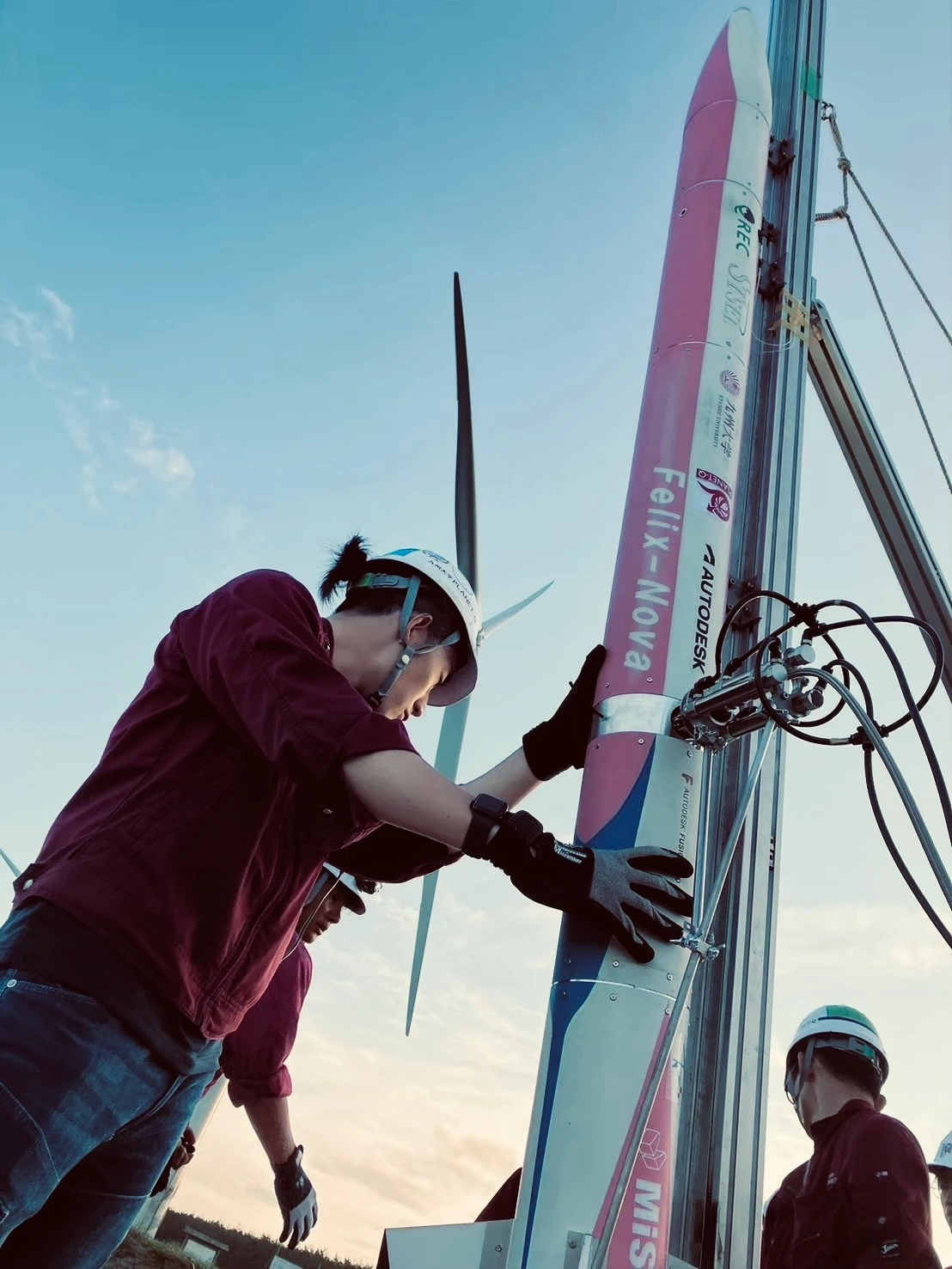
For nearly a decade, PLANET-Q, a space development club at Kyushu University, has used Autodesk Fusion across design, analysis, and manufacturing for their projects, especially hybrid rockets.
The use of Fusion has supported collaboration, knowledge transfer, and even kept the club active during the pandemic.
The team is currently working on goals to achieve supersonic speed and a 6.21-mile altitude with a brand-new rocket design.
With growing expertise in generative design, their goals are closer than ever.
PLANET-Q blasts off with new supersonic and altitude goals
PLANET-Q is an officially recognized space development student club at Kyushu University, based on the Ito campus that spans Fukuoka City and Itoshima City in Fukuoka Prefecture. Since its founding in 2004, the club has brought together students interested in space for more than 20 years. Currently, around 70 members are engaged in four space-related projects: small satellite mockups (CanSat), high-altitude balloons that reach the stratosphere, solid-fuel model rockets, and hybrid rockets that combine solid fuel with a liquid oxidizer.
The main focus is the hybrid rocket project. Twice a year, the team develops rockets to be launched at joint experimental events held with other universities in locations such as Noshiro, Akita, and Izu Ōshima, Tokyo. In preparation for these events, the team designs and builds two rockets annually.
For their new rockets, the goal is to reach Mach speed and 6.21-mile altitude. In the last year, they have made significant progress. They reached an increase of 0.1 to Mach 0.81 and achieved an additional .3 miles (3100 m) altitude, which made a new altitude record for student projects in Japan.
Full-scale use of Fusion for design, analysis, and CAM
PLANET-Q adopted Autodesk Fusion as its primary design tool. Previously, the CAD software in use had licensing restrictions that limited its use to within the university, making it difficult to expand the number of users. This led to the decision to switch to Fusion, which is free of charge for academia and open to students without restrictions.
“In developing our hybrid rockets, we use Fusion for everything—from the airframe and internal mechanisms to the engine and valve design,” says Hinata Komera, a member of the structural team responsible for the rocket design. “The assembly function allows us to check the motion of movable parts, and the weight and center of gravity analysis using 3D materials contributes to flight stability and improving design precision.”
Shoutarou Suga from the combustion team adds that in cases where no specific CAD software is designated by the engineering faculty, most students default to Fusion.
“Fusion is often introduced as a beginner-friendly option in classes,” she says. “After actually using it, I found it visually and intuitively easy to operate.”
Cloud collaboration supports knowledge transfer beyond the pandemic
For a student club rotating members annually, passing on design and engineering knowledge is a major challenge. Third-year students make up the core team, with fourth-year and graduate students supporting them
“Of the two rockets we develop each year, the first is built referencing previous designs by senior members,” says Erika Tsunoda, club leader. “The second incorporates our own ideas and improvements. In both cases, access to past design data stored in the cloud is extremely helpful. Even for CNC machining with CAM, we create new programs based on past examples, deepening our understanding in the process.”
Fusion’s capabilities in design and manufacturing not only support ongoing development but also enable intergenerational knowledge transfer. The cloud functionality also enables flexible work styles unconstrained by location or time.
“Balancing academics and club activities often means working from home,” Suga says. “When launches are held in remote locations, we can conduct final design checks on site. This ability to make design edits right before launch is critical to the project's success.”
Immediate access to the cloud is a critical factor in the success or failure of a project, as it is sometimes crucial to modify the design just prior to launch. During the COVID-19 pandemic, Fusion’s cloud features became vital for maintaining operations.
“Each member worked from home, progressing designs and sharing them via the cloud,” Tsunoda recalls. “That capability was what kept our club going.”
While some student groups were forced to suspend activities or lost their technical expertise due to disruptions, Fusion provided a foundation that ensured PLANET-Q's continuity.
Even in “normal times,” the cloud platform enhances project operations. With many members involved in the hybrid rocket project, real-time collaboration through Fusion Team proves highly effective.
“Including alumni, everyone can monitor the progress of rocket development in real time,” Komera says. “We can hold in-depth discussions on topics like assembly, watertight structures, and machining methods while looking at the same data. That’s a major strength.”
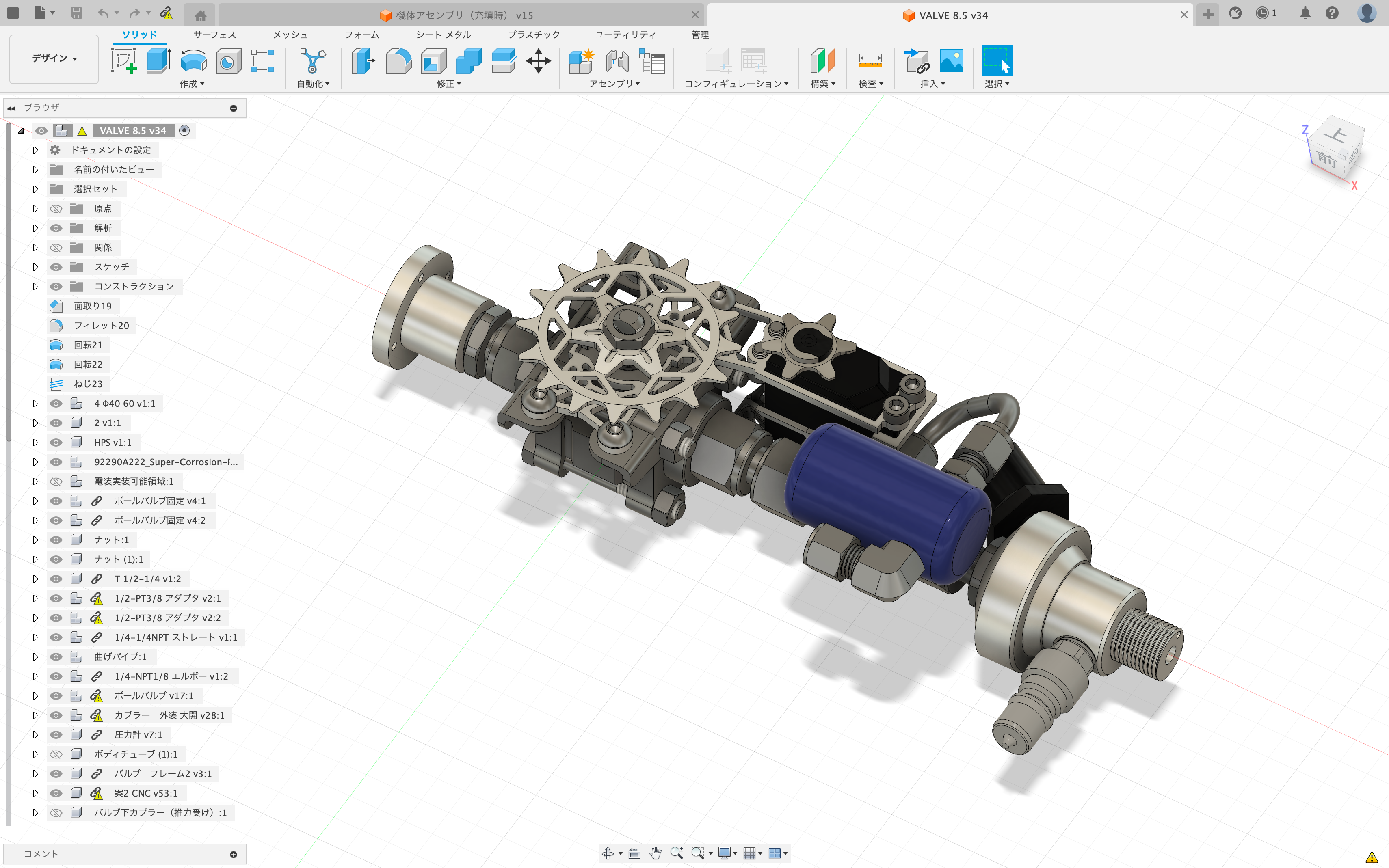
67% reduction in unit weight and 80% in part weight accelerates project advancement
PLANET-Q’s goal is to develop hybrid rockets capable of exceeding Mach speed and reaching an altitude of 6.21 miles (10 kilometers). Achieving this requires both greater thrust and significant weight reduction.
One major challenge was the heavy and inefficient fuel valve system from past designs. In the 2024 rocket, the team took on the task of redesigning this system using generative design. They focused particularly on the valve body, the motor driving it, and the frame securing the control board. The results were substantial. The valve unit’s weight dropped from 13.22 lb (6 kg) to approximately 4.4 lb (2 kg), and the frame alone was reduced from about 3.53 oz (100 g) to 0.7 oz (19.8 g)—an 80% reduction.
By setting more than 20 conditions in the simulation, they accounted for all types of loading. The previous flat-plate design suffered from stress concentrations and inefficiencies. The new structure not only improved strength reliability, but also made it possible to maintain piping without removing the frame—enhancing maintainability.
“With traditional FEM (finite element method) analysis, stress would often concentrate in one area or we'd have unnecessary parts,” Suga says. “With generative design, we could input all conditions simultaneously and consider them comprehensively. That led to a design that could withstand any kind of force while incorporating ease of maintenance.”
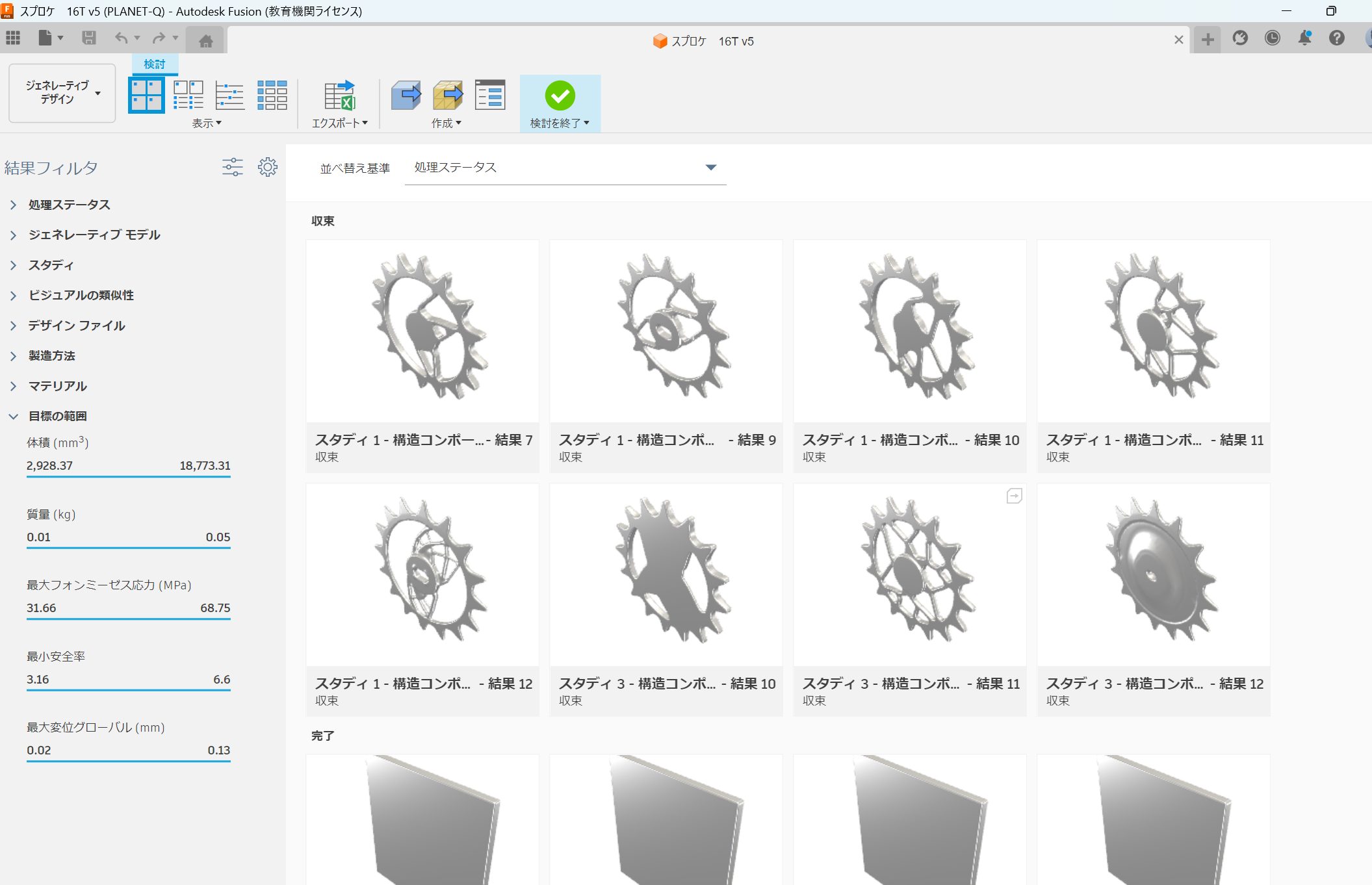
From “design teacher” to “design partner:" A new way of working with generative design
Suga first encountered generative design in the summer of his second year at university. Although he had some knowledge of propulsion system piping, FEM was mostly new territory. Thanks to education licensing, he could use Fusion freely and began learning FEM and generative design simultaneously.
“At first, generative design was like a ‘design teacher’—it showed the right direction or pointed out mistakes,” he says. “ I progressed through trial and error.” But as Suga became more proficient, the relationship changed: “Eventually, it felt like a ‘partner’ that responded to my design intentions with proposals,” he adds. “ I experienced a new style of co-designing with AI.”
Engineering textbooks often explain that “stress will be applied under these conditions,” but tend to conclude with “engineering intuition is required.” That so-called “engineering intuition” must be developed through hands-on experience. Generative design was the perfect training tool for him.
Suga now mentors younger students in strength design using generative design. He emphasizes starting with simple shapes and basic force applications, letting them experience how different constraints affect results. Even if a student’s assumptions differ, the goal is to spark the realization—“Ah, this is how Fusion interprets that.” Based on his own trial-and-error experiences, he helps foster design intuition with the next generation.
Get free educational access to software, learning content, and other resources.