Construction is an industry built on experience, but it's evolving faster than ever. During my time working for general contractors, a construction tech startup, and now Autodesk, I've seen firsthand how much has changed—from paper-heavy workflows to cloud-based collaboration.
But there's one thing that hasn't changed, and that's the value of learning from others who've been in the trenches.
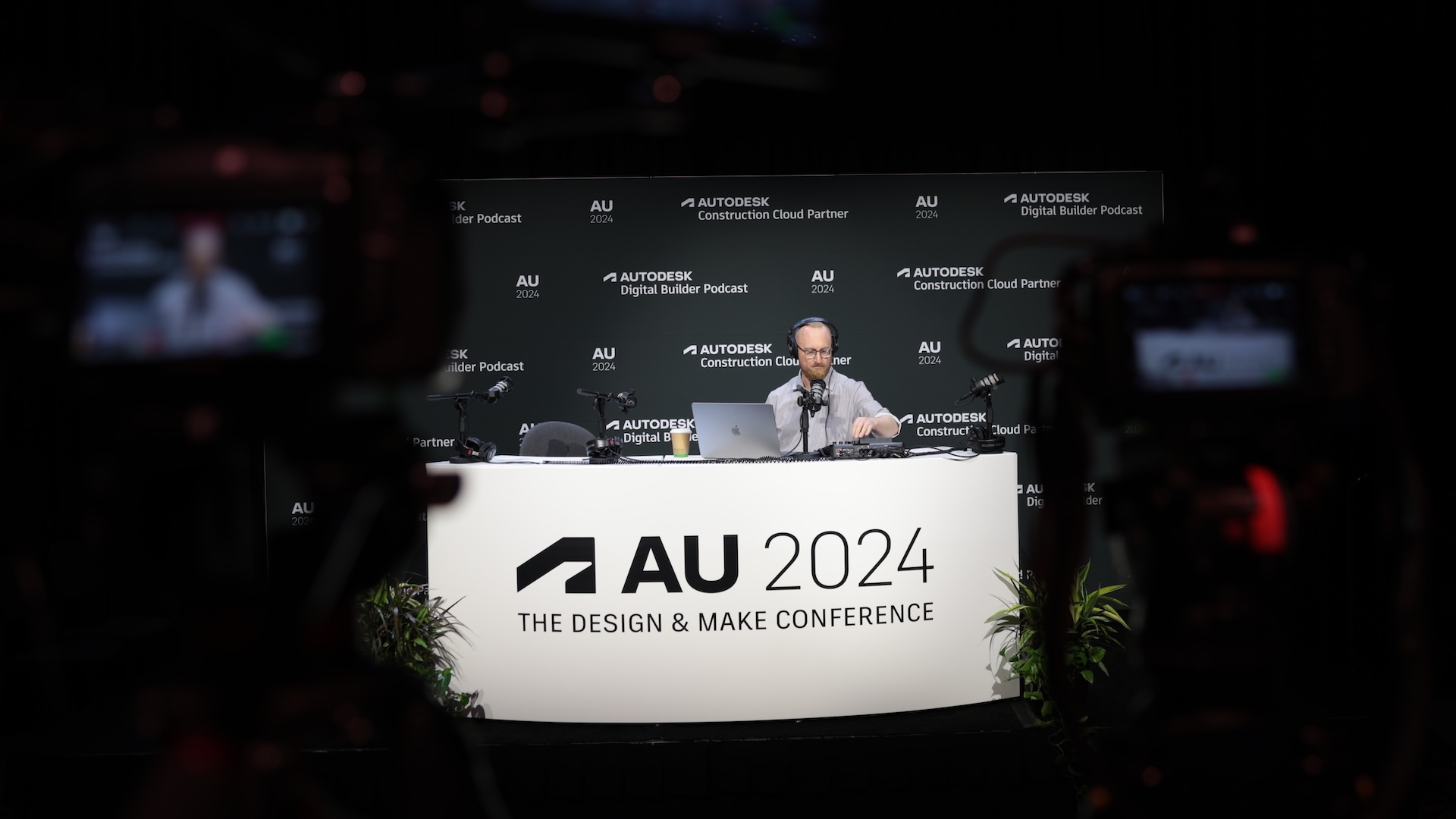
Since I’ve had the pleasure of launching and hosting the Digital Builder podcast nearly five years ago, I've had the privilege of speaking with many bright and inspiring construction leaders.
Today, I'm reflecting on five of the biggest takeaways from the more than 100 conversations I’ve had to date.
I also recently recorded an episode at Autodesk University 2025 wrapping up the event and reflecting on lessons learned from over 130 episodes so far. Listen in.
Working in construction is incredibly rewarding, but it's not without its challenges. Burnout is common, and teams are stretched thin due to the ongoing labor shortage. In some cases, workers have to travel far from home and spend extended periods away from their families, which adds to the mental strain.
All of these factors can take a toll on a person's well-being and lead to tragic outcomes. As Mark Dyke, a tenured professor of Construction Technology & Management at Ferris State University, pointed out in episode 79, "Suicide in the construction and extraction industries is the highest of any industry. If you take all of the deaths in construction due to falls and hits… suicide is still five times higher than that."
Addressing mental health issues in construction starts with open dialogue, increased awareness, and a commitment to prioritizing people over productivity. As cliché as it sounds, health truly is wealth.
"It's the only thing you truly own. And you need to prioritize your own health," said Amit Oberoi, the Executive Chairman of the Considerate Contractors Scheme (CCS) in episode 71.
So, make it a point to look after your mental health and be mindful of your stress levels.
Amit's advice? "Spot the signs early, take a step back, and understand that you're part of a bigger picture here. You can't work 24 hours a day. You need to have a bit of downtime and be flexible with yourself as well."
From an organizational standpoint, firms must incorporate psychological safety into the work culture. People must feel safe to speak up when they're struggling.
"Do you have an open culture where if something doesn't look or feel right, you have the mechanisms so people can put up their hand? The companies that do this well have a different feel in their culture. Even walking on a site, you can feel that morale is different, and you just know it," remarked Amit.
Corporate training also helps. The good news is, companies are starting to embrace it.
"I'm getting more and more requests now for corporate training," shared Mark. "Organizations come to me and say, 'Hey, can you talk to us about stress and burnout? Can you talk to us about conflict resolution?'"
It's encouraging to see more firms prioritizing mental health as a key part of jobsite safety. It's good for workers and good for business.
Tech adoption is an absolute must in construction, but it won't be effective without a clear strategy and cultural buy-in. For your digital tools to improve outcomes, you need to be strategic with how you implement technology. Also, don't lose sight of the fact that it's people—not software—that ultimately drive change and results.
As such, the best technology strategies are the ones that are rooted in strong objectives that teams can get on board with.
"What's the need, what's the vision? If we can articulate that throughout the organization, you get people to follow your vision, which is important for change," said Rexine Jones, the Chief Financial and Information Officer at Hansen Yuncken in episode 108.
Tomislav Zigo, VP and CTO at Clayco, offered a similar sentiment in episode 92, stating that successful tech adoption starts with understanding your problems before chasing new tools.
"Knowing what you are trying to do is the first step to understanding the technology you should bring in. Which technology addresses any of the specific issues you have? And then what is the transformative potential of the technology?" said Tomislav.
Then, you need to focus on alignment across the organization. At Hansen Yuncken, tech initiatives are approached with intention and tested before scaling. "It's really about knowing upfront where we see the value, testing the technology, and then we zip it up all the way through the organization. When everything is aligned, and the team is ready, the zipper goes up easily."
Along the same lines at Clayco, technology is seen as a tool for inclusivity, not just productivity. "Whatever we do needs to be geared toward empowering people, adding inclusivity, expecting diversity, and bringing everybody that can contribute in the same fold," said Tomislav.
Now, throughout your firm's tech adoption journey, teams may feel overwhelmed or resistant. Change isn't easy, and tech often introduces new tools and processes that disrupt familiar workflows and require a learning curve.
You can manage this by investing in thoughtful, ongoing training and support to help teams adapt confidently.
"There are always new enhancements coming out, but at the end of the day, if we're not providing the resources and training to those who are consuming the software daily, then all of our work is for nothing," explained Brad Buckles, VP of Technology and Innovation at CPPI in episode 110.
He added, "Yes, people get tired of change, but when they start seeing the value behind our decisions, they're going to be on board. And so, it is my job to ensure that we're delivering a value proposition and providing the training to minimize change fatigue."
AI is transformative; it streamlines workflows and helps teams analyze and uncover insights faster than ever. But there's also a lot of noise in this space, which is why teams must be thoughtful and strategic with how they approach AI.
For starters, cover your bases from a legal standpoint. Being careless about what you feed AI tools can lead to issues around privacy, copyright infringement, and more.
In episode 82, May Winfield, Global Director of Commercial Legal and Digital Risk at Buro Happold, pointed out, "Generative AI models scrape data across the internet or other sources. There are loads of cases at the moment, particularly in the US, where writers say ChatGPT has been fed all their novels and therefore is in breach of copyright because you can produce a novel exactly the same."
May also warns against relying on AI too much, and forgetting that these platforms make mistakes.
"A generative AI model is only as good as the data it's trained on. But what if you don't know what data it's been trained on? Saying to your client, 'Oh, the AI got it wrong,' is like saying the calculator got it wrong. It's not going to help, and I think that's a real risk."
In episode 77, Tonya Custis, the Director of AI Research at Autodesk, notes that AI isn't magic—it's just math, and it requires human guidance to be useful and safe.
"Honestly, computers really are quite stupid, or I would not have a job. Number one, they don't learn what you don't teach them. A lot of the Skynet and Terminator scenarios are from movies, and it's also a little bit of psychological projection. Whenever someone is afraid of AI doing bad stuff, I'm like, 'Well, what bad stuff are you going to do?'"
She continued, "Technology is neutral. It's the people behind it that do bad stuff. You could use databases for a lot of bad things, but again, it's not the database's fault."
All this to say that AI has incredible potential, but only when paired with clear guardrails. Smart and forward-thinking firms ensure that AI is used intentionally and with governance in place.
Take it from Brad, who has taken a careful, values-driven approach at CPPI.
"We've taken a cautionary approach to implementing AI. We want to make sure that we're protecting our intellectual property. So, we've put some governance around implementing AI at CPPI and leaning towards trusted partners like Autodesk."
The labor shortage is top of mind for many folks in construction, and for good reason: demand is growing, but firms are struggling to keep up. Between people retiring and recruitment challenges, some companies can't build teams fast enough to keep projects on track.
However, with the right recruiting strategies, construction firms can attract the talent they need.
Jon Marks, Principal CEO at Corvus Star Consulting and Former CTO at Swinerton, said in episode 51 that the industry must do a better job of showcasing its value and appeal to the next generation.
"We don't toot our own horn very well. We need to share with people why it's so much fun to be in this industry. There's a sense of camaraderie on jobsites. There's nothing more rewarding than working with a high-performing team, and you get those opportunities in construction all the time."
He continued, "If we can share those stories, we wouldn't have the labor shortages we're talking about today."
Beyond that, those recruiting for construction should have a strong understanding of the roles they're hiring for to build trust with candidates.
According to Alison Tripp (episode 112), National Talent Acquisition Leader at DPR Construction, recruiters need to be immersed in the jobsite experience to truly connect with candidates in a meaningful way.
"I see to it that my teams respect how hard construction is and what folks are doing on a jobsite. I encourage them to spend time with these teams so that they can be authentic in what they're speaking to."
Both Jon and Alison recognize the importance of diversity and inclusion, especially when hiring in construction.
"I believe the most effective organizations are those that make diversity a priority in their talent. Having different perspectives sitting around a table will lead to the best decisions," said Jon. So, it is critical for companies to have that community engagement and make sure that their organizations reflect the communities they work in."
Bringing diversity to life on your career page starts with making sure your content speaks to a broad range of candidates—visually and linguistically.
As Alison noted, "Your career page often is the first introduction candidates have. So, it was essential that our career page is also bilingual and that our craft and tradespeople could see opportunities for themselves."
Some of the most interesting career paths are the ones that take an unexpected turn. And for a lot of folks, their construction career doesn't follow a straight line—it evolves as they discover new strengths and passions.
Consider Erin Saiki, a superintendent at DPR Construction who appeared on episode 95. She began her journey with a degree in Civil Engineering and started down the typical path of project engineering. However, she realized her strengths were better suited to field leadership. With DPR's support, she pivoted into a superintendent role where she now leads complex projects, embraces new technologies, and fosters an inclusive jobsite culture.
For Erin, now is an exciting time to be in construction, especially as the role of superintendent expands to include professionals from all backgrounds.
"It's fascinating to see these new superintendents come in who definitely have different backgrounds but still get to interact with this generation of really talented builders who became superintendents. And when you mix them together, we get to see the full spectrum of a project, and that's exciting."
Regardless of how you end up in construction, it's important to find people who have your back.
For Natalya Cappellini, Founder and CEO, Licensed GC at Curato Design Build, having a great support network has been key to building confidence and staying focused on what matters most.
"Ninety percent of the partners and clients we work with are male. They are all extremely respectful and don't make weird comments or anything like that. And as soon as I encounter somebody that does, we just don't work together," she explained in episode 61.
Natalya continued, "I surround myself with men who are complimentary, respectful, and who don't see me as a woman. They see me as the boss and the one who's getting it done."
And whatever happens, trust yourself. Confidence and clarity come from backing your own decisions, even when the path isn't linear.
According to Kaitlin Frank (also episode 61), Co-founder and CEO at eMOD, "You're trusting yourself to make these decisions, and you're proving to yourself over and over again that you may not have all the answers, but you know who to contact. You know how to figure out what the answer is. The greatest lesson I've learned throughout my career is that I can trust myself."
The conversations I've had on Digital Builder have been inspiring to say the least, and we are far from ending these conversations. With timely topics and inspiring guests ahead, there's still so much more to explore.
Want to keep learning and stay ahead of the curve? Subscribe to the Digital Builder YouTube channel and newsletter to stay up to date with fresh insights, new episodes, and more exciting conversations coming soon.