Hot take: technology adoption isn’t about the tech itself. It’s really about the people using it and solving the problems they deal with day to day.
The best digital leaders understand this. That’s why, when introducing technology, they don't start with the newest tool or the latest AI announcement. They start by getting as close to the work as possible, then find better ways to help folks build.
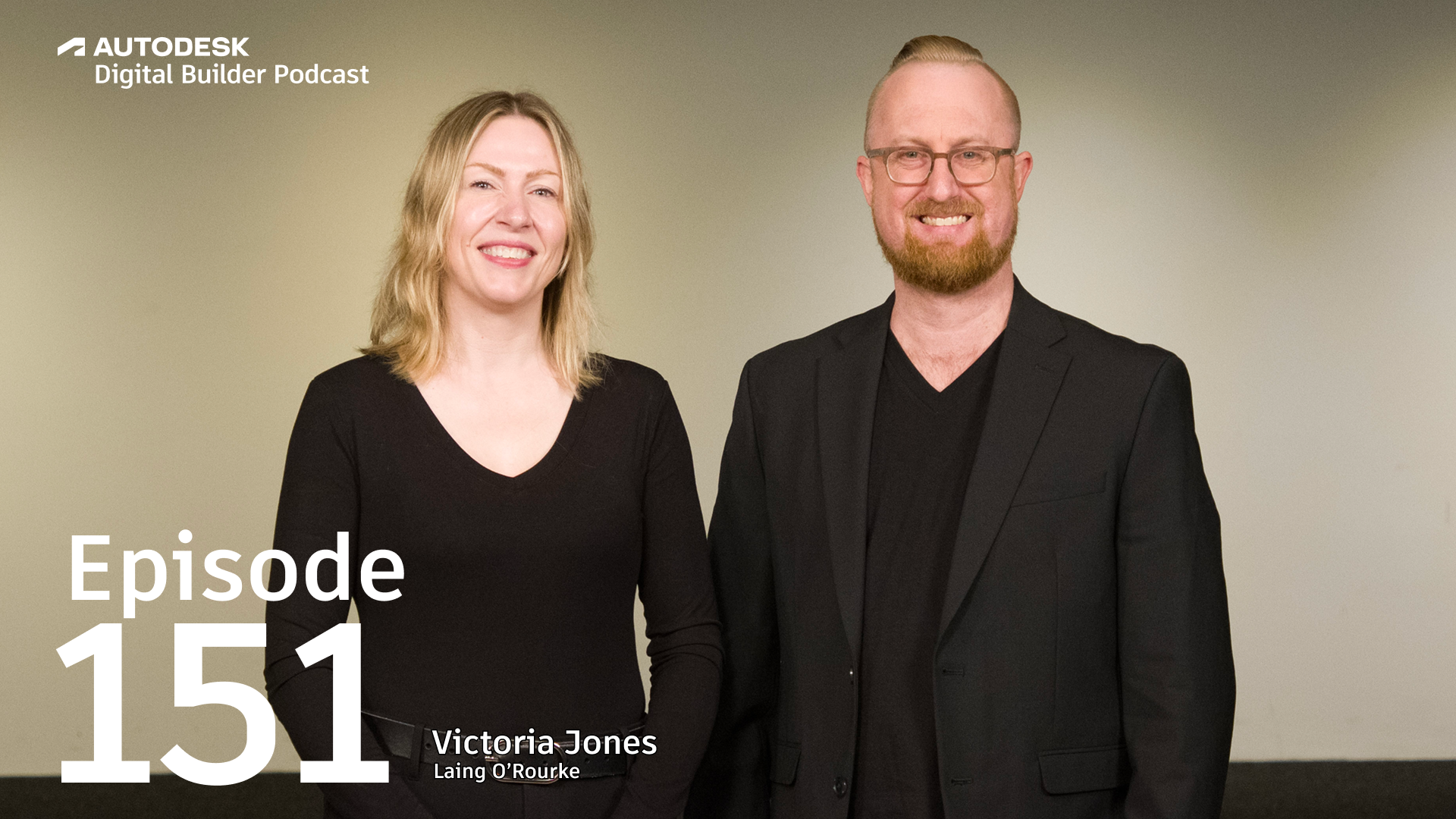
Victoria Jones has done just that throughout her remarkably diverse career. She's worked with her hands, built deep engineering expertise, and now serves as Principal Digital Developer at Laing O'Rourke.
In this episode of Digital Builder, we explore what it truly takes to drive technology adoption on complex projects, why staying close to the field matters, and where AI has the potential to make the biggest impact.
We discuss:
Sometimes, tech adoption in the field goes smoothly. Other times, not so much. So, what separates the successes from the setbacks?
Technology doesn't fail because field teams resist change. More often, it fails because it doesn't fit the reality of how they work. As Victoria puts it, site teams are "under so much pressure" that if a tool is clunky, "they'll start implementing workarounds."
And that behavior happens not because folks in the field aren’t capable. In fact, she argues the opposite. Teams are "incredibly capable people trying to adapt to systems that don't work for them."
Instead of forcing adoption, organizations should involve the people doing the work, explain the "why," and design solutions that solve real problems.
Successful technology adoption often comes down to something surprisingly simple: meeting people where they are. Victoria recalls working with an engineer who found the team's model review software "absolutely daunting."
“Despite being a fantastic engineer, he'd repeatedly say, ‘I can't get my head around this. I have absolutely had enough of this.’”
Instead of pointing him back to the training materials, Victoria sat down beside him and said, "Show me what you're trying to do," then guided him through it.
The team also realized the software was more complex than many engineers needed. So rather than forcing everyone to use the full tool, they built a simpler interface using Power BI and IFC View with "just a handful of filters."
That small change made a big difference. Engineers went from "not engaging with the model at all" to "being all over it," even chasing the digital team down when they spotted an outdated model.
When teams run into technology that doesn't fit the way they actually work, the tendency is to create workarounds. Now, it's easy to see a workaround as something to be eliminated, but for Victoria, it represents an opportunity to improve.
"A workaround obviously signifies that the system isn't working," she says. The next step is figuring out whether it's a one-off or "a pattern" showing up across teams and projects. If the same workaround keeps surfacing, it's worth asking why. Sometimes the underlying constraint can be removed. Other times, "we have to standardize the workaround."
That being said, those conversations shouldn't be punitive. Instead of asking, “Why did you break the process?” ask, "Help us understand what was happening that caused you guys to go break this."
In other words, don’t just see a workaround as something that’s wrong or needs to be shut down. Often, it’s a chance to uncover what's driving behavior and build a better process from there.
The principles around tech adoption and getting teams on board become even more important on projects where the stakes, the scale, and the complexity are all significantly higher.
Hinkley Point C (HPC) is a perfect example of what that looks like in practice.
HPC is the UK’s first new nuclear power station in a generation, and it’s one of the country’s most ambitious infrastructure projects.
The scale is hard to wrap your head around. Victoria describes the site as spanning "84 football pitches," with roughly 70 buildings and around 12,000 people. “It's so large that you can't walk around the site. You have to catch a bus to get from one part to the other."
Despite its size and the strict governance required for a nuclear project, HPC also became a proving ground for digital innovation. Because the project was established when information management was still in its infancy, the team had the opportunity to build "absolutely bonkers tools" that brought together fragmented data and structured previously unstructured information. One example automatically pulled rebar data from the CDE, enriched it with pour information, and fed live dashboards showing concrete and rebar quantities.
"I've been in construction for 20 years, and I've seen things at Hinckley that just blew my mind," she remarks.
Rolling out new technology across thousands of people isn't about getting everyone to use the same tool. It's about making that tool worth using.
For Victoria, successful adoption came down to a few simple principles:
One example was the move to paperless rebar inspections. Rather than relying on paper checklists, engineers used tablets to review rebar and update statuses in the field. The tool was simple, easy to access, and delivered immediate value. Office teams could also see live updates as work progressed.
As a result, project teams didn’t just adopt the tech, they bought into it. As Victoria explains, “people embraced the new process because we made the system easy for them to use."
Construction of Hinkley Point C has been underway since 2017, and operations are scheduled to start in 2030. So, HPC isn't just massive in scale. It also spans more than a decade, making long-term consistency just as important as day-to-day execution.
Keeping a megaproject on track for that amount of time isn't about freezing processes in place. Change is inevitable. The challenge is making sure everyone stays aligned as that change happens.
Victoria acknowledges this. "I won't pretend that everything stayed consistent." But on a project with half a million embedded items, consistency still matters because repeated mistakes become expensive.
Her advice is quite practical: document how teams work, communicate often, and make information easy to find. "It sounds really simple, but there’s quite a number of times that I've come across things where that's not happened,” she remarks.
Just as important is creating a culture where teams share information instead of guarding it. Victoria sums it up really well: "Don't be protective, don't keep your cards close to your chest, let go of your ego and work together."
No conversation about technology and ways of working would be complete without the topic of AI.
Here, Victoria shares a balanced perspective on where the technology stands today. While there's plenty of excitement around its potential, she cautions against oversimplifying what AI can actually do.
"It's not something you can just run off with and tell it to do something, and it's going to churn out that information. AI needs context. It needs support. It needs information. It needs structure."
That doesn't mean she’s skeptical of AI. Quite the opposite.
She points to Microsoft's Copilot as a recent example of technology that's already changing the way her team works. While she's used ChatGPT for years, she says the real breakthrough has been the integration across platforms. "That's been a real game changer."
Looking ahead, Victoria sees AI becoming less about standalone tools and more about embedded workflows. As systems become more connected, AI can help more people access information without needing to master every piece of software they use.
All to say: AI isn't replacing human expertise anytime soon. But when it's built on quality data, integrated into existing workflows, and given the right context, it can become a powerful partner in how construction teams get work done.
Digital Builder is hosted by me, Eric Thomas. Remember, new episodes of Digital Builder go live every week. Listen to the Digital Builder Podcast on:
or wherever you listen to podcasts.