There's a popular saying that goes, “If you want to go fast, go alone. If you want to go far, go together.”
That simple idea sits at the heart of one of the most unique collaborations in the construction industry. While contractors don't usually have a reputation for sharing notes with their competitors, a group of industry leaders in the Netherlands recognized that some challenges are simply too big to solve on their own.
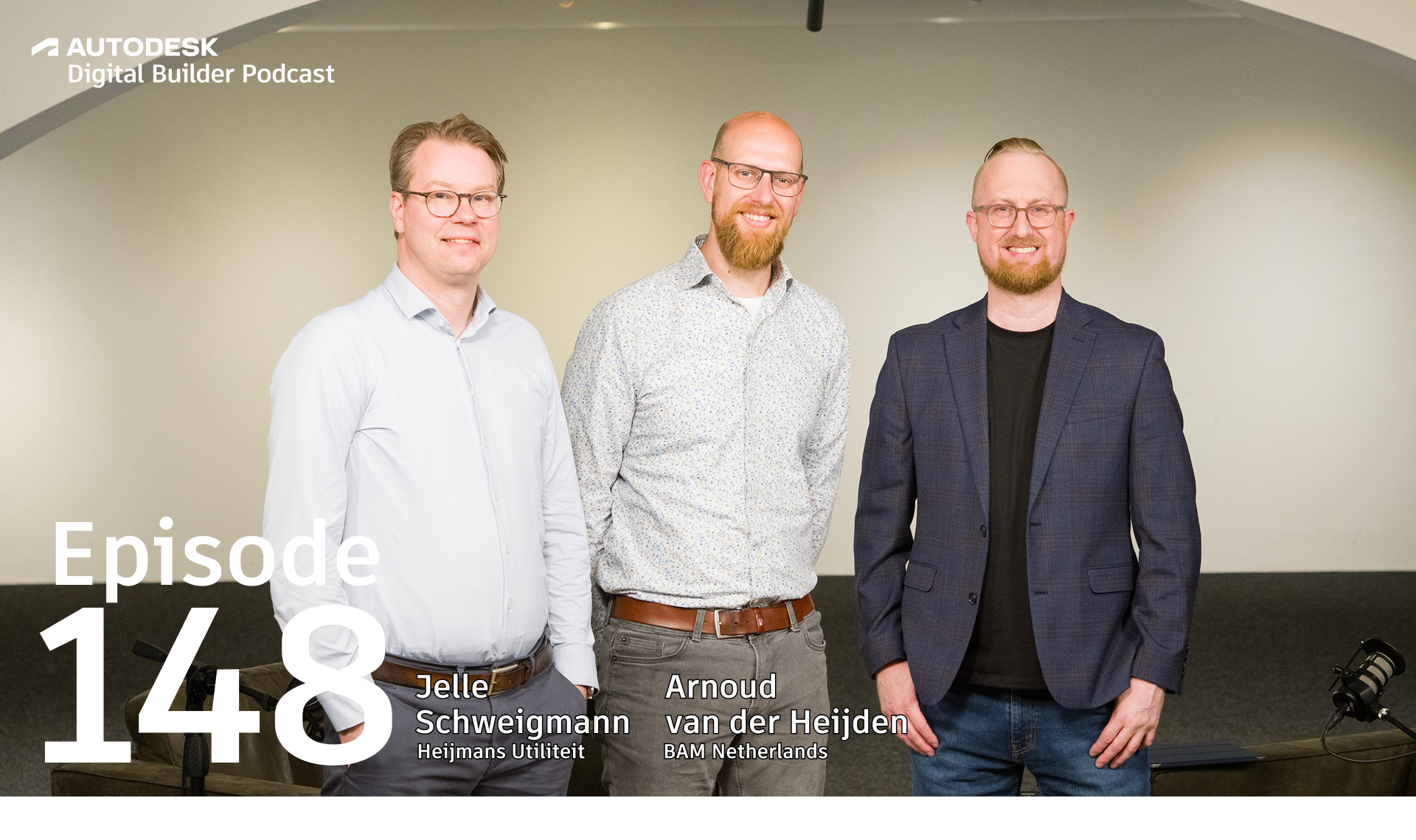
In this episode of Digital Builder, I sit down with Arnoud van der Heijden, Project Manager Digital at BAM Netherlands, and Jelle Schweigmann, BIM Manager at Royal Heijmans, to discuss the NL5, a coalition of the five largest construction companies in the Netherlands. We explore how their firms are working together to tackle shared challenges around digital transformation, sustainability, standardization, and the future of construction technology.
We discuss:
The NL5 brings together the five largest construction companies in the Netherlands to tackle industry-wide challenges. The group serves as a forum for sharing knowledge and working through common issues around technology, sustainability, and standardization.
It makes sense because many of the challenges facing construction today extend beyond any one company. As Arnoud explains, "Together we have a bigger voice."
The NL5 traces its roots back to Autodesk University, where leaders from several Dutch construction firms realized they were facing many of the same challenges. According to Jelle, the conversations started around "obstacles in the way they want to work" and questions about "what could be done."
Rather than approaching Autodesk separately, they decided to come together as a group.
The impact was immediate. "We got more attention," he says. The group gained more visibility into Autodesk's roadmap and found it easier to have productive conversations about shared priorities.
For Arnoud, the value of the NL5 goes beyond vendor relationships. "In the Netherlands, we are pretty big as a company, but when you zoom in, you're just one company in one country in Europe. It's really small."
By coming together, the group can address challenges that no single organization could solve as effectively on its own.
According to Arnoud, the group primarily exists to share knowledge, discuss common pain points, and collaborate on industry-wide challenges.
To keep things moving, the NL5 operates with both a core leadership group and topic-specific working groups. Jelle explains that members meet every two months to review progress and align on priorities.
For deeper discussions, each company assigns representatives to focus on specific topics and "really go in a deep dive." That structure is intentional. As Jelle puts it, "You don't want it to be a talk group. You want to have results and be really specific."
One of the biggest challenges facing the NL5 is deciding what deserves attention in the first place. Each member company has thousands of employees, countless priorities, and no shortage of ideas. Arnoud explains that the group has to gather those priorities internally, then "prioritize with other companies" to identify the issues that matter most across the industry.
Sustainability and industry standards
One major focus area is sustainability. Dutch contractors are required to provide environmental calculations to government agencies and clients, but many of the tools they use are built around American or other international databases. According to Arnoud, that creates challenges because the Netherlands has its own standards and databases.
To address the issue, the NL5 has been working with Autodesk to explore API connections between Autodesk solutions and Dutch sustainability databases.
Influencing product development
The group also works closely with technology vendors to improve the tools construction teams rely on every day. During the industry's transition from BIM 360 to Autodesk Construction Cloud, members identified several gaps that were creating significant process challenges.
Doing so helped the group accelerate change. Arnoud recalls that several issues the NL5 raised were addressed within "two or three months" instead of taking a year or more. "That's the biggest plus that we had in this collaboration."
For Jelle, one of the most interesting outcomes is how these efforts often create momentum beyond the original problem. The sustainability initiative, for example, helped bring together other industry efforts around standards and data. "It does more, and it connects more than just a sustainability tool," he says.
Balancing collaboration with competition
At first glance, it might seem unusual for competing contractors to work this closely together. But according to Jelle, the group stays focused by concentrating on "the problems we all face" and leaving project-specific discussions at the door.
"We don't talk about projects," he says. "We're not going to change anything about that." Instead, the NL5 focuses on shared challenges where collaboration can drive meaningful progress for everyone involved.
Jelle also believes the people in the room matter just as much as the topics being discussed. "You need to have people who want to collaborate," he explains. The group includes a mix of leaders, practitioners, and professionals involved in broader standardization efforts across the Netherlands. That balance helps ensure the conversations are tied to real-world challenges while keeping an eye on the bigger picture.
One of the biggest advantages of the NL5 is that it gives both vendors and customers a clearer picture of what the industry actually needs. Instead of five companies raising similar concerns separately, the group can come together around shared priorities and have more focused conversations.
Jelle points to a recent Autodesk University meeting as an example. During discussions around ACC, the group was able to connect with teams from across Autodesk, including people responsible for Docs, Build, Model Coordination, and other products. "Usually you talk to one or the other. You don't know what the bigger picture is," he says.
That broader view helped the NL5 better understand how Autodesk operates and what it takes to drive change across a global platform. It also gave Autodesk a more complete view of the challenges its customers are facing. "That helps both ways,” Jelle remarks.
For those interested in creating their own version of the NL5, both Arnoud and Jelle stress the importance of focusing on shared challenges rather than competitive interests.
"Focus on similarities" and "common interests," says Arnoud. Just as importantly, "avoid topics around contracts and commercials." In his view, those are separate conversations. To make collaboration work, companies need to focus on technical challenges and industry-wide opportunities where everyone stands to benefit.
Jelle believes success also depends on having the right people involved. "You need people who are open to discussions and open to new ways of working." Bringing together individuals who are already active in industry groups, standards initiatives, and digital transformation efforts can help create momentum and ensure the group is focused on meaningful outcomes.
Finally, Arnoud encourages firms to involve their technology partners. Vendors often have a unique perspective because they see the same challenges across multiple organizations. In fact, he argues that companies sometimes "underestimate the power of vendors."
By listening to those broader industry insights, firms can uncover common challenges faster and identify new opportunities to collaborate.
Digital Builder is hosted by me, Eric Thomas. Remember, new episodes of Digital Builder go live every week. Listen to the Digital Builder Podcast on:
or wherever you listen to podcasts.