Extended reality (XR) technologies like AR and VR have come a long way since the days of bulky headsets and grainy visuals. If you picked up a VR headset years ago and walked away unimpressed, I encourage you to take another look and see just how far the technology has come.
More than just a visualization tool, XR is starting to solve real problems in construction. In fact, firms like Kane Group are now using AR and VR for everything from design reviews and coordination to training and installation planning.
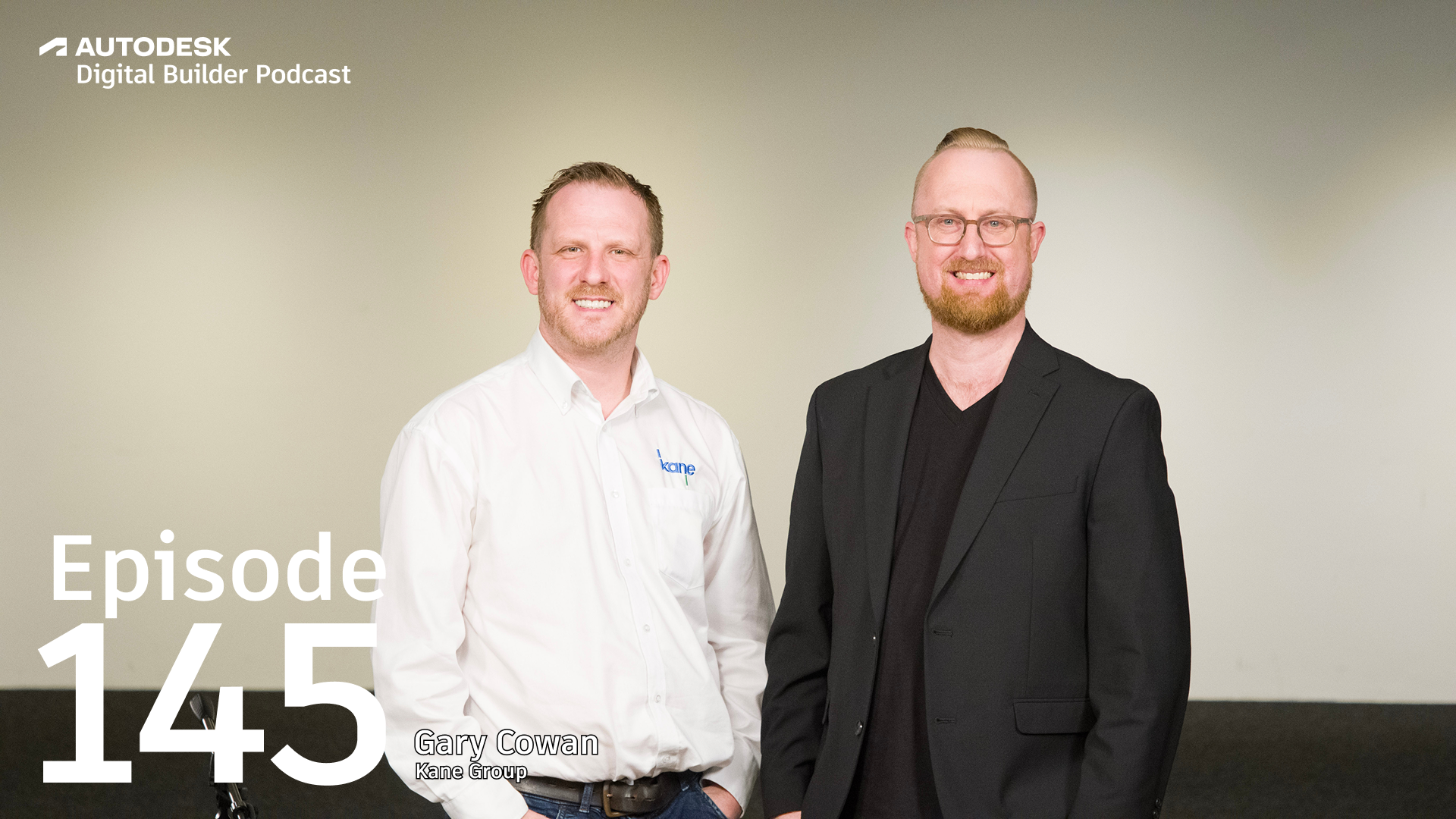
If you’re interested in using extended reality in your construction workflows, this episode is for you. It features Gary Cowan, Head of Digital Construction at Kane Group, who shares how his team built a complete XR technology stack and why he believes immersive technology will become an essential part of construction's future.
Check out our discussion below.
We discuss:
One of the biggest challenges in construction is the gap between what's designed and what gets built. According to Gary, that disconnect often comes down to details that aren't captured early enough.
"Design intent in early-stage design is very low LOD (level of development)," he says. "You don't think about all of the small pieces, the fixtures, the clips, all those kinds of things that normally aren't modeled."
As such, teams can arrive on-site and discover that things don't fit together as expected. Clearance requirements are missed. Support structures aren't accounted for. Small oversights snowball into bigger issues.
His solution is simple in theory, though harder in practice: think through more scenarios before construction begins. "The more you pre-think, the more you put into your model, the more you account for, the smoother the installation goes on-site."
For Kane Group, the journey into XR started with a problem many construction teams know all too well: some projects become so complex that traditional design reviews simply aren't enough.
Gary points to a major hotel project in London that involved roughly 11 kilometers of pipework and extensive prefabrication. The model was packed with information, making it difficult to evaluate on a standard screen.
"There was no real other way to design review it," he says. "It was so dense. And if you looked at it on a computer screen, it was like a Where's Waldo picture. You just couldn't pick anything out."
That challenge led the team to begin experimenting with virtual reality in 2017. Today, Kane Group uses a complete end-to-end XR technology stack that combines both virtual reality (VR) and augmented reality (AR) to improve design reviews, collaboration, and project delivery
The benefits of XR
One of the biggest advantages of VR is that it changes how people experience a model.
Gary has this analogy to explain it: Imagine asking two people to describe the Eiffel Tower. One studies a photograph for an hour. The other travels to Paris and sees it in person.
"Who do you think is going to give you the most accurate, the most vivid representation?" he asks.
For him, VR is the closest thing construction teams must physically walking a project before it's built. Team members can step into a model, move through the space, and evaluate issues from a completely different perspective than they would on a 2D screen.
The technology also creates opportunities for younger team members. "We can give our junior design engineers almost real-world access to the site without putting them in danger.”
The need for smooth processes and team collaboration
Technology alone isn't enough to make XR successful. Effective implementation depends on strong collaboration between design managers, BIM teams, and operations staff.
VR helps accelerate that process by making communication more visual and interactive. Instead of relying on markups and redline drawings, teams can review models together in an immersive environment.
"Trying to convey design intent with scribbles on a page is impossible for me," Gary remarks. "How could you ever get an accurate picture across from one individual to another?"
VR gives teams the ability to review issues together, which can then shorten feedback cycles and reduce the back-and-forth that often slows projects down.
A quick reality check on XR
While XR can deliver significant benefits, Gary cautions against viewing it as a plug-and-play solution. "You can't just buy VR and stick it on, and it solves all your problems.”
Successful adoption requires strong modeling standards, complete project data, and well-defined workflows. Teams need to understand how information moves through their systems and ensure their models contain the level of detail needed to support immersive reviews.
"There are so many moving parts to that stew to make it nice. It takes a bit of skill and a bit of foresight and a bit of knowledge."
All to say that XR works best when it's supported by the right processes, people, and data.
So, what’s it like to leverage AR and VR in construction? Gary says the experience of stepping into a virtual model often changes how people think about their work. "When you put them into that virtual reality, it's almost like a penny-drop moment," he says. "It makes it real to them."
That's because a model viewed on a screen can only tell you so much. Designers might think a space looks fine based on plans and sections, but VR introduces something that's often missing: context and scale.
"You don't get a sense of the scale of what it is that you're drawing.”
He continues, "Looking at it on paper, people say, 'Yeah, I think that's okay.' But when you put the headset on, and you walk in, you see people go, 'Oh.'"
Exposing issues early on
Working with mixed reality also helps expose potential issues early on, before the project makes it to the field. Headroom concerns, access challenges, and design shortcuts that looked acceptable in 2D suddenly become obvious.
The result is better design decisions and higher-quality outcomes. "It raises the bar," he says, because people can see exactly how their decisions will play out in the real world.
Use cases beyond design reviews
While design coordination remains a primary use case, Kane Group has found several other ways to use XR throughout a project.
For one client, the team used VR to support decision-making during the design process. Instead of reviewing color palettes on paper, stakeholders were able to walk through different options in a virtual environment and choose the one they preferred.
The technology is also proving valuable for training, visualization, and installation planning.
In fact, Gary says his team is working to get field crews into the virtual model before they ever set foot on-site. The goal is simple: familiarity.
"They've already seen it in their mind's eye," he explains. "So, when they go to actually put it in, it's already familiar."
If you’re considering XR, Gary’s advice is to start with the problem, not the technology.
Different teams have different goals. An architect might want to visualize finishes and design options, while a contractor may be more focused on coordination, constructability, and field execution.
That's why he recommends asking one key question first: "What do we hope to achieve from adopting this technology?"
Is the goal to create better client experiences? Improve design reviews? Reduce coordination issues? The answer will help determine which tools make the most sense.
Just as importantly, don't let outdated perceptions of VR hold you back. "Don't be scared of it. Just go and buy a headset."
That's much easier today than it was a decade ago. Early VR systems required dedicated hardware, significant investment, and equipment that was literally tethered to a computer. Today, standalone headsets are relatively affordable and easy to deploy.
"It's not a huge cost for any company depending on their size and scale," says Gary.
So, dive in and experiment. "See what you can do. It's a discovery."
You don't need a fully developed XR strategy on day one. Sometimes the best way to understand the technology's potential is simply to put on a headset and start exploring.
On the question of where XR is headed, Gary's answer starts with AI.
“In the next three to four years, we're going to see AI properly getting implemented. And for me, I see that snowballing with XR. Think of the Apple Vision Pro and how they've coined spatial computing.”
He continues, "I think we'll be doing spatial coordination. We won't be coordinating in a Revit session on a screen. We'll all be in a model, and we'll be making decisions."
He envisions a future where construction professionals can interact with AI assistants inside immersive environments, eliminating many of today's manual tasks. "Every construction professional needs their own Jarvis," he says.
The technology is advancing quickly, and Gary believes it's only getting started. "It's only going to get better. It's only going to get faster. What a time to be alive."
Digital Builder is hosted by me, Eric Thomas. Remember, new episodes of Digital Builder go live every week. Listen to the Digital Builder Podcast on:
or wherever you listen to podcasts.