It’s easy to throw around buzzwords like “AI” and “innovation,” but they don’t mean much unless they change how work gets done. Innovation isn’t just new tech or shiny tools. It’s about solving real problems, improving outcomes, and making work easier, faster, or more reliable for the people doing it. And in construction, that impact must show up on the jobsite, not just in theory.
That’s exactly what we’re unpacking in this conversation.
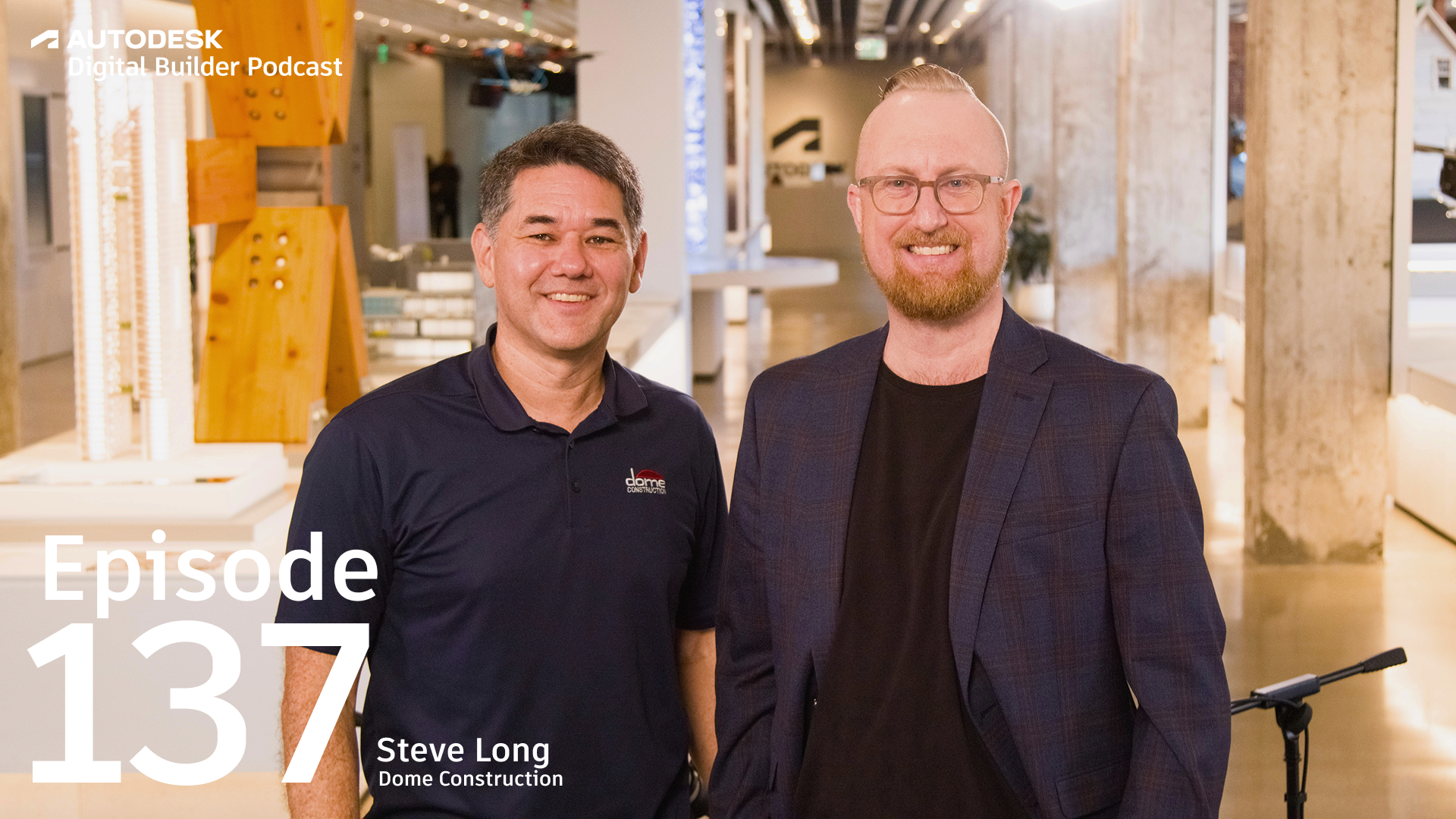
On this episode, I’m joined by Steve Long, Director of Innovation and Learning at Dome Construction, to double click on the concept of innovation and how technologies like AI are reshaping construction.
We discuss:
Steve has been at Dome for nearly 30 years, so he’s seen how innovation in construction plays out over time. When he started in the late ’90s, the industry was largely analog. Think: paper plans, manual workflows, and processes.
He recalls joining Dome at a time when even adopting basic digital tools felt like a big leap forward. "I know our organization at the time was one of the first to bring computers into the construction world. At that time, it was a new thing in construction because we are generally not an industry that is known for doing all kinds of crazy things really quickly.”
Innovation in construction hasn’t been about sudden breakthroughs or overnight change. At Dome, that’s meant steady progress. First, bringing computers into the business. Then mobile tools. Then BIM.
It’s also worth noting that some of the firm's biggest shifts and innovations didn’t come from technology alone. “A huge change was lean construction and how we think about working together as a group. From an organizational standpoint, that was one of the biggest innovations for us, because it was about rethinking how the business was structured,” shares Steve.
That’s why, for him, innovation is less about tools and more about rethinking how teams collaborate, make decisions, and move projects forward.
AI shows up differently depending on where you sit. In the field, it’s about speed and staying mobile. In the office, it’s about depth, analysis, and handling more complex workflows.
AI adoption in the field
For superintendents, the job is simple on paper and chaotic in practice. “Their prime directive is to be on the job site all day, every day, moving around, solving problems in the moment.” They don’t have time to sit behind a screen. But the paperwork still has to get done.
That’s where AI is making an immediate impact.
Instead of typing long emails or reports, teams are using voice-to-text and AI writing tools to capture ideas on the fly. “They just got to go,” Steve says. So, they talk into their phones, and AI turns that into something clear and professional.
It’s also speeding up routine tasks. A superintendent can mark up a PDF, flag an issue, and then “put it in whatever LLM and say, ‘Convert this into an RFI.’ Boom, written, done.” No extra typing. No delays.
Meetings are another big win. Daily huddles and foreman meetings used to mean more notes and more admin later. Now, teams record conversations and instantly generate summaries, action items, and follow-ups.
At the end of the day, it all comes back to one thing, remarks Steve: “How do we get them to be faster and quicker and not be beholden to the machine?”
AI adoption in the office
In the office, the workflow looks completely different, and so does the way AI gets used.
Project engineers and managers spend more time at their desks, working through procurement, submittals, and coordination. That opens the door for deeper use cases. “The usage is certainly a little bit more enhanced,” Steve explains.
One of the biggest gains is in document-heavy work. Teams can take a full specification and “turn that into a submittal register, boom, done.” They don’t have to manually sort through pages; AI handles it in seconds.
Coordination is also faster. Office teams are using AI to connect information across documents, spot gaps, and keep everything aligned. Even schedules are getting a second set of eyes. Steve shares how he once uploaded a PDF schedule and asked AI to analyze it. “It came up with pretty much exactly what it needed to be.” From there, it can turn that analysis into a clear narrative for clients.
Preconstruction teams are seeing similar gains. Takeoff, which used to take days or weeks, can now be done almost instantly.
The work is more complex, but the goal is the same: reduce manual effort and free up time for higher-value thinking.
That high-value thinking mentioned above is critical because ultimately, AI should support your judgment, not replace it. So, the risk isn’t using AI. It’s relying on it too much.
Steve puts it plainly: “When an estimator does takeoff, that’s how they learn about the job, the scope, what’s in, what’s out, what are the risks.” If AI handles all the admin and clicking around, you save time. But you also might lose understanding. “We have to balance the reduction in clicking with, do you still know what’s in there?”
That’s the tension teams are navigating right now.
“You can’t divorce yourself from understanding the scope and knowing what’s important,” Steve says. “We can automate a lot of things, but we have to be careful not to over-automate and take the thinking away.”
There’s also a larger question underneath it all: how do you train the next generation?
“That’s probably one of the biggest challenges,” he says. “How do we develop future managers and leaders if we’ve automated the learning curve?”
AI can speed things up. But teams still need to create space to learn, think, and build real judgment.
There’s no question that teams can benefit from AI and organizations should promote their use. That being said, leaders must be thoughtful about how they communicate and implement their AI strategy.
Because, for better or for worse, AI introduces major changes to how folks work. As Steve points out, AI is "the ultimate change management situation.”
“This is the mother of all changes,” Steve says. And like any big shift, people react differently. Some see risk. Others jump in right away. “You’ve got a whole spectrum,” he explains, which means one-size-fits-all training doesn’t work. Field teams, office staff, and back-office roles all need different approaches. The key is to “meet people where they’re at.”
At the same time, structure matters.
If you want adoption, you need clear guardrails. Dome started by defining its AI strategy and setting expectations early. “You have to be very clear with what’s allowable and what’s not,” says Steve. That includes addressing real concerns around privacy, hallucinations, and data security.
From there, it’s about creating a safe environment to experiment. To facilitate this, Dome uses a walled-off system using Microsoft Copilot so employees can explore without putting sensitive data at risk.
At Dome, the goal isn’t just to use AI. It’s to build something bigger around it.
Steve describes it as “sticking a brain on all of our back-of-house data.” The idea is simple, but the impact is massive. Instead of digging through systems, teams could ask a question and get a clear answer right away.
“I want the insights and the proactive ability to identify risk,” he says. “What are the combinations of factors that lead to success or failure?” After years of running team alignment sessions and project retrospectives, Steve has a sense of what drives outcomes. Now he wants AI to pressure test that. “What am I missing?”
The end goal is a single place where “no question goes unanswered.” Whether it’s process-related (“How do I do an RFI?”) or project-specific (“When are we installing drywall on level three?”), the answer is there, instantly.
And it all ladders up to something bigger than efficiency.
“This is in service of allowing our people to be on the job site more, so they can solve more creative challenges and build relationships.” Because at the end of the day, “it’s a people business.”
Digital Builder is hosted by me, Eric Thomas. Remember, new episodes of Digital Builder go live every week. Listen to the Digital Builder Podcast on:
or wherever you listen to podcasts.