Last year was a tough period for a lot of folks, particularly in Southern California, which experienced devastating wildfires that destroyed around 19,000 structures, 16,000 of which were single-family homes.
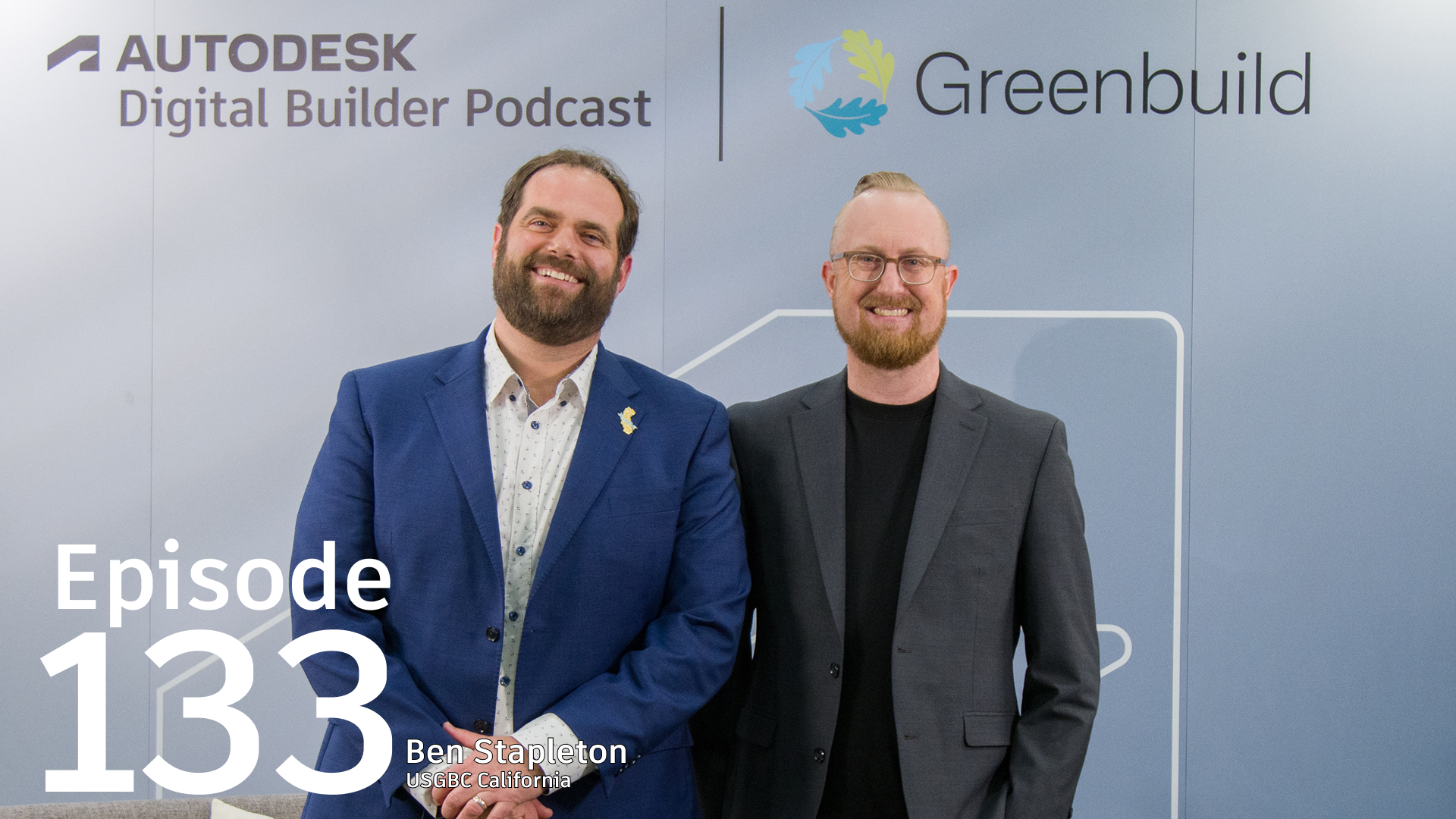
Rebuilding efforts are well underway, and to learn more about how recovery is unfolding, I caught up with Ben Stapleton, Executive Director at USGBC California. In this episode, Ben discusses what it takes to rebuild after the wildfires, how climate change is reshaping our communities, and why action, education, and resilience matter now more than ever.
We discuss:
The scale of the 2025 wildfires in Southern California is still hard to fully process. Entire neighborhoods were impacted. Families were displaced. And the rebuilding journey ahead is long. Ben recalls that in the weeks after the fires, communities rallied and plans formed quickly. But that early momentum doesn't last forever.
“We're helping each other, and there's this high that comes from that. But then the action fades. People move on. We're in this dip right now, and the reality is it's going to take five or 10 years to rebuild from this,” he says.
Through his work on the LA County Blue Ribbon Commission, Ben saw just how complex recovery is. Still, one thing stood out. Access matters. Compared to other disasters, LA’s recovery moved faster because resources were available.
“We were already much further ahead of recovery than the folks who lived through the Lahaina fire in Maui. And that's simply because of access to resources and supply chain.”
That perspective shaped USGBC California’s response, and the team focused on educating and coordinating with key community members. They unified green building groups across the country and leaned on lessons from past fires.
This helped Ben and his team gather even more insights and set clear goals for recovery.
For example, Ben initially told his team that if they could help 20% of the roughly 16,000 destroyed homes be rebuilt in a more resilient and sustainable way, that would be meaningful progress. But those expectations quickly shifted.
“I talked to a gentleman who managed a lot of the recovery from the Marshall Fire out in Colorado, and he said that by educating the public and the contractors and by creating some availability incentives, they were able to get 80% of homes rebuilt to be all electric and more resilient and sustainable.”
Natural disasters like wildfires can feel completely out of our control. And while there are a lot of aspects that are out of our hands, there are things we can do to better prepare our homes and communities.
Simple steps like protecting vents, closing eaves, using more fire-resistant materials, and avoiding attached structures can reduce wildfire risk. A lot of these things aren’t difficult or expensive to do. The gap, says Ben, is in awareness and education.
And so, USGBC California stepped in to fill that gap, through efforts like:
“I found there was no one owning this space, and the education could do so much,” Ben remarks.
“We need to start taking more ownership as communities on how we care for each other and how to respond to a disaster. We’d like to think our first responders are the fire department and the police, but honestly, it's probably your neighbors. So, how are we lifting each other up in those events of disaster and putting the tools and infrastructure there to support that?”
Even when people want to rebuild greener and more resilient, cost can be the biggest barrier.
To this, Ben says that USGBC California set out to make rebuilding more affordable and accessible. Instead of leaving homeowners and contractors to navigate pricing on their own, the team created a shared marketplace designed to lower costs through scale.
“We white-labeled a platform by a company called Building Ease, and we created a rebuild marketplace,” Ben explains
When people in the same area need similar materials at roughly the same time, those purchases can be bundled. That gives manufacturers an incentive to compete on price.
“If people are going to purchase a hundred grates, they might get, say, a 25% discount. And you can see it as a neighbor and go, ‘Oh, there's a bunch of people here purchasing heat pumps. If I get on that, I can drop my cost by 15%.”
He continues, “We’re trying to get these things out there to see how we can do this a little bit differently.”
Rebuilding is always a challenge. For those dealing with the aftermath of the Southern California fires, those hurdles include the following.
Supply chain and logistics
Los Angeles already struggled to build housing before the fires. “The LA region built about 12,000 homes in the last decade,” Ben says. Now, communities are trying to rebuild roughly 16,000 homes in just a few years.
Developers feel the strain. “We need 20 to 50 more of us,” Ben recalls hearing from builders. “There’s no possible way we can build enough.”
Electrification costs and knowledge gaps
While all-electric homes can lower utility costs over time, upfront pricing can be steep.
“I’m hearing from people who are rebuilding that those costs are coming in 25 grand, 30 grand more,” Ben said.
The issue isn’t the technology. It’s execution. Many contractors don’t yet know how to design all-electric homes efficiently, including eliminating gas infrastructure altogether. Until that knowledge gap closes, costs stay higher than they need to be.
Landscape, fire risk, and competing priorities
Homes get most of the attention, but landscape matters just as much. Fire safety guidelines often call for bare zones around homes, especially within the first 5 feet.
“We can’t have no vegetation in entire areas of the city,” Ben said. Urban communities already face heat, biodiversity loss, and water challenges. The better path is smarter design, using native oaks, grasses, and shrubs that reduce fire risk while restoring ecosystems. “That’s the future,” Ben said. “And we could do that now.”
Insurance and labor pressures
Insurance may be the toughest challenge of all. Even when owners rebuild to the highest code standards, coverage isn’t guaranteed.
“You could rebuild your home, follow all the rules, and you still may not be insurable,” Ben explained. Insurers often assess risk at the community level, not the property level.
Layer on labor shortages and rising costs, and rebuilding becomes even harder. Without changes in how insurance, workforce, and education come together, these challenges will continue to slow recovery when communities need momentum most.
Digital Builder is hosted by me, Eric Thomas. Remember, new episodes of Digital Builder go live every week. Listen to the Digital Builder Podcast on:
or wherever you listen to podcasts.