As the world moves toward more complex challenges, human-centered design becomes more important than ever. Whether we’re rebuilding after natural disasters or designing healthcare facilities, the built environment plays a critical role in how people heal, connect, and move forward.
But what exactly is human-centered design, and what does it look like in practice?
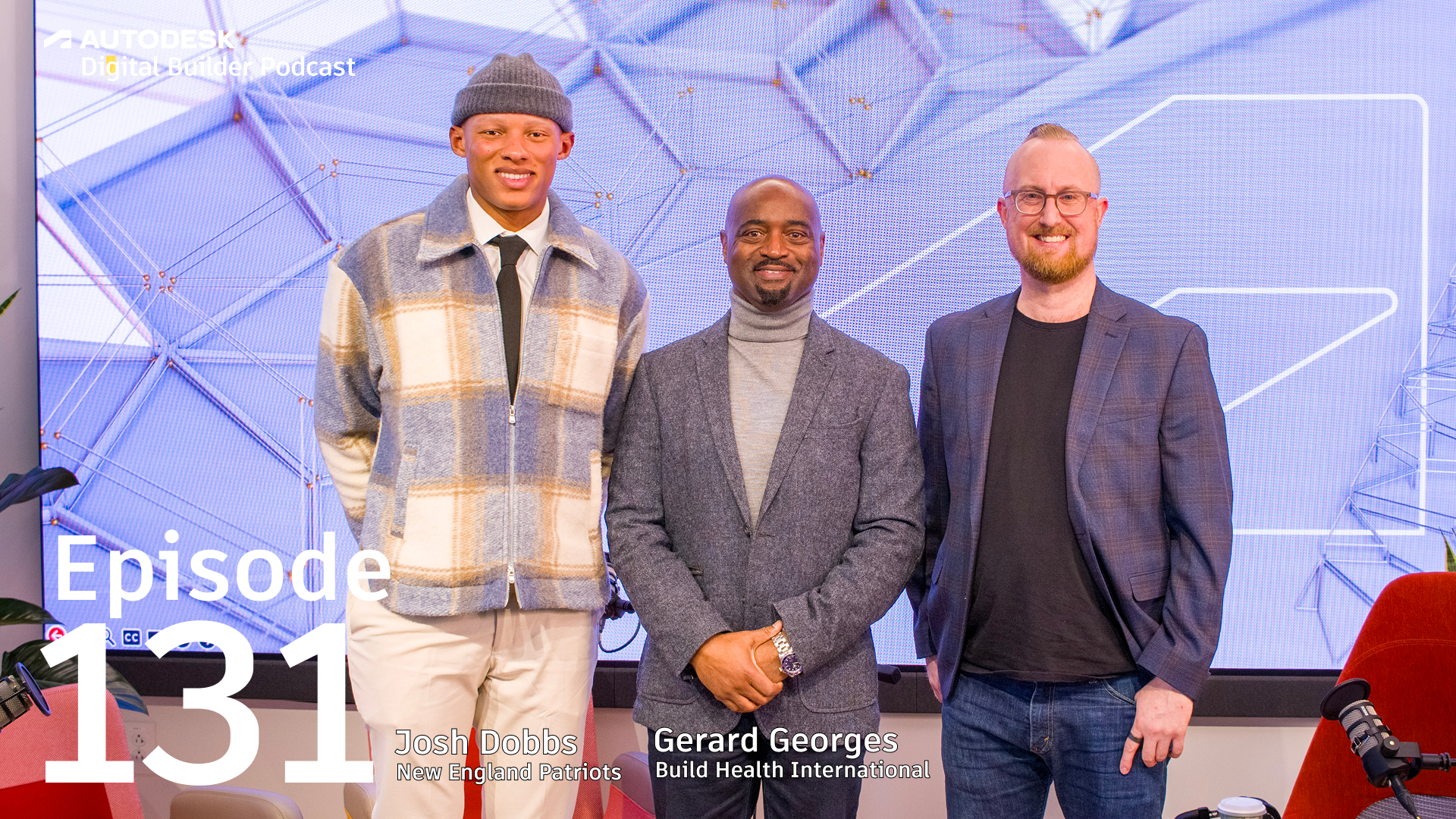
We answered this question and a whole lot more during this special episode of the Digital Builder podcast filmed live at the Autodesk Technology Center in Boston. This conversation is part of the launch of our new Make It Heal film series starring New England Patriots quarterback Joshua Dobbs. The event also kicked off the 2026 Design & Make It Real program, an initiative that empowers students to develop digital skills, explore careers in architecture, engineering, construction, and operations, and design solutions that help communities recover and thrive.
In this episode of Digital Builder, I’m joined by New England Patriots quarterback and aerospace engineer, Joshua Dobbs, and Gerard Georges, Director of Architecture at Build Health International.
We dig into the concept of human-centered design and explore everything from designing with empathy and purpose to the role that technology plays in improving collaboration.
We discuss:
As the term clearly illustrates, human-centered design starts with people. It goes beyond plans or blueprints, and instead puts the humans (i.e., the people designing buildings and those using them) at the heart of the build.
“Human-centered design is really around making an environment, a culture, a community that inspires and supports the basic human person. We all want to engage with each other. So, we need to think about spaces that support that engagement,” remarks Gerard.
He highlights the importance of designing environments that encourage connection and healing. That could be through biophilic design, access to natural light and views, or creating buildings that can withstand changing climate conditions.
In addition, Gerard stresses that it’s crucial to think beyond the immediate end user; builders should also consider how spaces will serve future generations.
Josh weighs in with his observations on the design side. For him, human-centered design shows up in how diverse perspectives and problem-solving approaches come together to improve outcomes.
“I also think about the designers. I think it's cool just seeing the different backgrounds of the designers and their thought process, their problem-solving skills, their creativity—and seeing how it comes to life.”
He continues, “That's what's been so unique about learning about the Autodesk software, and how it’s able to make things come to life quickly. You're able to see multiple iterations of the solution to a problem. You're able to see how it fits in different places and different environments. And I think being able to have multiple choices and then being able to go through the data and decipher what the best solution for the problem is really cool.”
Human-centered design really comes to life when a project serves the community in a meaningful way.
Gerard explains that such projects stem from teams having a shared commitment and collaborative approach.
“We really strive ourselves on the idea of collaboration, communication, and shared outcomes. So, as long as we all come to the table with that mindset, we really have a great roadmap to move forward with our projects.”
“So how do we do that? We have user or stakeholder engagement sessions where we really try to understand priorities, needs, and goals. And then we think about how we influence the notions of sustainability and resiliency in each project that we work on.”
Josh agrees and notes that one way people can build that shared understanding is by seeing the work take shape before it hits the job site.
“I think just people coming together is extremely important. One thing that stood out was the VR session, where you're able to walk through the process of what it looks like to build something. It's very similar to what we do on the field, where we go through various walkthroughs before the games. When you're in that moment, you're able to see things come to life the right way.”
Lessons around teamwork are most visible in sports because success depends on people with very different backgrounds working toward a single outcome.
With that in mind, Josh points out that the same dynamic shows up on construction and design teams. Everyone brings their own experiences to the table, and that diversity is what makes teams stronger.
“I think the biggest thing is that everyone has their own unique background that got them to wherever they are,” Josh says. “In our complex in Foxborough, everyone comes from different places. I come from Atlanta, Drake [Maye] comes from North Carolina, Stefon Diggs comes from Maryland, and so on. But it’s all the work we’ve put in, and all the past experiences we’ve gone through that allow us to come together, apply what we know, and ultimately win on Sunday.”
Another lesson that’s highly visible in sports? The ability to perform in high-pressure situations.
Here, Josh says that teams can turn that pressure into excitement by being well-prepared for anything.
“It comes down to your preparation. For us, the season starts in April, when we go through our off-season activities and go through fundamentals, while getting the flow of the plays. Then you go through the beginning of the season where you're put in different situations, and you have a chance to go out and perform.”
He continues, “I think in every single industry it is the same. It's the habits that you've created studying; it's the habits you've created working with other people. It's those reps that you build up over time.”
“And so, at the end of the day, because of that preparation, if you do it the right way, you don't really feel the pressure. You're just excited to perform and achieve your goal at the end.”
For Gerard, staying composed comes down to trusting the process and staying flexible when conditions change.
“We have to be flexible, malleable enough to say, ‘Okay, can we get to this goal? But maybe we're taking a different path, maybe we're introducing a different system or a different partner to end up getting to this process.’”
“So, dealing with stress is really thinking about the risks you might face. Then determining how to address those risks and determine the strengths of your team to be able meet your goals. So, there's always this inner chaos that happens, but having a measured approach is always beneficial for me personally as well as for the team.”
Great teams, whether on the football field, office, or job site, become even better when there’s strong leadership behind them. And to be a strong leader, you need to show up for the people around you.
As Josh puts it, “You have to be a great teammate first, and how you learn and get to know the people around you. And then, after that, it's about making sure you're doing the work first. I think a lot of leaders like to lead from the front and drag people behind, or they like to tell people what to do instead of leading by example and doing the work, putting in the time and effort that their other coworkers or teammates are doing.”
He continues, “And so it's all about being consistent and being a great teammate. And I think if you do that, then when you're in your leadership role, you're able to pour into your teammates and collectively accomplish a goal.
As for Gerard, he sees empathy as the foundation of effective leadership.
“Empathy is really the word that comes to mind as a leader. A good leader leads by example, I believe. The way to do that is to understand the needs of your teammates, your community, as well as the stakeholders that you're working for.”
“Once you understand what their goals and their needs are, you make space for them to contribute. And I think that makes them feel like they have power. It gives them agency. So by leading by example and then leading with an empathetic thought, you're allowing others to flourish, and they support you.”
Digital Builder is hosted by me, Eric Thomas. Remember, new episodes of Digital Builder go live every week. Listen to the Digital Builder Podcast on:
or wherever you listen to podcasts.