We've been having a LOT of conversations about AI, most of which center on broad strokes and high-level insights. Think: the potential of AI, its legal implications, and why teams should adopt it.
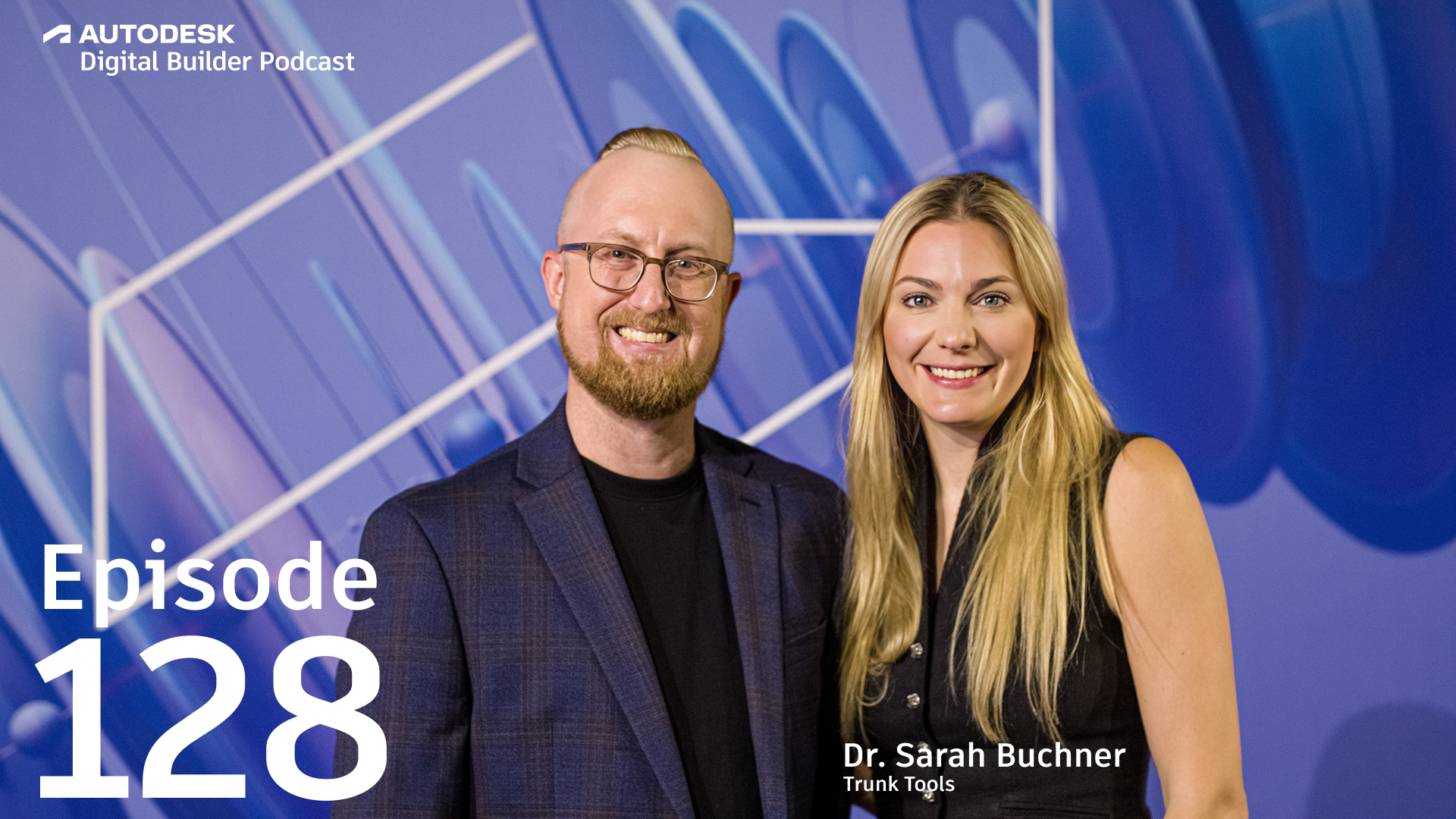
This episode of Digital Builder is a little different. I'm joined by Dr. Sarah Buchner, founder and CEO of Trunk Tools, a platform that automates construction workflows through AI.
Rather than giving 35,000-foot takes on artificial intelligence, Sarah gets into the trenches. We talked about the messy reality of AI adoption, the necessity of tough love when teams resist change, and how to deal with the fears that hold teams back.
We discuss:
Being an AI company itself, you'd think that Trunk Tools wouldn't have any trouble getting the team on board with AI. But according to Sarah, she herself faced challenges in encouraging broad adoption across the business.
"The process wasn't elegant. We are fully AI native, we produce AI, and we still had struggles adopting AI in every department."
Sarah says the process involved a lot of "top-down pushing" across departments, with leaders promoting the use of new AI tools and encouraging teams to rethink workflows and objectives.
She continues, "Change is hard for humans in general. And so we need to create an environment where change is incentivized by either a stick or a carrot. I used a carrot first, then I used a stick."
Sarah breaks it down simply: construction has three groups that matter for AI adoption.
First, you have the people in the field who actually use the tools. Then there's the support teams like IT and legal, and finally, the executives who set direction.
According to Sarah, "the only times I've seen a successful AI adoption… is when at least the C-suite and the field were aligned."
Support functions matter, but they shouldn't be blockers. If legal or IT keeps saying no, Sarah's advice is to get them help. "Your lawyer that does the normal GC contract might not be the best lawyer to look at an AI company," she says. The same goes for IT. If they're not equipped to evaluate AI, bring in outside expertise.
But even with the proper support, nothing moves if the field doesn't see value. "No AI will get adopted if the field doesn't see value and if there's no top-down pressure." In other words, it can't be a pure bottom-up effort. The C-suite has to signal that AI matters, back it with real support, and be willing to change how the business works.
Sarah also pushes back on the idea that construction has a "technology adoption problem." The real issue, she says, is that many tools simply aren't adoptable. "UIs from the nineties and workflows with manual data input are just dead." If you give the field something that actually removes pain, they'll use it. But without leadership modeling the change and clearing the roadblocks, even the best tools won't stick.
When discussing AI's impact, Sarah draws a clear line between blue-collar and white-collar work.
She doesn't see AI changing hands-on field tasks anytime soon. It might help in small ways, like pulling up information with tools like Trunk Text, but the physical craft itself isn't going anywhere. As she puts it, "I'm actually very excited that the future means that blue collar workers will be even more uplifted… because that's not automatable."
The AI story is different on the white-collar side. Sarah points to research showing that "about 80 percent of white collar workflows in construction can be automated with the technology that's out there today." It's a tough reality for some teams, but it's also where the biggest ROI sits. Repetitive, clearly defined workflows—especially those that mix rules with pattern recognition—are the first to benefit.
Meeting minutes, search and retrieval, scheduling, and other administrative or coordination-heavy tasks follow the same pattern. Plenty of tools already exist to optimize schedule logic and clean up routine documentation.
She continues, "We see a lot of smaller workflows that are really done end to end by AI, which is really exciting."
That "end-to-end" implementation is something that Sarah is really bullish about, not just because of the efficiency gains, but also because it'll help with AI adoption.
"We are focusing more and more on end-to-end autonomous agents. What that means is there is a trigger, and then the agent actually does it without any human involvement. Once you reach that level, we don't need the behavioral change to happen, which has always been the problem in construction tech."
When getting started with AI, Sarah's first piece of advice is simple: start at home. "It's less scary, there's less risk involved," and it helps people loosen up creatively before bringing AI into their job. She tells folks to play with it in ways that feel fun and low-stakes. Write a personalized bedtime story for your kids. Ask it for a new recipe. Plan your trip to Paris. Just "start talking to it" the way you'd talk to an expert in whatever you're trying to figure out.
Once people feel comfortable, then bring it into work. At Trunk Tools, Sarah actually requires her executives to spend two hours a week talking to an AI about the problems they're wrestling with. She wants them to treat it the same way they'd speak to a McKinsey consultant. And the tools are good enough now that they don't just answer a question. They suggest next steps, help you reason through decisions, and push your thinking forward.
For Sarah, the hardest part isn't the tech. It's getting people over the initial fear. Once they do, "you open up a whole world of possibilities."
Sarah sees AI as an opportunity to fix the problems people have been frustrated with for decades. It starts small. AI wipes out boring, bureaucratic tasks that nobody in the field wants to touch.
"I hated that part of my job… where I had to fill out a daily log," she says. "Nobody has to fill out a daily log anymore. AI can do this for you." Those little wins add up fast.
But the bigger impact is on rework. Roughly 10 percent of construction costs come from doing things twice. Sarah's team has shown in R&D that "about 80 percent of this you can actually figure out with AI before it happens." They're catching RFIs before they hit the site. At industry scale, that could mean a trillion dollars saved and a massive reduction in carbon emissions.
To get there, leadership has to lean in early. One GC CEO told her he wasn't fixated on whether Trunk Tools was the exact right tool long-term. What mattered was getting his people to "start thinking about AI," because that mindset shift will matter more than switching tools later.
That's the kind of behavior Sarah wants to see across the industry. And it's why she's genuinely excited about where construction is headed.
Digital Builder is hosted by me, Eric Thomas. Remember, new episodes of Digital Builder go live every week. Listen to the Digital Builder Podcast on:
or wherever you listen to podcasts.