In the world of construction project delivery methods, design-build has proven to give teams a leg up on speed and streamlined execution.
Data from the Design‑Build Institute of America (DBIA) shows that design-build projects are "61% faster than Construction Manager at Risk (CMR)" and "102% faster than DBB" from design through completion.
Design-build is clearly reshaping how teams collaborate and deliver work. And because nobody knows this space better than the DBIA, I'm excited to say that today's guest brings a great perspective straight from the source.
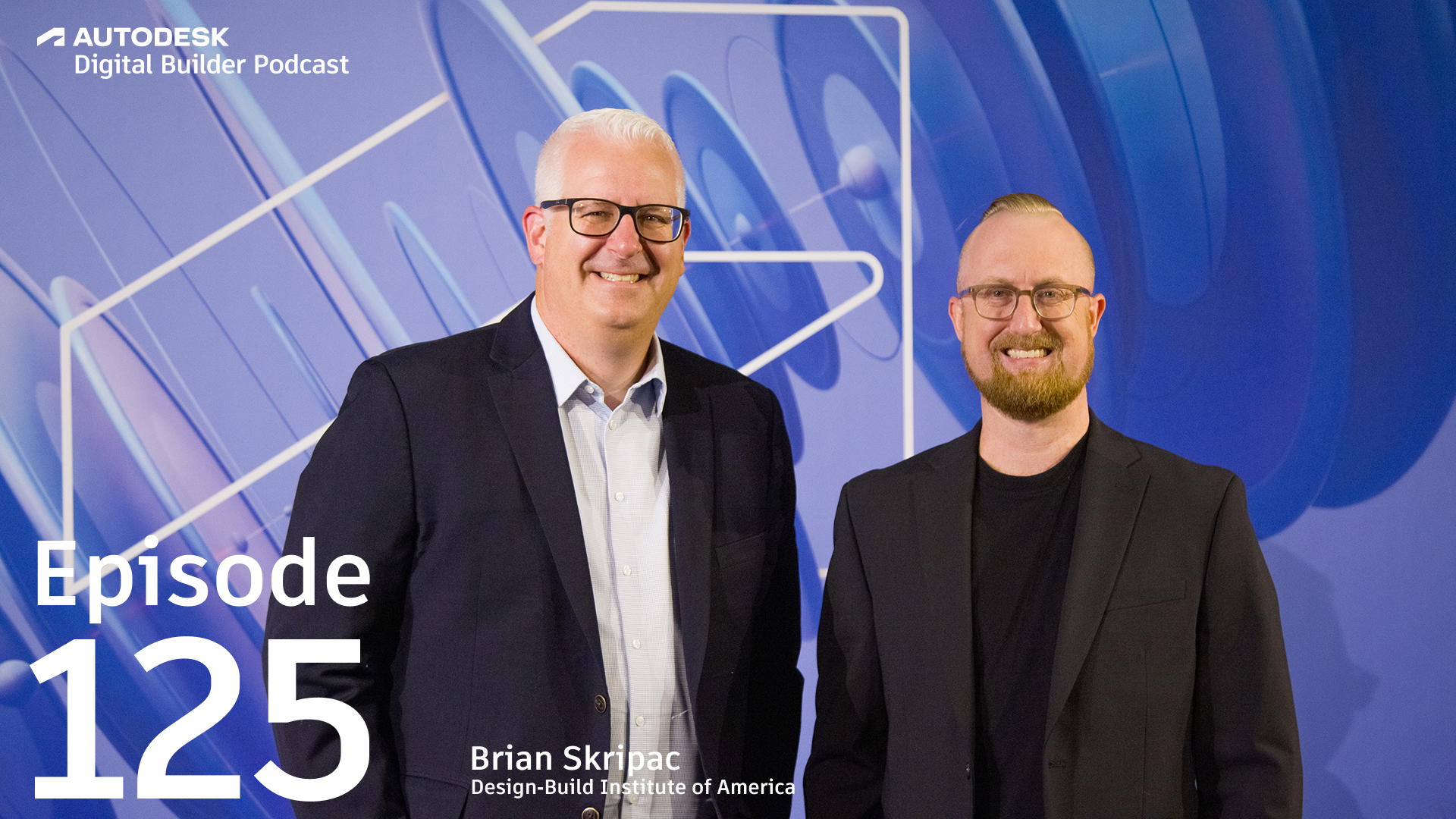
In this latest episode of Digital Builder, I'm joined by Brian Skripac, Director of VDC at the Design-Build Institute of America. We chat about how design-build works in practice, common myths, and the role technology plays in making it all possible.
We discuss
When it comes to project delivery methods, it helps to understand the options most teams rely on today. Brian names the "big three" of delivery methods: design-bid-build, construction manager at risk (CMAR), and design-build.
Design-bid-build was historically the default delivery method for many organizations. However, the industry has evolved. FMI Corporation projects design-build to represent over 47% of spending by 2028 and account for $2.6 trillion of construction spending over the 2024 – 2028 forecast period.
The design team hands off a finished set of drawings, the project goes out to bid, and the lowest price usually wins. That low bid structure feels predictable, but it often puts teams at odds. Brian puts it plainly: under this model, the designer's goal is to "produce a set of documents and give them to the owner," while the contractor doesn't see what's in those documents until it's time to price and deliver the work. This disconnect leads to surprises and tension that later surface as change orders or rework.
CMAR sits somewhere in the middle. You get earlier contractor input, which helps with pricing and constructability, but the design work and construction responsibilities are still split. Teams collaborate, but not as fully as they could.
Then there's design-build, where the designer and builder work under a single contract. Instead of choosing a team based only on price, owners can use "a qualifications-based selection process," which Brian highlights as a major shift in mindset.
Why design-build is ideal for many teams and projects
Design-build has a reputation for delivering smoother projects, and Brian calls it a "sweet spot" because it brings the entire team together early and aligns everyone under a single contract.
"You have the owner forging a contract with a design builder, and that design builder is responsible for design and construction services," he explains.
Beyond the unified contract structure, design-build also gives teams more room to collaborate, which sets the stage for stronger outcomes.
"We have a team that's working together from the outset and trying to define a common solution for the owner as opposed to a design professional saying, 'My end goal is to produce a set of documents and give 'em to the owner and the contractor not knowing what's in those documents."
Brian continues, "Having those teams move together and progress through the design is a really different and unique opportunity, and you're all bound by the same contract, so you're all working for the same goal."
Design-build has grown quickly over the last decade, but many teams still hold outdated assumptions that don't align with how the model actually works. Brian sees these misconceptions often, and most of them stem from past projects that struggled for reasons unrelated to the delivery method.
One of the most common beliefs is that owners give up decision-making power once they choose design-build. Brian hears this all the time. "The owner doesn't have any control in the project," people will say.
Another worry is that architects or engineers lose their voice once they sit under the design-builder contract. But Brian points out that this fear usually comes from legacy project structures where teams feel siloed or shut out.
Some teams also assume design-build comes with a premium. Brian hears claims that "it costs more, it takes longer, it's too much risk for the owner." But real data tells a different story:
"We do annual reports with FMI and surveys, and they've shown data that says design-build projects are delivered quicker," shares Brian.
"They end up coming in on or under budget. It's less risk for the owner. You have higher quality delivery, and you have more opportunities and flexibility for how you procure the projects."
Where do these myths come from?
Most of these misconceptions trace back to other project problems, not the delivery method itself. If a team was mismatched or communication broke down, it's easy to blame the process.
"I think some of those issues come from bad experiences from projects, but folks blame it on the delivery method," says Brian.
He stresses that design-build should be intentional.
"Design-build teams are assembled to pursue the project. It's not a forced marriage where a lot of confrontation may come into play. So when you're working together, you can really minimize that."
Technology has always shaped how construction teams work, but in design-build, it plays an especially powerful role. Here's how Brian sees it.
A shared model changes everything
Design-build, when empowered by technology, eliminates silos and lets teams work from one source of truth. Brian describes the shift: "We have the opportunity to collaboratively build these models for the built environment. We're sharing information from day one."
Cloud platforms make it possible for designers, builders, trade partners, and owners to view and contribute to the same environment instead of passing static documents back and forth.
This transparency isn't just convenient. It helps teams work smarter. The owner "has transparency and an opportunity to visualize what's going on," while the rest of the team can flag issues earlier, coordinate systems, and prepare for long-lead items without guesswork.
Better planning from the start
Technology also strengthens early planning. Brian says one of his favorite moments is sitting in those first pull planning meetings and asking, "Alright, we have this milestone deliverable. What do we need to get?" That collaboration helps the structural engineer, steel fabricator, architect, and trades align on sequencing and requirements long before construction begins.
Shared models improve coordination, too. Teams start to see "those fabrication details," understand where framing will land, and anticipate conflicts, such as gusset plates or leader lines that won't fit in tight spaces. These insights eliminate costly rework and reduce downstream surprises.
Interested in design-build but not sure where to start? Brian says the best thing you can do is "get educated on it."
"Come visit us at DBIA," he remarks. "We have courses and we have education. Hear from your peers in the industry who understand how it's being executed properly."
Beyond that, Brian says teams must recognize that design-build isn't just a contract structure. It's a different way of working, and success depends on how well teams communicate, collaborate, and build trust.
"I think that's the biggest thing. It's more than just a delivery method. It's a larger strategy".
Digital Builder is hosted by me, Eric Thomas. Remember, new episodes of Digital Builder go live every week. Listen to the Digital Builder Podcast on:
or wherever you listen to podcasts.