The need for skilled talent in construction comes up constantly, and it’s an issue that’s top of mind because of widening skill gaps and higher project demands.
The good news is that there are many great ideas for addressing the talent shortage, one being to form stronger partnerships among firms, colleges, and tech.
Even more good news? We’re already seeing such partnerships come to life, and our latest episode of Digital Builder explores how collaboration between employers, educators, and technology providers helps build a job-ready talent pipeline.
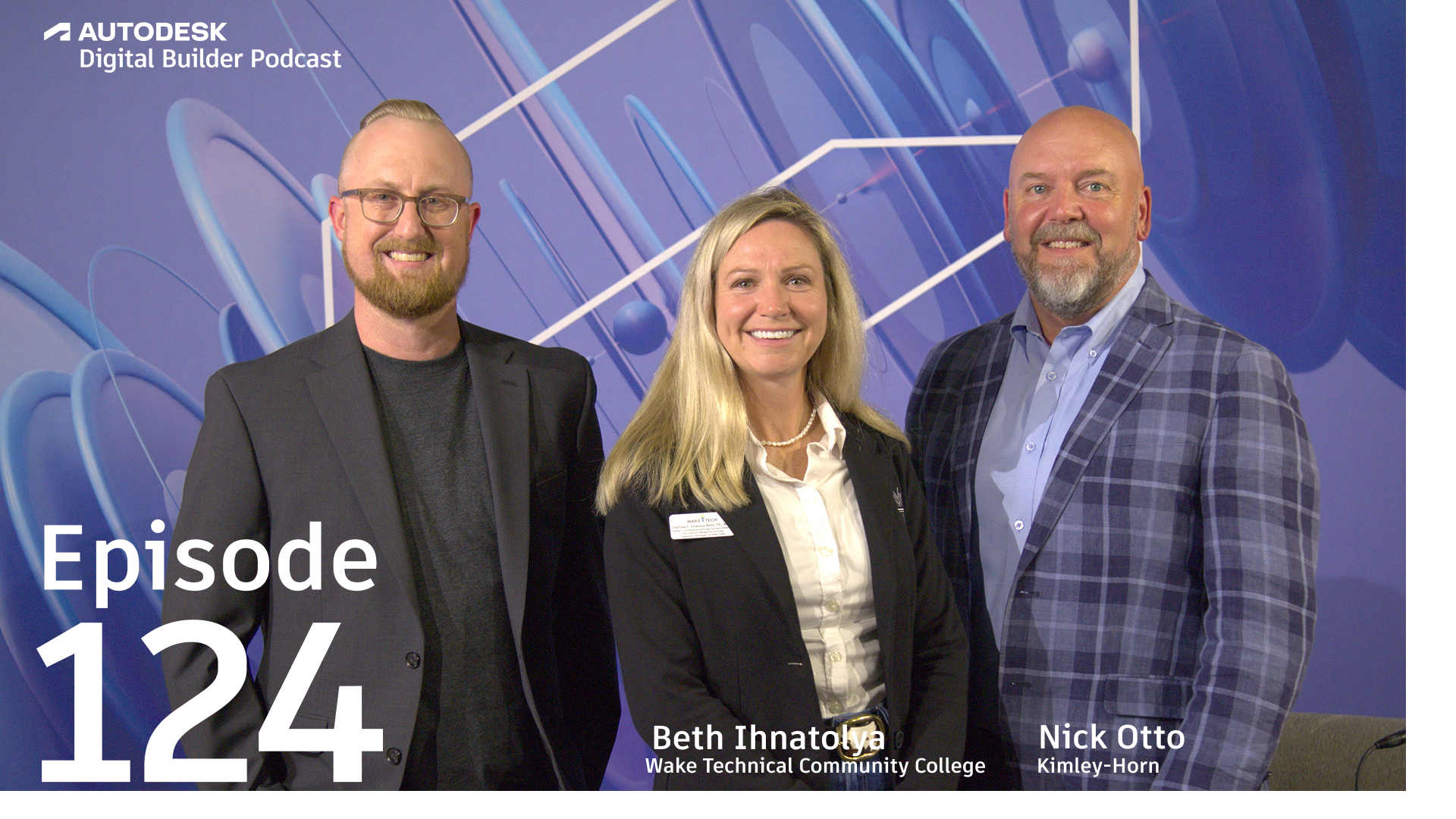
This week I’m joined by Nick Otto, Chief Technology Officer at Kimley-Horn, and Beth Ihnatolya, Program Director of Civil Engineering and Geomatics Technology at Wake Technical Community College.
We cover everything from closing the school-to-work gap to developing meaningful internships and upskilling faculty. Check out the highlights from the episode below.
We discuss:
Kimley-Horn and Wake Tech’s partnership began as a small idea and has grown into something that’s already making a real impact. Over the past two years, both teams have been working to ensure that students are equipped with the real-world knowledge and skills they need to succeed as construction professionals.
As Nick puts it, “There’s a gap between what we see coming out of universities and what happens in K-12. We see the need for emerging technical talent—people who understand civil infrastructure and how these tools are used as the industry changes and evolves. What better place to start than at one of the largest community colleges out there?”
From Wake Tech’s side, Beth explains that many graduates—even from four-year universities—leave school with a degree but little practical experience.
“We’re trying to make those changes,” she says. “With the partnership with Kimley-Horn, we’re able to work together to train students while they’re still in school so they’re billable and productive on day one.”
Autodesk is also involved (almost by chance), and it’s since grown into a key part of the partnership. Beth shares that the connection started when Kimley-Horn reached out about helping Wake Tech expand its civil engineering program.
“It just so happened that an Autodesk representative was at that first dinner meeting,” she recalls. “That was the beginning of a relationship that’s really flourished over the last year.”
Together, Wake Tech, Kimley-Horn and Autodesk have redesigned the college’s CAD and Civil 3D courses using real-world examples. Autodesk also helps fund instructor externships—giving faculty firsthand exposure to the tools and workflows shaping today’s industry.
At the heart of the partnership is an active advisory board that helps Wake Tech keep its curriculum aligned with real-world industry needs. The board includes 10 to 15 industry partners who are passionate about shaping the next generation of civil engineers and geomatics professionals.
As Beth explains, “We bring these industry partners together and collaborate with them to help make changes to our program.”
The board’s input has led to tangible changes. For instance, when Wake Tech considered splitting its construction management program into horizontal and vertical tracks, the idea was first discussed with the advisory board.
The same was true when the college added three new drone courses. “Before we invested all the time and money into those programs or into those courses, we wanted to meet with our advisory board and find out what the industry standard is for these drones. Their insight into what's being used in the real world is invaluable to us,” Beth continues.
Construction is evolving faster than most roadmaps can keep up, and Nick sums it up perfectly: “You’ve got to look out eight or ten years, but you also have to zoom in close—zero to six months. You’ve got project deliverables today and emerging technologies tomorrow. The churn rate is so fast now—six, eight, nine months. There’s no more 18-to-24-month roadmap.”
As such, firms need to think differently about the skills they need, not just now, but years down the line. What roles will matter in the future? Which ones might disappear?
As Nick put it, “Years ago, you had physical database management teams or drafting tables. Those jobs don’t really exist today. So, we have to think about which roles are going to change and build that into our current plans.”
The need to work in the present while planning for the future is a key reason why collaboration between construction firms, educators, and tech providers matters so much. Folks from each side can bring their unique lens to the table, and everyone can get a clearer picture of what the future workforce should look like.
“At Kimley-Horn, our perspective is informed by client delivery,” Nick says. “Autodesk’s view is shaped by their product roadmap and where they see the industry going. And then the community college systems are seeing what students are trying to achieve or trying to learn, and then who's coming to them asking for these roles.”
He continues, “When you take all three of those perspectives, you can come up with an idea of where things are going to be in the next few years.”
Construction internships aren’t new. At Kimley-Horn, for example, there are over a thousand interns who participated over the summer. That said, the firm's partnership with Wake Tech is opening doors to what Nick calls “a different kind of intern.”
These students aren’t just traditional four-year engineering majors—they’re CAD operators, designers, and technical specialists who are learning skills that meet the industry’s needs today.
According to Beth, Wake Take offers two main paths: work-based learning and apprenticeships. In the work-based learning model, students earn college credit while working roughly 320 hours a semester.
“We’re not sending them out just to get coffee,” Beth says. “We’re making sure they have measurable goals, that they’re learning while they’re there. Employers give us feedback, and we use that to strengthen our programs.”
The setup benefits everyone. Employers get to “try out” a student for a semester to see if they’re a good fit, and students get to see if the company matches what they’re looking for. “If it works out, great—they can stay on,” Beth said. “If not, no hard feelings.”
The other option, says Beth, is their apprenticeship program. “Through the apprenticeship program, students can work a full-time job. They get paid a fair wage, and then we have government funding that pays their tuition so they can go to school for free. They can work and gain that valuable industry experience and get paid full-time.”
For Kimley-Horn, the impact goes beyond short-term staffing. It allows the firm to have a pipeline of candidates who can hit the ground running.
“You want expectations to match between the company and the intern,” Nick explains. “So, they take the role, and then they're successful in the role. They ramp up quickly, which is good for us, but then they tell their friends how good the experience was. And then you can create a pipeline of students who say, ‘I really wanted an internship at Kimley-Horn.’”
Speaking of ramping up quickly, both Kimley-Horn and Wake Tech are focused on making sure students can contribute from day one.
According to Beth, that means shifting away from traditional classroom learning and leaning into hands-on experience with real industry tools. “In a four-year university, you spend a lot of time learning theory and calculations,” she explains. “But in the real world, you’re not sitting there doing all those things by hand.”
At Wake Tech, students get hands-on experience with tools they’d be using in the real world.
“We know time is money for industry partners, and so they're using things like AutoCAD, GIS, drones, and survey equipment. And so, we're giving students plenty of time hands-on with the technology so that when they go to work, they're able to do something.”
Beth’s advice for educators is simple but powerful: start with relationships. “Connections with industry are really going to be paramount to running a successful program,” she said.
Colleges that thrive are those that build genuine partnerships with firms and tech providers and have leadership that supports those efforts. “We’re lucky to have support from our dean, our provost, all the way up to the president. They trust us to make the right decisions for our programs.”
She adds, “I think that making these relationships with teams at firms like Autodesk, who are willing to come in and train your staff and your students, is really important.” After all, students need hands-on experience with the tools and technology they’ll actually use.
Nick agrees and challenges companies to act now instead of waiting for universities to fix the workforce gap. “The skills we need are going to come from technical schools and two-year colleges. We have to acknowledge that and lean into it instead of waiting for the education system to solve the problem because they're trying to solve a lot of problems and they're trying to serve a lot of things.”
The takeaway: don’t wait for talent to appear. Build the bridges and connections that bring it to you.
Beyond forming impactful partnerships with schools, tech providers, and construction companies, Beth and Nick agree that the industry also needs to change how it tells its story.
One way to shift that perception, says Beth, is to showcase the cool tech that construction teams are using.
“I think it’s fun to show our flashy equipment,” Beth remarks. “Geomatics is kind of sexy—you bring out your total stations, scanners, and drones, and people think it looks fun. It’s like playing video games.”
Wake Tech is leaning into that excitement by bringing technology into classrooms, open houses, and even high school recruitment events. “You don’t just show up with a hard hat and orange vest anymore. You show up with your equipment and software and show them what’s possible. We’ve got to go bigger.”
Nick is on the same page, adding that changing perceptions starts with reframing what the work means.
“In the world of critical infrastructure, there’s a lot of things we do that help the world around us operate,” he shares. “People don’t always see it that way, but when you work in this space, you’re literally building things that make life better.”
He adds that there’s a unique sense of pride that comes with the job. “You get to work on projects that will exist for 30, 40, even 60 years. It’s pretty cool when you’re driving around with friends and can say, ‘Hey, I designed that bridge,’ or ‘That’s my pond.’”
Digital Builder is hosted by me, Eric Thomas. Remember, new episodes of Digital Builder go live every week. Listen to the Digital Builder Podcast on: