No exaggeration here: the future of preconstruction is brighter and more exciting than ever. Not only is the precon space brimming with fresh talent, but it’s also fueled by powerful technologies that are redefining how teams plan and price projects.
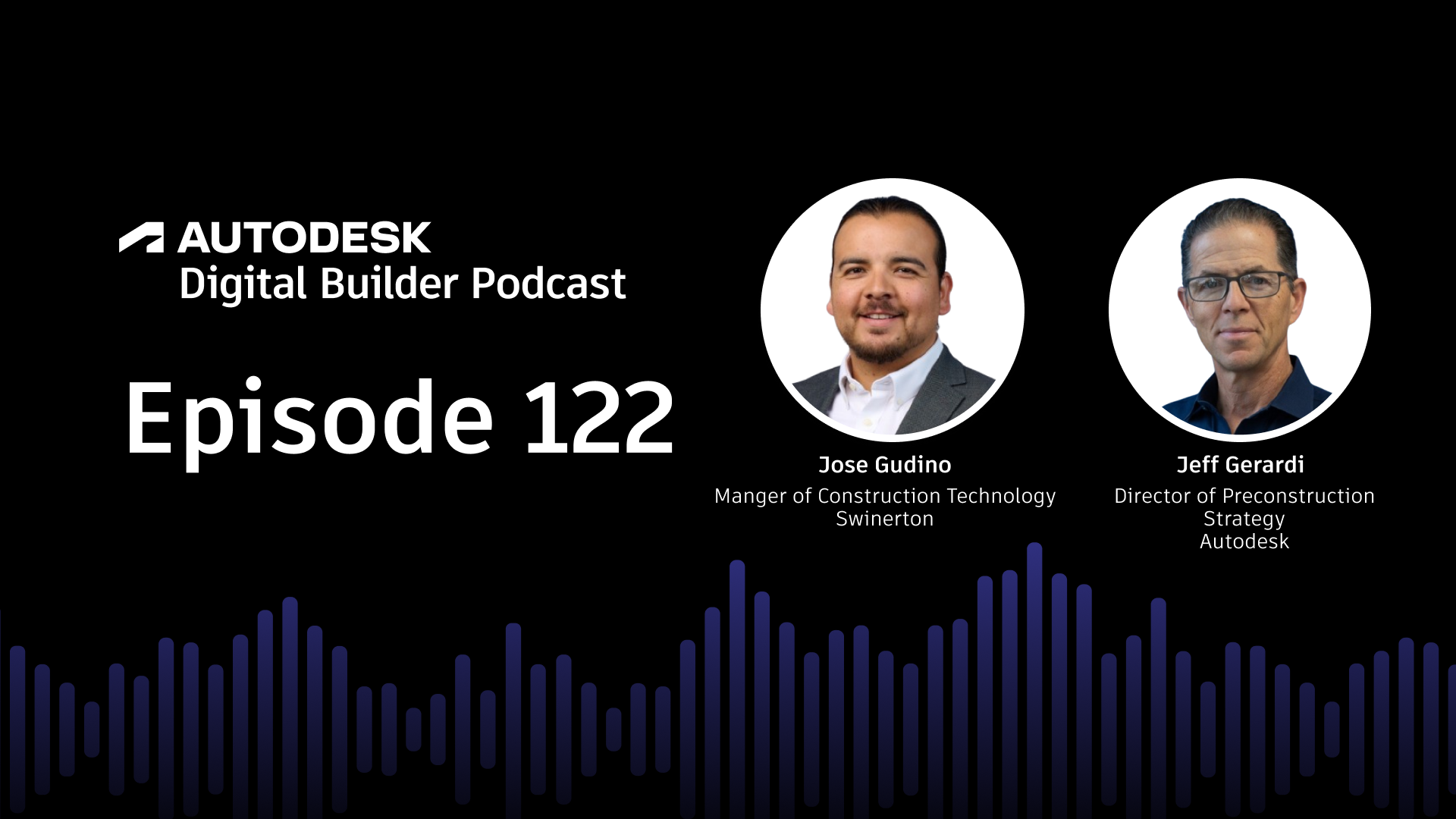
In this episode of Digital Builder, I’m joined by Jose Gudiño, Manager of Construction Technology at Swinerton, and Jeff Gerardi, Director of Preconstruction Strategy at Autodesk. With decades of experience bridging the worlds of estimating, technology, and construction strategy, both Jose and Jeff offer insightful perspectives on the state of preconstruction today and where it's headed tomorrow.
We discuss:
One of the best ways to understand preconstruction is to look at how far it’s come. When asked about how previous precon processes compare to what teams are doing today, Jeff says it used to be a process built around blueprints, highlighters, and spreadsheets.
“We would always need to measure a blueprint. If a contractor gets a 2D blueprint, they need to figure out the quantities and then somehow put a cost to it. Most of the time, it's been Excel.”
As far as where things are going, Jeff says the focus now is on data and integration.
“How do we combine all these workflows? How do we combine the takeoff, cost estimating, and bid management processes? They all have data points that should connect.”
Jose agrees, adding that preconstruction has evolved to become more dynamic and collaborative.
“Historically, precon has been very segmented. You get your drawings, you have a period where you're estimating, you deliver the estimate, and you wait for the results.”
He continues, “Then over the past 12 to 14 years, I've seen that shift where those lines are getting a lot more blurred. Precon is going in parallel with the design. You see a lot more value engineering going on. You also see a lot of addenda being sent out as we're currently pricing. I think the industry has finally acknowledged that precon is the first area where we can really mitigate risk.”
If it feels like there’s a new preconstruction app launching every week, you’re not imagining things. From takeoff and estimating tools to bid management and cost analysis platforms, precon teams today have access to more software than ever before.
“When I joined Swinerton as a junior estimator 12 years ago, our first goal was simply implementing a software solution we could all use,” recalls Jose.
Fast-forward a few years, and the challenge shifted from adoption to overload.
“We had six or seven takeoff solutions, three or four estimating solutions, all used to varying degrees. As Swinerton has grown, we’ve acquired more technical debt because of that.”
This story is familiar across the industry, and Jeff says that he's seen the same pattern everywhere.
“We did a survey with our precon advisory group,” he explains. “The lowest number of tools used was 10, and the highest was 20. All disconnected, all different user management systems, different data.
With that in mind, Jeff and Jose agree that the problem isn’t necessarily about the lack of tools. Instead, it’s more about keeping everything connected.
As Jose points out, “The reality is that everyone’s all over the place. Some still use on-prem solutions, some remote desktop, but the cloud is where most people are headed. The bigger thing is integrating the tools, so workflows actually work together—from bid invitation to estimate, or estimate to alternates module—so everything’s connected.”
AI is here to stay, and it will undoubtedly reshape how teams estimate, analyze, and collaborate. As Jeff sees it, all the buzz that AI is getting is well-deserved, particularly in the preconstruction phase.
We see AI supporting takeoff processes and cost analysis. When we start to pull all these data sets together—estimating, takeoff, bid management, prequalification—AI starts to give us the ability to offer insights like cost risks or schedule implications, even sustainability improvement suggestions.
At Swinerton, Jose is already seeing those possibilities take shape. “Estimating’s gotten bigger than just the cost side. Where I see AI helping is in dividing the low-value activities from the high-value activities. Low value being just sifting through drawings, doing takeoff, clicking around, and coloring drawings. We know how boring and tedious that can be.”
Today, nearly every takeoff solution has an AI module baked in, and Jose’s team sees even more potential in the near future. “We’re seeing AI handle constructability reviews—ingesting drawings, referencing building codes, and finding missing connections. If you have a water fountain, is it connected to power? Is it connected to water?”
With the help of AI, preconstruction pros can focus on higher-value activities, like collaborating with subcontractors to identify scope gaps, refining estimates to match owner expectations, and making strategic decisions earlier in the project.
A new generation of savvy builders is entering the workforce. For these preconstruction pros, the job is becoming less about counting doors or coloring drawings and more about strategy, collaboration, and leadership.
“I think this is a great opportunity for us as an industry to look at some of these tasks that are more tedious,” says Jeff. The takeoff tasks that might’ve taken days or even weeks—if we take that off their plate, the role becomes a little more strategic. The role becomes about learning the project more versus just doing a takeoff.”
Jeff also recommends that teams lean into mentorship bridges between generations. “It’s an opportunity for the more experienced senior-level people in our industry to pair with young adults coming up through the industry, who probably went through college with more technology,” he explains.
“That’s an interesting marriage to me. Those young people are using technology every day, which the older generation didn’t use as much. So, it’s a great opportunity to lean into learning more about the project together.”
At Swinerton, Jose is seeing similar trends.
“Over the last 10 years, I’ve seen a big shift in schools,” he says. “We work closely with San Diego State and the ASC Reno competition, coaching the precon teams. More and more students coming out of college are interested in careers in precon. They see the value of having a stable place to go every day in the office. They see the value of seeing multiple projects quickly within a short amount of time.”
Jose believes AI can accelerate this transition. “Precon is no longer going to be sitting in a corner doing a takeoff for 10 hours,” he says. “It’s going to be, ‘Here’s your takeoff—now how do you categorize it? Go call the subs and make sure they have the scope gaps filled.’ It’s a bigger shift to focus on soft skills, not just the technical ones.”
All this to say that the next generation isn’t just inheriting the tools—they’re shaping what preconstruction will become.
Digital Builder is hosted by me, Eric Thomas. Remember, new episodes of Digital Builder go live every week. Listen to the Digital Builder Podcast on: