Sustainability in construction isn’t a new topic; industry professionals have been having conversations about reducing carbon emissions and building responsibly for years. That said, the nature of those conversations is starting to shift, with firms increasingly moving from talking about why sustainability matters to how to make it happen.
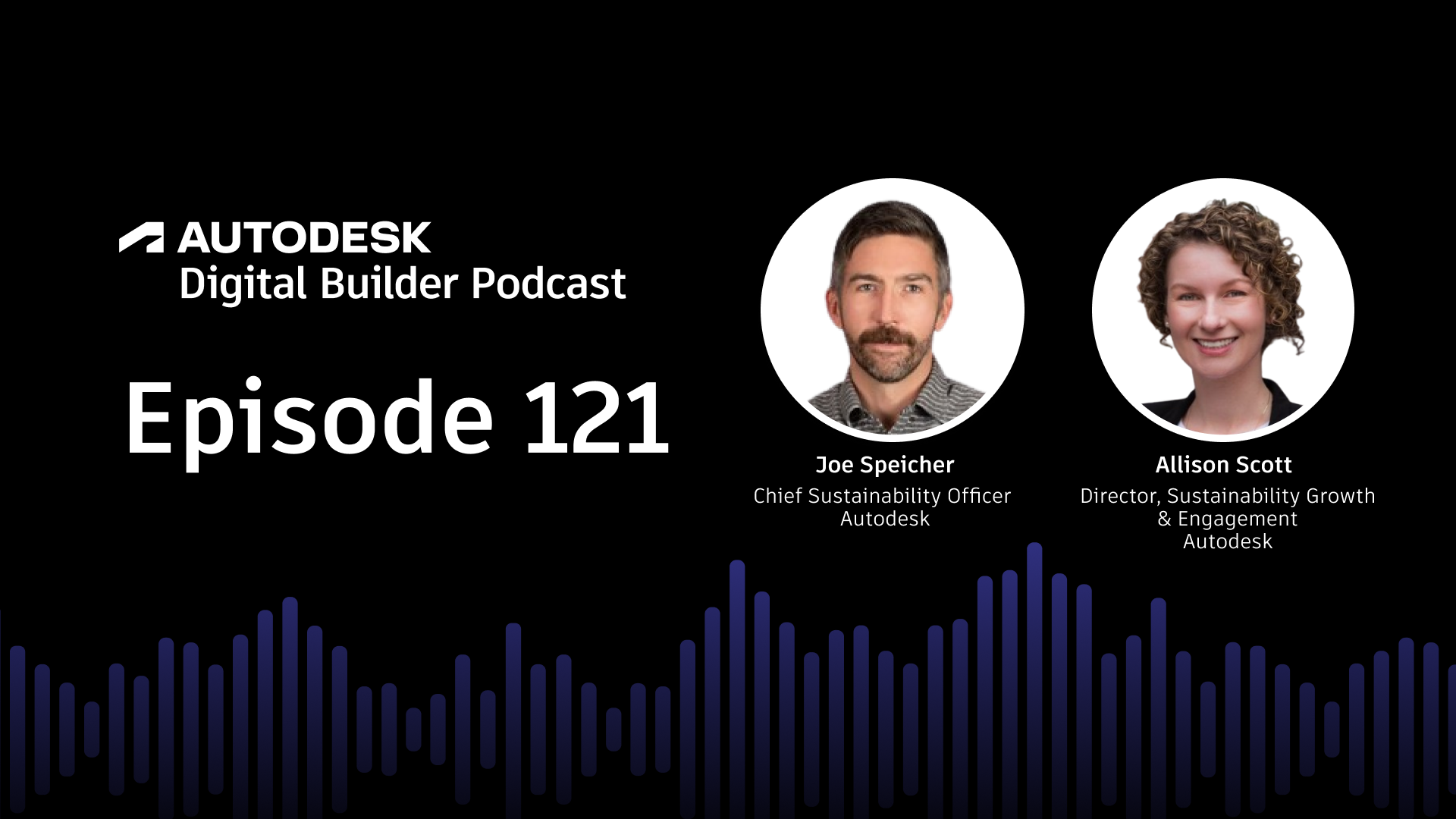
At Autodesk, we’re constantly in dialogue—internally and with our customers—about what it takes to turn sustainability goals into measurable results. And at the heart of many of those conversations are Joe Speicher, Chief Sustainability Officer, and Allison Scott, Director of Sustainability Growth and Engagement at Autodesk.
Allison, Joe, and I caught up at Autodesk University 2025 in Nashville to discuss how the industry is operationalizing sustainability and the role of technology in helping you drive more sustainable building practices. Check out the highlights from our conversation below.
We discuss:
Now is a great time to be working on sustainable construction initiatives, because the conversation has matured. Discussions are moving beyond vision statements and press releases to real plans, metrics, and accountability.
As Joe puts it, “Sustainability has moved from aspirational, pie-in-the-sky notions to operational conversations.”
Whereas people were more concept-driven in the past, teams today are all about getting things done and aligning on specific outcomes.
Allison echoes this and adds that Autodesk customers are asking different questions now, and it's clear that they're focusing more on urgency and accountability.
“Even in the customer conversations we’re having day-to-day—it’s not just about ‘How can we have sustainability as a brand promise?' but 'How can we realize that promise with very actionable goals?”
She also points out that sustainability is good for business, citing an EY study that found companies with dedicated sustainability goals earn 1.8x more revenue than those without.
“The idea of sustainability only being about reputation these days is gone to the wayside. It is much more integrated into the way of working.”
Beyond that, Joe says that momentum is building at a global scale.
“The vast majority of the world is moving inexorably towards a lower carbon future. Last year alone, we spent over $2 trillion on the low-carbon transition. Overall, we've got over 40 countries around the world that have put peak carbon emissions in their rear-view mirror. A lot of that is driven by global policy changes.”
Data and technology are becoming so ingrained in our workflows that we can’t really talk about building more sustainably without also talking about building more digitally.
When it comes to sustainability, it’s clear that going green also goes hand in hand with going digital.
And for Allison and Joe, it all comes to data.
“Joe has a wonderful turn of phrase that goes, ‘Sustainability as a data problem.’ That could not be truer today. When we are trying to think about decarbonizing the built environment, we need to understand the role of decarbonization down to the detail level. That means, how does that carbon data travel from early design stages all the way down to the site, and then into building operations? That whole life cycle is a data problem.”
The solution to that problem? Connected construction.
“An AEC firm can design the most sustainable building on the planet. But the moment those plans go to construction docs, you lose a lot of data,” explains Joe. He adds that having a “digital thread” connecting design, construction, and operations is a prerequisite to sustainable outcomes.
“That’s because you can carry that data through and ensure that what gets designed is what gets built, and what gets built is performing as it should.”
AI presents both challenges and solutions to sustainability.
According to Joe, the impact of artificial intelligence can be viewed in two ways. First are the energy consumption and emissions required to power AI. Then, there’s the application of AI in our daily workflows.
On the infrastructure side, the growth curve is steep. “McKinsey just estimated that between now and 2030, the world will spend roughly 6.7 trillion on data center infrastructure. That is an astounding number,” Joe notes.
The good news: “We have the tools to decarbonize that to a significant degree, which is really exciting. We can make every additional build more and more sustainable.”
In other words, as the footprint expands, the industry has an opportunity to bake in lower-carbon design, cleaner power, and smarter operations.
Of course, leveraging AI responsibly means being mindful of its environmental cost. That’s why it requires a lot of intentionality in how it’s deployed and scaled.
Joe, for his part, is optimistic that using tools like AI to build sustainably will yield net positive results for the planet.
The key is balance—minimizing emissions while using AI to drive efficiency and smarter resource use.
“We have to design and build and apply AI with intention,” Joe says.
When we talk about AI’s environmental impact, we can’t ignore the backbone that powers it: data centers. As Allison explains, “the rapid expansion and acceleration of AI is dependent on the infrastructure behind it.”
The data center market is booming worldwide, and with that growth comes a wave of new design and sustainability challenges.
To navigate this successfully, Allison says we need to work together and share connected solutions.
“To really advance the role of data center design and construction, we have to work closer together. We have to do more connected workflows, we have to share data, and we have to optimize together in order to achieve speed, scale, quality, and sustainability.”
In short: the data center boom is here. But it’s up to us to ensure it’s built sustainably, with shared data, connected workflows, and design choices that stand the test of time.
Digital Builder is hosted by me, Eric Thomas. Remember, new episodes of Digital Builder go live every week. Listen to the Digital Builder Podcast on:
or wherever you listen to podcasts.