
Data integrity is foundational to the success of AI technologies, especially in the construction sector, where sensitive information and intellectual property are constantly being handled. Which brings me to one question I hear from Autodesk's construction customers over and over again: What are the AI protocols for data integrity?
Backing up, we have to face the facts. Construction leaders are noticeably less enthusiastic about AI than they were last year, with trust in the technology dropping 14 points year-over-year according to Autodesk’s 2025 State of Design & Make: Spotlight on Construction report. And while 68% believe AI will enhance the construction industry, this is down sharply from 80% in 2024.
At Autodesk, we understand that the power of AI is secondary to the trust our customers place in us to protect their data. With a legacy spanning over 40 years in data stewardship, Autodesk is committed to responsible, ethical, and secure AI development, deployment, and use.
Investing in making AI a success is crucial to harnessing its full potential in our lives and industries. Autodesk’s journey in AI dates back to 2009, with continuous research and development paving the way for advanced solutions like Construction IQ, released in 2019, and more recent releases like Autodesk Assistant. This history of innovation underscores the company's deep expertise in developing AI technologies tailored for various needs and applications.
It’s also why Autodesk has established a dedicated Trust Organization, led by the Chief Trust Officer, to ensure adherence to strict governance processes that protect clients' personal data and intellectual property. This team embodies Autodesk's unwavering commitment to acting responsibly and ethically while delivering AI solutions.
Autodesk has voluntarily committed to the EU AI Pact, which encourages and supports organizations to plan for the implementation of AI Act measures across the EU. In addition to signing the AI Pact, Autodesk is involved in several initiatives to enable trusted AI across industries, including participation in the U.S. AI Safety Institute Consortium (AISIC), run by the National Institute of Standards and Technology (NIST), and the Content Authenticity Initiative (CAI).
In a similar vein, one of the core elements of Autodesk’s strategy is its native approach to AI. Unlike some companies and solutions that rely on shortcuts or third-party services, which can potentially compromise data security, Autodesk ensures that data remains within its ecosystem. This method leverages existing infrastructure to bolster the security of client data.
Furthermore, different AI-powered features require distinct approaches. Not all of Autodesk’s AI tools rely on machine learning or data for training. When features do necessitate training data, Autodesk uses various sources to optimize functionality while ensuring transparency and security.
Transparency is vital in building trust. Autodesk’s Trust Center offers detailed insights into AI features and their data sources through AI Transparency Cards. These cards function like nutrition labels for AI, disclosing information on the functionality, data sources, and privacy and security safeguards of various AI tools.
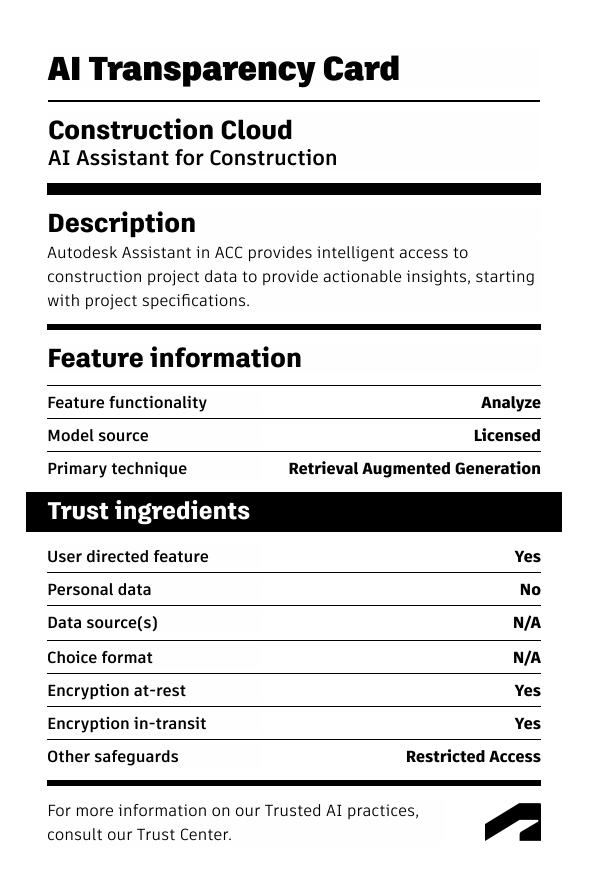
AI Transparency Cards exemplify our ongoing commitment to delivering trusted AI. These cards provide users with clear and accessible information about AI features, enabling informed decisions regarding their use.
As a leader in design and make, Autodesk holds itself to high standards of responsibility, setting benchmarks for the industry and its customers. Through our dedication to ethical AI practices, we aim to inspire and guide other companies in developing trusted AI capabilities.
Explore more about Autodesk’s AI protocols and commitments by visiting our Trust Center and discovering how we can help you achieve secure and reliable AI solutions for your projects.