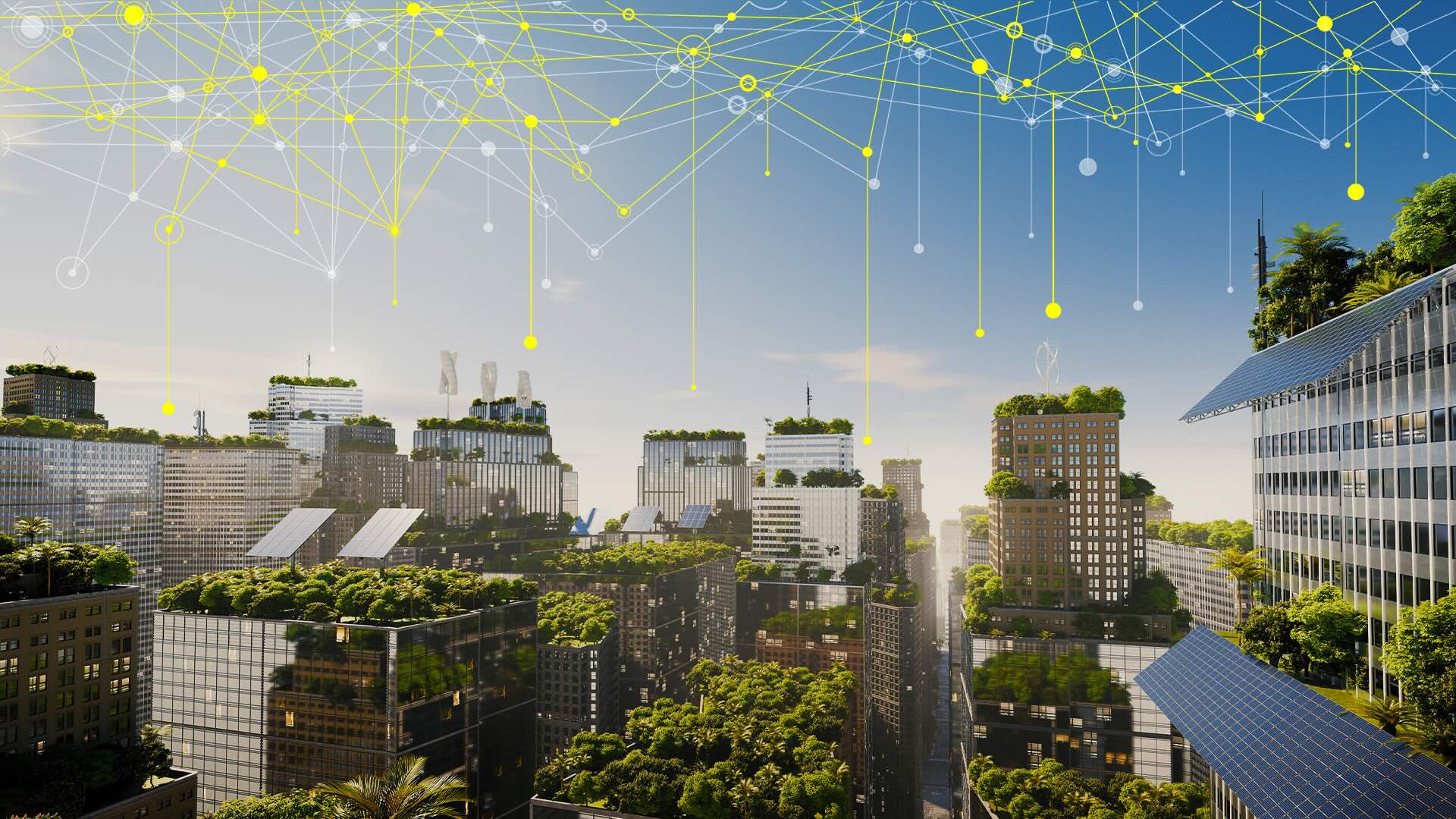
Sky-high carbon emissions. A growing global population. Resource scarcity. These are just some of the environmental issues we face today—and ones that the construction sector is uniquely positioned to address.
For forward-thinking construction businesses, sustainability is becoming a core strategy. Many now recognize the short- and long-term value of sustainable practices, from winning new work and increasing revenue to attracting and retaining top talent.
And one powerful ally throughout all of this? Artificial intelligence.
Sustainability may not be the first thing that comes to mind when you think of AI in construction, but leading firms are finding new ways to use it to reduce waste, improve energy efficiency, and attract more talent. Today, we explore just how.
Being sustainable hasn’t always been seen as strategic. Historically, "sustainability," along with terms like "eco" and "green," were treated as buzzwords. Sustainability has previously been seen as a "nice-to-have" or a box to check when working towards a certification like LEED in the construction industry. For many contractors and owners, it wasn't a priority over getting the job done on time and on budget.
But the tides are shifting, and sustainability is stepping into the spotlight in a more meaningful way. Rather than seeing it as a trend or add-on, companies are weaving it into their long-term strategy.
As Claire Romaine at Edged Energy puts it, "I think sustainability was another buzzword probably 10 years ago or so, but now it's really becoming a focal point for companies."
Industry data supports this. According to Autodesk's 2025 State of Design & Make: Spotlight on Construction report, 95% of construction organizations are taking steps to be more sustainable. And what's more interesting is that most firms (63%) are turning to tools like AI to enhance sustainability efforts.
How are construction leaders using artificial intelligence for sustainability? AI's use cases are varied, but most sectors are exploring it to increase the resilience of their supply chains, reduce waste, and drive efficiencies for sustainability focus areas like carbon, energy, circularity and biodiversity.
Based on this year's State of Design & Make report, the top AI use cases in sustainable construction include:
Analyzing and improving supply chain sustainability (44%) - AI can uncover hidden inefficiencies and opportunities in your supply chain. Depending on your data and the platforms you use, you can leverage AI to identify the most sustainable vendors, predict disruptions, and streamline logistics. All that leads to reduced emissions, costs, and delays.
Enhancing efficiency of sustainability documentation (42%) - Automating sustainability documentation helps teams save hours on reporting. AI can quickly pull data, flag inconsistencies, and ensure compliance with green building certifications. That way, sustainability reporting becomes seamless and stress-free.
Optimizing energy consumption and efficiency (41%) - AI tools can monitor energy usage in real-time and recommend adjustments as needed. This helps teams design and operate more energy-efficient buildings, ultimately reducing operational costs long after the ribbon-cutting ceremony.
Facilitating data-driven decision-making for sustainability initiatives (41%) - From site planning to material selection, AI helps decision-makers choose the most sustainable options to improve factors like embodied and operational carbon, energy efficiency, or biodiversity net-gain.
Monitoring and reducing carbon footprints (38%) - AI can help track emissions across jobsites, equipment, and supply chains to help companies pinpoint carbon hotspots and make recommendations on optimization before those carbon impacts happen.
Material waste reduction (36%) - Overordering and material waste not only hurt the bottom line, but they also harm the planet. AI enables smarter procurement, keeping excess material out of landfills and your projects on budget.

Focusing on sustainability also gives you a strategic advantage in talent development. This is particularly important today, as construction firms continue to struggle with attracting skilled workers.
According to the AGC's Workforce Survey, 94% of firms with craft worker openings are finding it difficult to hire for those positions. Similarly, 92% of firms with openings for salaried workers are struggling to fill those roles.
Having sustainable initiatives in place can alleviate these challenges. Today's workers are gravitating toward roles that offer meaningful work and real-world impact. Sustainability checks those boxes—especially when paired with technology like AI.
Speaking of technology, building a future-ready workforce isn't just about filling seats. Construction companies need skilled professionals who not only understand the industry but are also fluent in digital tools, automation, and data.
Fortunately, careers in construction are becoming increasingly tech-driven, with tools like robotics, AI, and digital twins. And while some folks outside the industry still perceive the construction sector as analog, the reality is that our sector is increasingly being driven by a new generation eager to build smarter and make a positive impact on both their projects and communities.
As Hannu Lindberg at DPR Construction puts it, "One thing that excites me about the future is not just the new technology, but the willingness of people to start adopting. We've got a new generation of builders that are coming in that are much more inclined to use technology, and that will fundamentally change the way the industry works."
Construction embracing sustainability sounds good in theory. Let's dive into what sustainability goals and achievements can look like on the ground.
Across the globe, I've seen firms explore and set bold sustainability initiatives including:
Of course, ambition alone doesn't guarantee impact. It all comes down to how these goals are put into practice.
The gap between big ideas and the need for solutions that are practical, efficient, and easy to adopt is still present. Leaders in the industry are overcoming these barriers to realize impressive sustainability outcomes.
One example is Populous, a global architecture firm leading the way in sustainable stadium design. By embracing industrialized construction, modular components, and early manufacturer collaboration, Populous builds venues that are faster to deliver and easier to reuse. In one project, the firm cut aluminum panels by 20,000 and reduced steel use by 40%. Populous also leverages AI and machine learning to optimize seating layouts and energy use, helping venues maximize both sustainability and revenue.
There's also Norconsult, whose work on Norway's Sotra Bridge shows how digital innovation and sustainability can go hand in hand. Norconsult designed the world's first fully digital suspension bridge. In doing so, the team reduced drawings by 99.5%, captured 60 million data points, and utilized automation to simplify processes like managing issues, RFIs, and submittals.
Sustainability in construction is no longer about chasing one-off wins. The industry is shifting toward long-term strategies that balance innovation with impact. Consider the following.
The construction industry's approach to sustainability is evolving, with new trends and technologies promising to transform how projects are designed, built, and maintained.
From sourcing low-carbon materials to minimizing waste and rework, digital tools help construction teams build more sustainably.
Sustainability shouldn't live in a separate system or spreadsheet. To deliver real results, sustainability needs to be embedded directly into your day-to-day workflows. That's where integrated solutions shine.
To unlock long-term sustainability gains, digital workflows must be connected to Environmental Product Declarations (EPDs), supply chain data, design and preconstruction tools. Takeoff in Autodesk Construction Cloud (ACC) supports sustainable design and construction by improving material planning, enabling prefabrication, and reducing rework—cutting both cost and optimizing for embodied carbon.
Plus, with Carbon Accounting in Takeoff (beta), teams can view carbon data directly in the platform. It automatically maps MasterFormat codes to EC3 database carbon values, giving teams the visibility they need to assess material impact early in the preconstruction process without leaving their workflow.
And for renovation and adaptive reuse, Autodesk ReCap Pro helps capture accurate site conditions, so it's easier to model existing structures and reduce demolition waste. Whether you're working on a retrofit or a net-zero new build, Autodesk's integrated ecosystem helps turn your sustainability goals into real-world impact.
For sustainability to work, your data needs to do more than sit in a silo. It must be accessible and actionable so teams are empowered to make informed decisions.
Autodesk Construction Cloud supports your sustainability initiatives by bringing together data across the project lifecycle. ACC doesn't just centralize your data—it helps you make sense of project information. AI capabilities makes it easier analyze project data and surface risks in design, quality, and safety. That way, you can get your hands on insights when and where they're needed most.
Sustainability datasets vary significantly by region due to different methodologies and legislative requirements. This results in a lack of technical standards,creating a fragmented ecosystem of data providers that usetheir own data formats and disparate systems.
The Autodesk Sustainability API is a standardized framework to connect users with the third-party datasets that they trust, want, and often required to use. Now in Public Beta, it enables teams to build applications utilizing sustainability datasets and provides quality environmental data when needed for compliance.
To continue driving real progress, construction leaders must commit to the technologies, tools, and talent that make sustainability scalable. That means investing not just in platforms—but in people. Success requires ongoing adoption of AI and integrated systems, paired with robust training to future-proof the workforce.
With collaboration, innovation, and bold action, construction can lead the way in building a more sustainable future.
Explore more insights in Autodesk's 2025 State of Design & Make: Spotlight on Construction report.