Data is everywhere in construction projects. Emails. BIM models. job site footage.
These days, the challenge that teams face isn’t about collecting data, but turning it into insights and understanding.
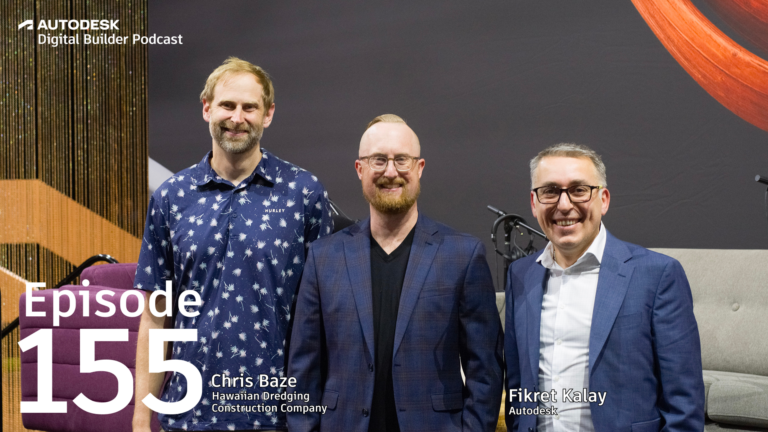
Chris Baze, Director of Construction Technology at Hawaiian Dredging Construction Company (HDCC), and Fikret Kalay, Director at Autodesk Research, know how hard it can be to connect the dots across all that information. The good news? There’s some exciting research underway to bridge those gaps and help construction teams make better, more informed decisions.
On this latest episode of the Digital Builder podcast, Chris and Fikret discuss a research project that explores how AI can help create a real-time understanding of the jobsite and enable teams to make better decisions before problems impact schedule and cost.
We discuss:
Construction teams generate massive amounts of data every day. But having data and knowing what to do with it are two different things.
As Fikret puts it, “We are moving from collecting data to connecting data.”
As projects move from design through construction and operations, information passes between different teams and systems. Along the way, connections get lost, and it gets harder to see the full picture.
Fikret points to research showing that 95% of construction data goes unused. “Why? Because it’s very difficult to find the data, to find what the problem is related to, or where to find that email that gave more information. The picture, the RFI, the schedule—all this information is very difficult to connect.”
How does that wealth of data show up on the job site?
Chris echoes Fikret’s sentiment and notes that having more data doesn't necessarily make it easier to understand what's happening on a project. He says that one common way the data gap manifests itself is through the growing volume of camera footage teams collect.
“I think one of the major changes recently is computer vision. We've all had cameras on site for a long time, and those cameras went from 1080P cameras to 4K cameras, which is four times the amount of data. So that adds up very quickly.”
He continues, “We have usually hundreds of terabytes of hard drives on a job site now just to receive that video footage. And it's great. You have an incident, you can go back, you can manually retrieve it, but now we're finding a lot more value using computer vision to turn it into an ongoing data stream, not just of pixels, but of events, activities, and what's going on on your job site.”
Construction projects bring multiple parties together, and each stakeholder has their own piece of the puzzle. The designer has the plans and specifications, the contractor has schedules and jobsite reports, and the owner has project requirements and operational priorities.
This is why connecting teams and data is critical. Even the best collaborators can struggle to make informed decisions if they don't have access to the same information and context.
“The construction industry is quite collaborative. “If you see how many stakeholders interact with each other, it's quite impressive,” Fikret points out.
“But on the flip side, the data is not. From the design to operations—the more we go through each stage, the more fragmented the data is. The more we go through the steps, the less the data remains connected and the more we lose the context.”
Consider a water leak on a jobsite. Spotting the leak tells you what happened, but it doesn't explain why it happened. To get to the root cause, teams need to look at the surrounding information, including project drawings, site conditions, and previous decisions.
“Going beyond the ‘what’ and trying to understand why it's happening is very important, which is why we need context,” Fikret explains.
He highlights three areas that teams need to connect:
The sooner teams have that context, the sooner they can address problems before costs pile up.
As Fikret puts it, “If you get to understand the context at the early stage, then the five million becomes maybe less, maybe 10K. You start to treat the problem sooner rather than later.”
To help construction teams use their data better, Autodesk Research is working with Hawaiian Dredging on a project that connects information across the construction lifecycle.
The aim of the initiative? To bring project data into one ecosystem, where teams can find information and understand how different pieces relate to each other.
Connecting project data through the data hive
Fikret walks through an example involving a wall. In a BIM model, you might see basic information like its thickness. Drawings and specifications provide more details about the materials, insulation, and studs. Meanwhile, jobsite photos show what that wall actually looks like during construction.
All of this information relates to the same wall, but it can live in different places.
The research team is working to connect those records so people can access the full picture without jumping between systems.
“We created this platform that we call the data hive, where everything is centralized. So you can search in a much more advanced, intelligent way. We make that data machine-readable,” says Fikret.
Now, finding information is just the first step. Teams also need to understand what's happening on the jobsite and why.
For example, suppose someone spots moisture on a wall. A photo shows the damage, but it doesn't explain where the water came from.
When that photo connects to the BIM model and other project records, teams can investigate nearby elements, such as a pipe above the ceiling or another room experiencing the same issue.
Testing the research on real projects
Connecting data in a research environment is one thing. Making it useful on an active construction site is another.
That's where Hawaiian Dredging comes in.
“Working with Chris and HDCC has been very productive and useful for us because we understand the real problems, we stress-test our workflows, and try to make sure that we add value when we solve a real industry problem,” Fikret says.
The collaboration helps Autodesk Research test its approach against actual jobsite challenges and learn what construction teams need from their data.
Ask an experienced superintendent to walk through a jobsite, and chances are they'll spot issues that someone newer to the industry might miss. After decades in construction, they've learned to recognize warning signs and anticipate problems before they escalate.
But what happens when those experienced professionals retire and take all that knowledge with them?
“For me, it’s all about transitioning the industry from experience-based to data-based decision-making,” says Chris.
“We have a lot of really experienced superintendents, project managers, people who have been around 30, 40-plus years, and they see something, and they know what those problems are. Those people are retiring, and they're being replaced by people in their first, second, or third job. And they don't have that insight that the industry veterans do.”
Chris sees the research initiative as an opportunity to capture that expertise and make it available to everyone.
For example, experienced team members could log issues in Forma, along with photos that help explain what went wrong. Teams could also feed jobsite sensor data, such as moisture meter readings, into the system to add context.
That information could then help less-experienced workers recognize similar problems and understand how to address them.
“If that context is living in the heads of people who are on the jobsite, then I'm not doing my job well,” Chris explains.
“I think what we're trying to do is embed, 'Hey, this is what happened on the jobsite, this is why it happened, and here's how you mitigate it.'”
Fikret agrees, pointing out that the reasoning behind decisions often goes undocumented. Capturing that knowledge in a shared data ecosystem would help teams learn from past experiences, even after the people involved have moved on.
Another area Autodesk Research is exploring is helping teams figure out next steps based on their project data.
Fikret returns to the example of moisture appearing on drywall. The team might have photos of the damage, humidity sensor readings, temperature data, and other project records. Instead of having someone manually piece everything together, the data hive could analyze the information and suggest possible causes.
“It will provide you maybe three or four hypotheses of what could have happened,” Fikret explains. “And it will share that openly with you and say, ‘Okay, these are the three hypotheses I believe you should explore.’”
From there, teams can add more context. Someone might mention that a major storm hit the building the day before. With that new information, the system could reconsider its initial assumptions and suggest that the moisture came from an issue with the exterior facade rather than a plumbing leak.
“At the end, you make the decision, you record that decision, and you explain again why you believe that's the right decision, so we can record that and do better,” explains Fikret.
Chris also sees opportunities beyond day-to-day troubleshooting. He points to warranty claims involving pipes hidden inside walls or concrete. Regular reality capture could help teams spot installation issues before those pipes get covered up.
“I think there are longer-term implications of not only what happened as problems during the project, but also what happened after you delivered the project that we might be able to catch and not have happen on our next project.”
Speaking of long-term implications, there's plenty to look forward to when it comes to AI and construction data. While Autodesk and HDCC are still in research mode, both Chris and Fikret see opportunities to change how teams function.
For Fikret, the next five years are about improving risk management and helping construction pros make better decisions faster.
Consider a scenario where a contractor expects two trucks of materials, but one breaks down. The team has just 10 minutes to decide which materials to prioritize.
AI could help by quickly analyzing how each option would affect the schedule, workers, and equipment, then suggesting possible courses of action.
“AI can help accelerate gathering the right insights, like how this is going to impact the schedule, workers, and the jobsite,” Fikret explains.
Looking further ahead, Fikret envisions a future where teams could “simulate a whole jobsite activity before it happens.”
Chris, meanwhile, hopes technology will help align the interests of everyone working on a project.
“I think by surfacing what's going on and how it impacts the project, it's going to help us better align our interests,” he says.
For example, if a subcontractor puts in extra effort to make downstream work easier, better project data could help capture that contribution and ensure it gets recognized.
Ultimately, Chris hopes these tools will help everyone understand how their decisions affect the project as a whole.
Digital Builder is hosted by me, Eric Thomas. Remember, new episodes of Digital Builder go live every week. Listen to the Digital Builder Podcast on:
or wherever you listen to podcasts.