What if the measure of a building's success wasn't how it looked, but the impact it had on people's lives?
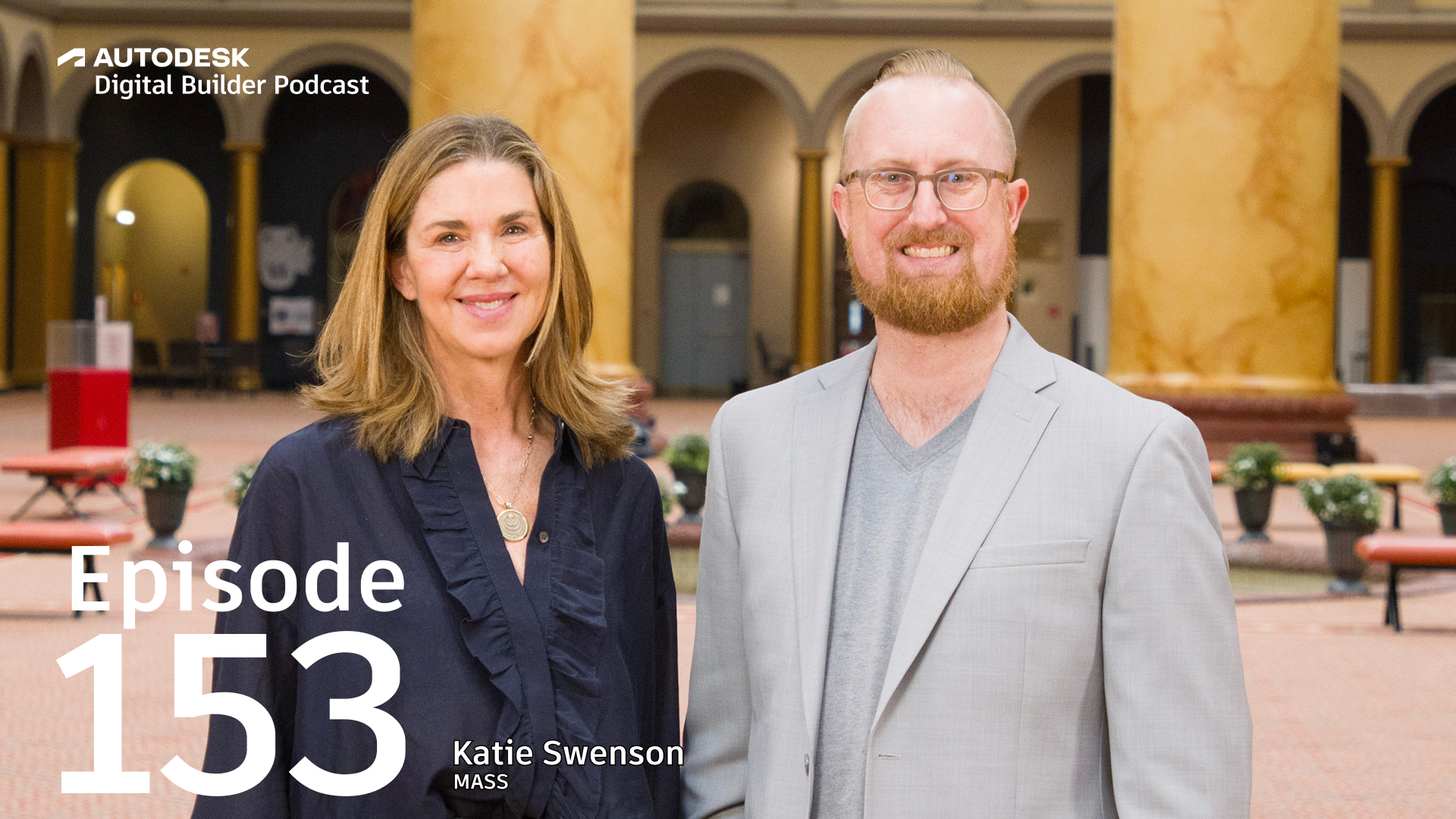
That's the question that shapes Katie Swenson's approach to architecture.
As senior principal at MASS (Model of Architecture Serving Society), Katie has spent her career proving that thoughtful design can do more than just look good. It can also support healing and strengthen communities.
In this latest episode of the Digital Builder podcast, Katie explains why she prefers the title "Home Maker," (with a capital H and M), and how that philosophy has shaped her work. We also explore why great architecture isn't reserved for landmark buildings, but has the power to improve everyday life for everyone.
We discuss
Katie intentionally describes herself as a "Home Maker," with a capital H and M, as a way to reframe what architecture is really about. While the term traditionally refers to someone who stays home and maintains the household, she argues that architecture is, at its core, an act of Home Making. Whether the project is a house, a school, or a community space, the goal is the same: to create places where people are comfortable and feel like they belong.
As such, the term Home Making, in the context of architecture, puts "the emphasis on the people, not just the structure." It also balances technical expertise with care, empathy, and human connection.
When the topic of architecture comes up, it's easy to think about iconic buildings, museums, or other landmark projects. And while those spaces certainly matter, Katie points out that architecture influences every part of our daily lives, whether we notice it or not.
"Architecture is part of everything we do," she says, because nearly every space we inhabit has been designed in some way. The real question isn't whether a place was designed, but "how is it designed, by whom, for whom, and with what intention."
According to her, architecture isn't reserved for large institutions or the wealthy. Instead, it's "the platform for all of our lives."
It shapes the everyday environments where people live, work, heal, and learn. When designers lead with care and intention, they create spaces that bring greater dignity to the people who use them.
For MASS, great architecture starts well before drawings or construction. Katie describes the organization, which again stands for Model of Architecture Serving Society, as a “nonprofit design collective that works with almost primarily nonprofit organizations.”
MASS’ goal isn't simply to deliver beautiful buildings, though she says they strive to create "the most elegant and beautiful architecture that you could ever find."
That said, the organization also "leverages the tools of the built environment to amplify and propel the missions" of the organizations they serve. That means getting involved early and, as she puts it, "staying late."
Starting with the mission, not the building
MASS’ philosophy shapes every client engagement. "It's not to build a building," Katie says. "It's to better increase the likelihood" that an organization achieves its mission.
She points to MASS's work with Iftin Global, a nonprofit in Somalia and Kenya that helps young people recover from trauma and connect with economic opportunities. Before designing anything, the team asked a different set of questions: What outcomes are you trying to achieve? What spaces foster care, belonging, and safety? How can the built environment make your programming more effective?
In many cases, partners don't yet have a site or full funding. What they do have is a mission. Katie believes that's enough to begin.
"The built environment will change their outcomes, for better or worse," she says. "There's no neutrality about the built environment." The challenge, then, is designing spaces that help those outcomes become better.
If there's one word that describes how MASS works with clients, it's accompaniment.
The concept came from the late Dr. Paul Farmer, founder of Partners in Health. In medicine, accompaniment meant you didn't simply step in when something went wrong. Instead, you "walk alongside somebody through their life" to improve their long-term health. MASS adopted that same mindset for architecture.
Rather than acting as consultants who show up to solve a design problem and leave when construction wraps up, Katie says they aim to be "a partner with an organization through their lifespan."
That shift changes how projects are approached and how success is measured. Instead of asking whether a building was delivered on time and on budget, the question becomes: How can this place continue helping people years after it opens?
Katie shares some examples of MASS’ philosphy in action:
Butaro District Hospital
MASS's first project, Butaro District Hospital in northern Rwanda, is a great example of how their approach comes to life.
Rather than focusing solely on the building, the team asked broader questions: "How could the physical infrastructure support the health outcomes of patients?” and "How could the building process itself bring economic viability, new skills, and beauty to the community?"
The team also challenged the traditional role of a hospital. Katie says they wanted it to be "not just a place for the provision of healthcare," but part of a larger effort to improve health for "patients, their families, doctors, nurses, and staff."
That work reinforced another lesson: beauty and thoughtful design are not separate from healthcare. Features like natural ventilation and intentional layouts became part of a larger understanding of "how the buildings affect our health."
Partners in Health, the Ministry of Health in Rwanda, and the University of Global Health Equity
The relationship didn't end when the hospital opened. Over the next 15 years, MASS continued working with Partners in Health, the Ministry of Health in Rwanda, and later the University of Global Health Equity, expanding what began as a single hospital into a broader healthcare ecosystem.
The team designed an oncology center for the region, housing for doctors, and helped develop national hospital design standards. They created both urban and rural hospital typologies, with design strategies intended to improve indoor air quality and reduce the transmission of airborne diseases.
Looking back, Katie says the experience showed that "the physical design of our spaces dramatically impacts our health."
More importantly, it demonstrated what accompaniment looks like in practice: "a 15-plus-year journey to understand how to best provide the infrastructure that allows for the best health outcomes for a population over time."
Katie firmly believes that thoughtful design is fundamental to better outcomes. "The first premise that we learned is that beauty is a core enabler of human dignity," she says.
This belief shaped the firm’s decisions when they worked on the Butaro District Hospital.
That starts with the campus itself. Instead of enclosing patients in a maze of corridors, the hospital is organized around gardens and outdoor connections. Paul Farmer, Katie notes, "loved nothing more than a beautiful garden." He understood that people respond to beauty and nature, and that staying connected to the outdoors while receiving care matters.
The design also supports better health in practical ways. The hospital has no indoor hallways, helping reduce the transmission of airborne diseases. Patients look out onto the landscape instead of another hospital room, while high ceilings, ceiling fans, and natural airflow improve comfort and ventilation.
Katie contrasts that with a colleague's experience in a U.S. maternity ward. Despite having access to excellent medical care, the room had "seven trash cans and no chair for her husband to sit in." It prioritized healthcare infrastructure, she says, "but not the core dignity of a human experience."
For Butaro, the MASS team was committed to delivering both. "We want to provide the very best healthcare infrastructure," she says, "but we also want to provide environments that provide for the dignity of the person."
For most architecture projects, success is fairly straightforward. Did the building open on time? Did it stay on budget? Does it meet safety and performance standards? Those metrics matter, Katie says, but they don't tell the whole story.
"We don't necessarily have a mechanism in place for evaluating how successful the building has been in creating the outcomes that the organization had for itself," she explains.
At MASS, the guiding question is much broader: "Has the building helped the organization achieve their mission?"
That's not always easy to answer. Katie points out that while the industry can measure energy use, water consumption, and embodied carbon, it's much harder to measure qualities like equity, beauty, or long-term impact. Still, she believes those are the questions worth asking.
The Dian Fossey Gorilla Fund offers a compelling example. MASS was hired to design a new campus, and rather than focusing only on the physical campus, MASS worked with the organization to understand its larger ambitions.
"How can a purpose-built campus expand their ambitions about who they are and what they do?" Katie asks.
The result went far beyond new buildings. The campus now gives researchers, scientists, and students from across Africa a place to study gorilla conservation in Africa itself. It has attracted more students than the organization anticipated, prompting plans for expansion.
And the landscape itself has become part of the mission. Built on what was once a potato field, the campus now supports more than 250,000 plants representing 110 native species, creating an ecosystem where bird species absent from the area for more than 50 years have returned.
For Katie, that's the real measure of success. Because the project didn't just fulfill a program; it also helped the organization "set their aspirations higher," and paved the way for an even greater impact.
Digital Builder is hosted by me, Eric Thomas. Remember, new episodes of Digital Builder go live every week. Listen to the Digital Builder Podcast on:
or wherever you listen to podcasts.