At Autodesk’s Digital Builder podcast, we spend a lot of time talking about technology. And while today’s episode also dives deep into construction tech, it also covers a lot of the things that make construction human: communication, coordination, and the people keeping everything moving.
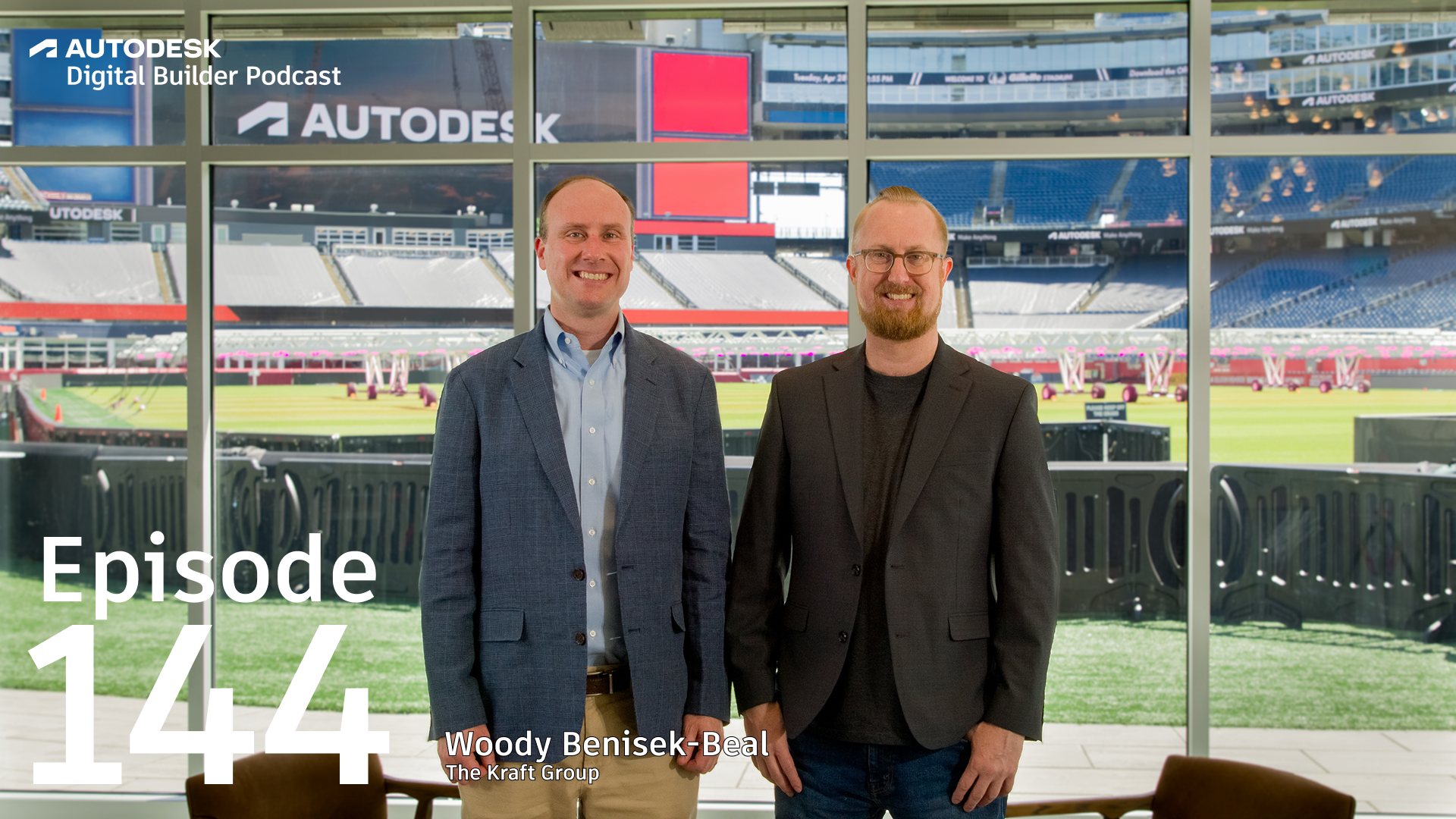
On this episode, I sit down with Woody Benisek-Beal, Director of Construction at The Kraft Group, the company that owns and operates Gillette Stadium. Woody and I talk about what it takes to manage construction at the stadium, given that it never truly shuts down. We cover how his team balances the fan experience during renovations around live events, along with the tech that powers it all.
We discuss:
What makes managing construction at Gillette Stadium so challenging is that the venue never really stops operating. As Woody puts it, “there are things going on in the stadium all the time.”
Beyond football games, the venue hosts concerts, corporate functions, birthday parties, and countless other events throughout the year.
As such, construction teams can’t just “slap up a couple of fences” and work without disruption. Every project requires coordination across operations, facilities, security, and event teams.
“You’ve really got to be on your A game in terms of communicating,” Woody says. In an environment this active, even small changes require teams to think several steps ahead before they do anything.
Having lots of meetings often gets some flak because people associate them with conversations that could've been an email. But at Gillette Stadium, those syncs are truly necessary because every group views the venue through a different lens.
Security teams think about safety and access. Operations teams focus on event flow. Facilities teams worry about maintenance and logistics. Construction teams are trying to keep projects moving. Bringing everyone together regularly helps prevent surprises and keeps projects from disrupting the experience for fans, staff, and event crews.
“We force ourselves to communicate,” Woody says. That includes recurring meetings with event managers, facilities teams, operations staff, security personnel, and construction leaders to make sure everyone stays aligned.
Those conversations often focus on the small details that can become big problems if teams aren’t coordinated. They ask questions like: “Do they know we’re coming in here to rip a wall down? Does security know that because we’re going to have to take a security camera off the wall?”
As Woody explains, “There’s no way that one person could manage all of this at the same time.” It takes a coordinated team effort to keep a live venue running while construction continues around it.
For Woody, the biggest challenge between design and execution isn’t necessarily the construction itself. It’s making sure everyone understands what’s actually being built—and believe it or not, that’s easier said than done.
People who work in design and construction every day can look at a plan set, a model, or a dimension and instantly understand the space. Operators and non-technical stakeholders often interpret things differently.
As Woody explains, “Four feet feels different to a lot of different people.”
A dimension on a drawing may technically work, but once people move into the finished space, the experience can feel completely different from what was expected. A clearance between a railing and a seat row might seem fine on paper, but operators may realize later that it impacts traffic flow, visibility, or fan movement in ways they didn’t anticipate.
That’s where visualization tools and model-based workflows become critical. Woody says getting designs, concepts, and construction drawings into model environments helps bridge the gap between technical and non-technical stakeholders.
“People are very visual,” he explains. “People who aren’t technical get a lot more out of this process when we’re able to show them what they’re going to see when they move into the space instead of just describing it on a two-dimensional plan.”
Like many construction teams, The Kraft Group didn’t overhaul its tech stack overnight. According to Woody, the team is still evolving how it manages information, drawings, and workflows across projects.
“We’re doing a little bit of crawling before we walk,” he says.
Today, the group uses Autodesk Forma to improve visibility into projects, track updates, and collaborate with design teams and general contractors. That includes reviewing models, managing RFIs and shop drawings, and staying connected to what’s happening during design and construction.
For Woody, one of the biggest improvements has been simply making information easier to access.
He shares a story about a utility drawing he originally created as a civil engineer more than 20 years ago. The drawing suddenly became relevant again while teams were preparing infrastructure work related to the FIFA World Cup. Facilities teams needed to confirm what utilities existed underground before installing grounding rods near electrical equipment.
A few years ago, tracking down that information could have turned into a lengthy search through old folders and outdated files.
“It would have taken time to sift through old information, and that might have taken half a day.”
Now, the information lives in Autodesk Forma, where teams can quickly locate the right files and verify they’re working from the latest version.
Digital twins are becoming a bigger part of how owners and operators manage complex facilities, but building one at the scale of Gillette Stadium is no small task. For The Kraft Group, the process has been years in the making and continues evolving alongside the stadium itself.
Building a digital twin years after construction
When people think about digital twins, they often picture brand-new buildings designed entirely in modern BIM workflows. But at Gillette Stadium, the process has involved stitching together decades of information across projects, renovations, and systems.
According to Woody, the team started with “22- or 23-year-old 2D CAD drawing sheets, PDFs,” along with a 3D CAD model that hadn’t been updated in years. From there, they layered in hundreds of stadium improvement projects and newer Revit-based workflows to gradually build a more complete digital representation of the facility.
“It’s really coming along,” Woody says. “Having the digital twin as a tool to allow us to access the information immediately is huge.”
The process has also exposed gaps in older documentation. “It’s forcing us to really double-check what we’ve got,” he explains. “We’re noting things that aren’t correct that may have just been sitting in the background.”
Faster decisions during live events
One of the biggest operational opportunities involves maintenance and facilities management during live events.
Woody shares an example involving a plumbing issue during a football game. Today, if water starts flowing out of a restroom, facilities teams first need to assess the issue, identify the fixture, locate replacement parts, and track down the right information before repairs can begin.
“That just takes time,” Woody says.
The goal is to eventually connect that information directly to the digital twin. A facilities manager could pull up the restroom in the model, identify the exact fixture type, verify replacement parts, and immediately see whether inventory is available nearby.
Extending beyond operations
The potential applications don’t stop with maintenance workflows. Woody says the digital twin could also support event operations, planning, and even venue sales.
Teams could use it to coordinate event setups, review crowd flow strategies, or virtually walk prospective clients through premium spaces before booking an event.
“The ideas are endless,” Woody says.
For a venue as active and complex as Gillette Stadium, the digital twin is becoming much more than a model. It’s evolving into a shared operational foundation for the people who run the building every day.
Virtual reality and immersive technology aren’t just flashy add-ons for construction teams. Woody sees them becoming a practical part of how projects get designed, reviewed, and communicated in the future.
“It’s going to become hand in hand with how we think of projects.”
Why models still aren’t enough sometimes
Even with highly detailed Revit models and video walkthroughs, Woody says there are still moments when stakeholders don’t fully visualize how a space will come to life once it’s built.
“We’ve created video fly-throughs on some of our larger-scale projects to give people a good sense of depth and space and height,” he explains. “But even throughout the process, some people just don’t quite understand it.”
Woody recalls an example involving a column in the middle of a newly completed room. The column appeared in the model and had been discussed throughout the project, but once the team occupied the space, they realized it had a bigger impact than expected.
“We may or may not rework it,” he says. “We may try to make it smaller.”
VR helps people experience the space earlier
That’s where XR and VR tools become valuable. Instead of asking stakeholders to interpret plans, renderings, or dimensions, teams can place them directly inside the environment before construction progresses too far.
“Having the model visible through a headset, we could have been standing in that room as the structure was coming up,” Woody explains. “Or frankly, before we even came up out of the ground.”
The opportunity is less about the novelty of headsets and more about improving decision-making earlier in the process.
“People will get so much more out of our conversations when we’re describing what a space will look like if they can get into the space,” he says.
A tool that the next generation may adopt naturally
Woody also believes immersive technology could resonate strongly with younger construction professionals entering the industry.
“You can tell they’ve got an eye on gaming,” he says, referring to the way modern VR systems are designed and navigated. “Folks who are just coming into the working world now, I think, will pick that up like a lot of other technology.”
As VR hardware becomes lighter, cheaper, and easier to use, Woody sees immersive design reviews becoming increasingly normal across construction workflows.
Digital Builder is hosted by me, Eric Thomas. Remember, new episodes of Digital Builder go live every week. Listen to the Digital Builder Podcast on:
or wherever you listen to podcasts.