Construction innovation doesn’t happen in a vacuum. From company founders who identify pain points and solutions to project teams who test those ideas in the field and decide what actually sticks, there are several parties that shape how the industry evolves.
Another key group? Investors. As the people who fund new ideas and back emerging technologies, investors help determine which solutions get built, scaled, and brought to market. That’s why it’s worth stepping back and understanding how the investment side of the industry thinks.
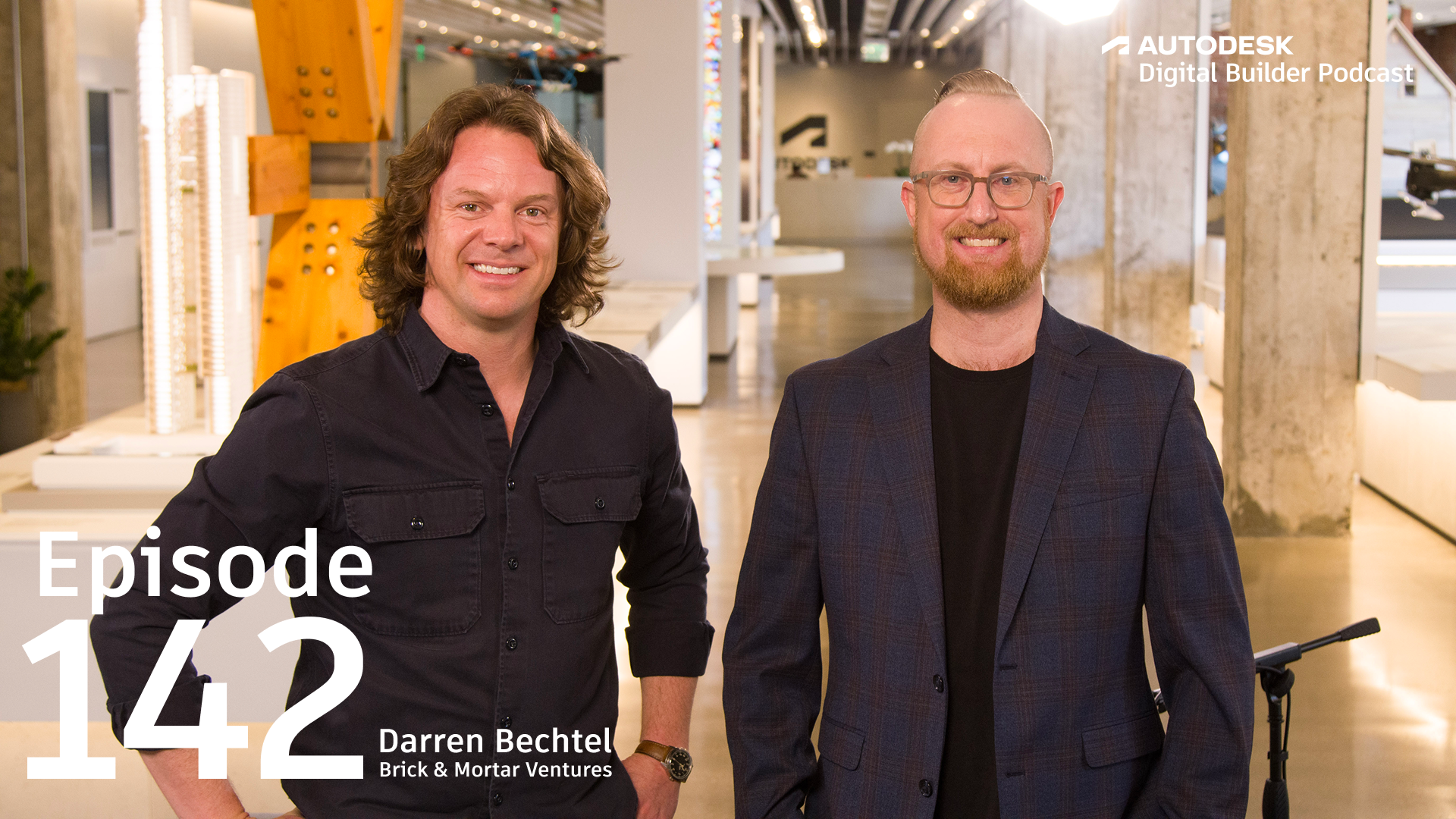
With that in mind, the latest episode of Digital Builder features Darren Bechtel, Founder and Managing Director of Brick & Mortar Ventures. As someone who sits at the intersection of capital and construction, he has a unique perspective on risk, innovation, and what actually moves the industry forward.
If you want a clearer view of how innovation in construction gets funded, scaled, and challenged, this conversation is a good place to start.
We discuss:
Venture capital plays a behind-the-scenes role in shaping what gets built and what companies make it to market. In the case of Brick & Mortar Ventures, Darren describes the firm as “the construction tech VCs.”
“More accurately, we say that we invest in emerging technology that helps the world improve the way that we design, build, operate, and maintain the built environment,” he explains.
Brick & Mortar Ventures invests early, often at seed or Series A, when companies are still figuring things out. “We typically invest during pre-revenue or negligible revenue. We like getting involved where we can still help refine the initial product and the go-to-market strategy.”
That early stage, of course, comes with risk. But the upside is just as real. As Darren points out, “The hope is that the winners, those that succeed, cover all of the losses and then some. As a rough generalization, to be considered good at what you do, you're trying to take whatever size fund you have as a VC and 3X that or 4X that over a 10-year fund life.”
Historically, the construction industry hasn’t been known for being tech-forward. But that’s been changing in recent years, and there’s plenty to be excited about. Darren, for his part, is energized by just how much ground construction tech actually covers and the kinds of problems it’s starting to solve.
It’s bigger than people think
From the outside, construction tech can look niche. But that’s not how Darren sees it. “It’s close to a sixth of global GDP, and it spans everything from enterprise software to novel materials, to robotics, to new business models.”
In other words, it’s everywhere.
That breadth is what makes it exciting. There’s no single lane. You’ve got digitization on one end and entirely new ways of building on the other.
Real solutions that actually get used
Darren points to early wins like PlanGrid as proof that the industry is ready for innovation. But only if the tech solves a real problem.
“PlanGrid proved construction was ready to change its ways and embrace technology that was purpose-built and helped people out in the field, not just help the bottom line.”
Founders who truly understand the work
Then there’s the people. Specifically, startup teams who spend time in the field, talk to real users, and truly understand their needs.
That’s why Darren’s advice is to lead with curiosity, instead of making assumptions or simply building a solution straightaway.
“Showing respect to all the different stakeholders and real subject matter experts is critical. And I think that's just a good lesson in life too: It’s best to approach things with humility, and ask more questions than talk.”
With LLMs and AI assistants making it easier than ever for non-technical people to create software and websites, some folks might be wondering: Should teams just vibe code their own software?
The short answer, according to Darren, is: it depends.
There’s no denying how exciting this moment is. As Darren puts it, tools like this are “almost energizing and intimidating all at the same time.” People with little to no coding experience can now spin up something that looks “game day ready.”
But just because you can do something, doesn’t mean you should.
“The fact that people who did not possess a skill can do a new type of work is really cool. But it doesn't necessarily mean it's what they should be doing. Nor does it mean that what they're producing will be able to keep up with the rigorous demands for an enterprise-grade client.”
Where vibe coding may make sense
For Darren, some use cases for vibe coding in construction include:
In those moments, having “something that works right now” can deliver immediate ROI.
It’s also worth noting that even if you don’t build production software, learning these tools matters. As Dan points out, these tools help teams “dream a little bit bigger” and better understand what’s possible.
When people think about construction innovation, software usually gets the spotlight. But there are also a lot of innovations that are designed to shape what’s happening at physical construction sites.
Rethinking how things get built
Construction has always been shaped by human limits. As Darren explains, “most of the ways that we have designed and built the built environment are because of the limitations of human workers.”
Think: material sizes, weights, even shapes. Rectangular everything isn’t just a design choice; it’s what people could actually handle and assemble.
But all that is starting to change. With new hardware and fabrication methods, “you can now dream in a different way.”
3D printing is opening new doors
3D printing is a perfect example. What used to be complex, expensive, or flat-out unrealistic is now possible.
Darren points to a portfolio company creating 3D printed exterior wall panels. They’re not just printing shapes, they’re layering in structure, insulation, and finish. The result? Designs that would have been cost-prohibitive before are suddenly within reach.
If you ask Darren, there’s no single trend that defines the future of construction. However, he does see a few themes that are starting to take shape.
AI becomes table stakes
First, AI isn’t going anywhere. “I do believe that AI will become table stakes and just ubiquitous,” he says.
One of the ways we’ll see the biggest impact of AI is in preconstruction and design. For years, the industry has struggled with fragmented and unstructured data. Now, those same messy datasets are becoming an asset.
“What’s really good at working with unstructured data… It’s a very exciting time to see how much value can be unlocked.”
Instead of relying on gut feel, teams can surface insights faster, compare past projects, and make better decisions before breaking ground.
A more connected jobsite
Another big shift: real-time visibility.
“We’re starting to see the full potential of the connected construction site, the connected worker, connected equipment, and connected tools.”
Darren continues, “When project managers have visibility into what is happening now, not what happened two weeks ago, and they have that global view across multiple projects and then down to the individual worker level… that’s when things get really exciting.”
That level of visibility unlocks productivity gains that construction has historically missed compared to manufacturing.
More standardization, less guesswork
There’s also a push toward standardization.
Darren raises a simple question: Do we really need every building to be unique? Or can we take a more product-driven approach?
“We really should be designing and building housing like a consumer product.”
That doesn’t mean eliminating choice. It means creating better systems, repeatable components, and higher-quality outcomes at scale.
Automation isn’t optional anymore
Finally, labor.
The shortage isn’t temporary. “It’s structural, not cyclical,” Darren says.
That’s why robotics, automation, and tools that extend human capability are becoming essential. Not just for productivity, but for safety and accessibility.
Digital Builder is hosted by me, Eric Thomas. Remember, new episodes of Digital Builder go live every week. Listen to the Digital Builder Podcast on:
or wherever you listen to podcasts.