We often talk about the importance of being nimble, adaptable, and forward-thinking. Many construction leaders will agree that companies exhibiting these traits are in a better position to succeed.
Of course, telling organizations to innovate and move faster is easier said than done. From challenges with change management to organizational drag, it can be tough to take meaningful action.
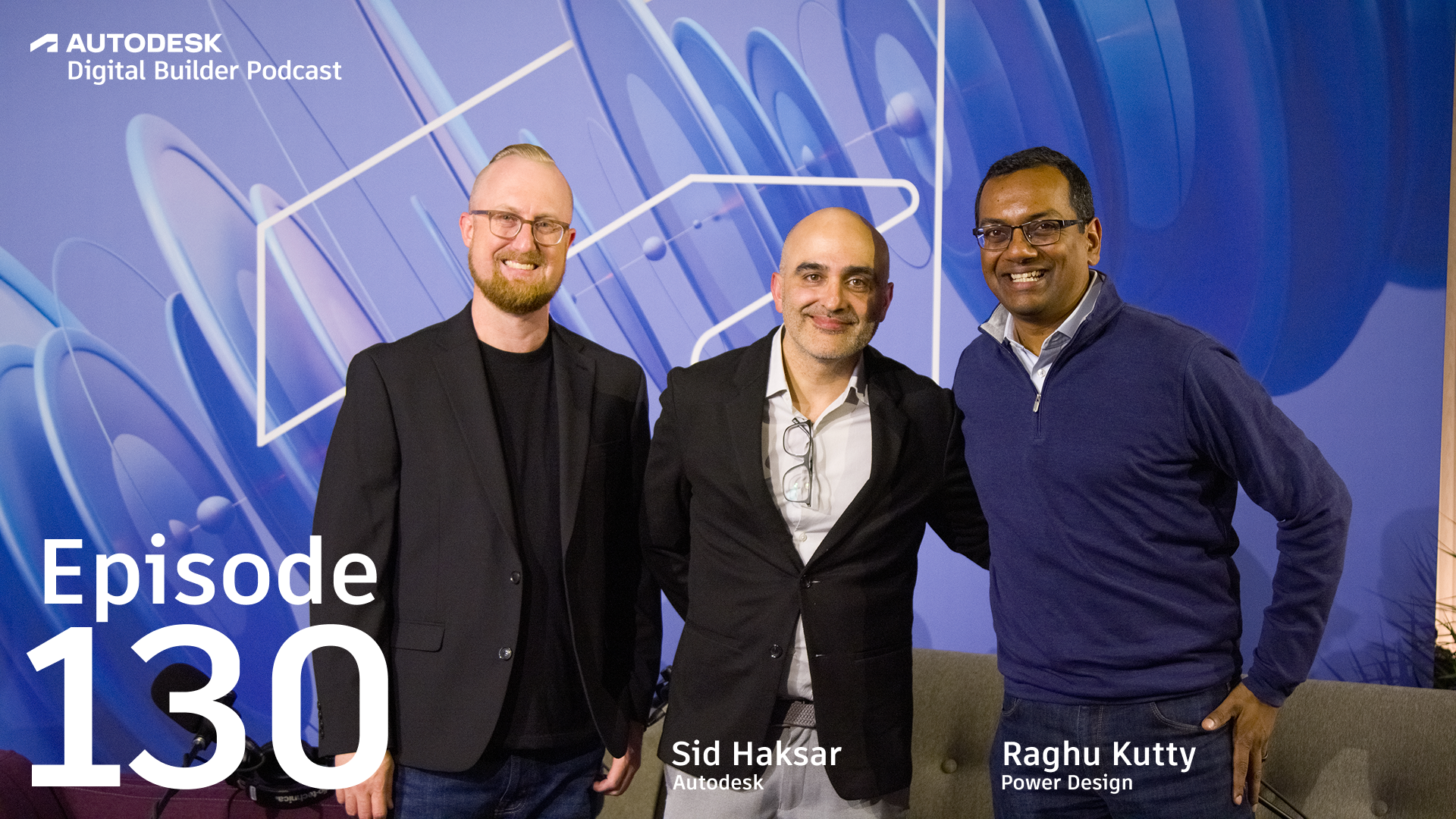
So if you're looking for inspiration on how to make real progress without losing your footing, this episode is for you. I'm joined by Power Design CTO Raghu Kutty and Autodesk's very own Sid Haksar to talk about what it really looks like when a specialty contractor leans into innovation.
Power Design's "one office, one culture" approach is rare at their scale, and it's driving consistency, high performance, and some of the most deliberate tech adoption we've seen in construction.
Power Design stands out because the company has made some very intentional choices about how it operates as a large specialty contractor.
As Raghu puts it, they're a "multi-trade subcontractor" working across 28 states, taking on 350 to 400 large commercial projects a year with roughly 3,000 employees and another 3,000 to 5,000 production partners.
But the real differentiator is how they're structured. Instead of regional offices and separate ways of working, the company runs everything through one unified model.
"We have one standard, one set of books, one team structure, one culture, and no regional subcultures. That translates to quality improvements on the job site as well as employee satisfaction."
The results of Power Design's strategy speak for themselves.
"One of the stats that I'm very proud of is the low EMR rates that we have. We have a 0.52, which is incredible in the construction world, and that happens because of a deliberate approach that we take to the way our company is structured," remarks Raghu.
Sid has seen this up close many times.
"Every time I visited, I left thinking, 'Wow, this is probably one of the most innovative companies I've seen.'"
"They really live and breathe innovation, from prefabrication to running their own fleets and being as vertically integrated across the supply chain as possible. The entrepreneurial spirit of the founders permeates the entire organization."
If there's one thing we can all count on, it's that uncertainty isn't going anywhere. Whether it's the economy, the labor market, or global events that throw entire schedules off course, something will always shift under your feet.
This is something everyone grapples with, and while some organizations stand still or let things happen to them, Power Design has been very intentional with getting ahead and staying on top of risks.
Raghu describes it as "taking control of our destiny."
For Power Design, that starts with understanding what truly matters to customers and then building the business around it. Supply chain challenges were a big one. Raghu walks through everything from the COVID era to today's tariff pressures and how material management is often where contractors get stuck. Instead of accepting that, they established an in-house switchgear manufacturing division. He calls it "a game changer," especially when switchgear delays were breaking project schedules across the industry.
Power Design has taken the same approach with trucking, owning last-mile delivery so teams can hit tight delivery windows without relying on third parties.
"We have Power Design trucks on the road to support last-mile delivery. This is especially important in urban locations where you have to deliver at a particular window." Raghu explains.
"Having our own trucks that can guarantee delivery to job site superintendents makes the entire process so much better and faster."
Operating at a high level requires robust technologies. And for a company like Power Design, which runs on standardized, controlled workflows, a unified platform built for the field is a must.
As Sid puts it, "You're field first, you're mobile first." He says that firms should strive to make life easy for job site teams "because there's enough chaos and there's enough unknowns that you deal with on a daily basis."
The other component, he says, is data accessibility.
"How can you surface information quickly when you need it? Things are happening, and you have to make decisions in real time."
According to Sid, the most seasoned folks can make decisions based on gut instinct because they have extensive field experience. But this is quickly shifting, as workers retire and newer people enter the industry.
"I think it's essential to surface the right information at the right time, while also having a form factor that you can easily access information in a simplistic manner, with fewer clicks."
But the conversation goes deeper than convenience. "At the end of the day in construction, it's all about risk," Sid says. A unified platform helps teams see issues earlier, reduce uncertainty, and make faster calls. And now that AI is becoming part of everyday workflows, that single source of truth matters even more.
Raghu has been in construction for about two decades, and he's seen the industry go through a few major shifts. Early on, the biggest challenge was getting data off the job site in a usable way. "Data capture and usability form factors at job sites were a pain," he recalls.
Today, the problem is the opposite. Teams have more data than they know what to do with. You're swimming in photos, models, documents, and daily reports. The question is how to turn all of it into something useful.
That's where Raghu sees AI stepping in. When generative AI started accelerating in the last few years, what caught his attention was its ability to digest structured and unstructured data.
"It solves a very pivotal challenge that exists in construction," he says. Reality capture is a good example. Power Design uses tools like OpenSpace, and instead of dealing with hundreds of loose photos, they now have geolocated images that time-lapse automatically and can be analyzed much faster.
Beyond that, Raghu also touches on agentic AI, noting its potential not only to analyze data but also to act on it and implement workflows.
To get ready for that future, Power Design has focused on the fundamentals. Clean data. Consistent workflows. A unified platform.
"We have to platformize our technology stack. We've got to move away from some of these edge applications and get into the clean data model. Autodesk was one of those pivotal strategic decisions we made. We moved to the Autodesk platform because it enables us to open up and unlock all these capabilities that AI can provide."
That being said, the tech is only half the story. The workforce needs to be ready too. Raghu believes companies will differentiate themselves by "resiliency and speed." Change management, training, and building an adaptable culture will separate the teams that thrive in the AI era from those that fall behind.
Digital Builder is hosted by me, Eric Thomas. Remember, new episodes of Digital Builder go live every week. Listen to the Digital Builder Podcast on:
or wherever you listen to podcasts.