Research and development teams don’t always get the spotlight, but they play a huge role in where our industry is headed. R&D folks sit at the very forefront of tech development, and this puts them in the best position to anticipate what’s coming next.
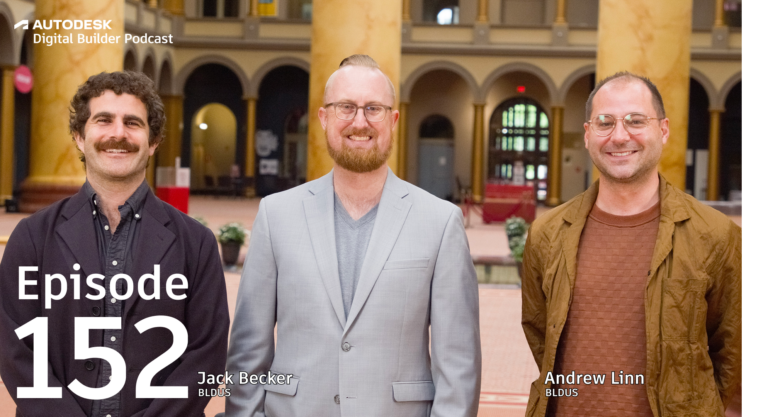
It’s always exciting to hear what they have to say, and this episode of Digital Builder allows us to do exactly that. I’m joined by Fope Bademosi, Circular Economy and Construction Researcher at Autodesk, and Lorenzo Villaggi, Principal Research Scientist, also from Autodesk.
Fope and Lorenzo pull back the curtain on what the Autodesk Research team has been working on, shedding light on future-focused projects around AI and sustainable construction.
Here are some highlights from our discussion.
We discuss:
As the team responsible for exploring new technologies, Autodesk Research works years ahead of where the industry is today.
“Autodesk Research explores how technology can be applied to emerging design and make challenges to prepare our industries for the coming future. What's unique about our approach to research is our teams are working five to 10 years ahead in the future across all the industries that Autodesk serves,” explains Fope.
Fope and Lorenzo focus specifically on AECO, and they collaborate with internal and external stakeholders to turn long-term ideas into applied research. One example of this can be seen in the Autodesk Research residency program, which houses a community of innovators from academic, industry, and entrepreneurial sectors.
“This allows us to cross-pollinate ideas that end up being applied research projects. We try to prove and test our workflows on actual construction and design challenges. And the Autodesk Technology Center is where these research projects come to life.”
Beyond working ahead of the curve, Lorenzo says that the ability to test ideas directly with customers sets the team apart.
“We’re in a unique position, and it’s a privilege to be thinking so far ahead in the future. We explore the possibility to test things directly with customers, being right there in the industry, doing research in the field.”
AI is top of mind for any futurist, and the Autodesk Research team is no exception. One of their key focus areas, as far as AI is concerned, is sustainability.
Why? Because the numbers are hard to ignore. As Fope points out:
“We've been thinking a lot about AI for net-zero buildings in the past years or so. And one way to achieve net-zero carbon buildings is to reuse as many materials and buildings,” shares Lorenzo.
According to him, the team has developed two AI innovations that help make reuse more practical and easier to act on. The first is a solution that assesses existing buildings by leveraging limited and multimodal data. The second AI innovation is all about using AI agents to develop low carbon wall assemblies.
Let’s explore these in more detail below.
An AI tool that predicts what’s inside a wall
Have you ever opened up a wall only to be surprised by what’s inside? Let’s say you’re working with an existing structure and are tasked with identifying materials that can be reused. Doing this can be difficult because you rarely have the full picture. Much of what matters is hidden behind walls or ceilings.
This is one of the challenges that Autodesk Research set out to solve.
The team developed a prototype that lets users point a tablet at a wall and see, in real time, what materials and systems may be hiding inside, almost like X-ray vision.
"What we're showing here is just the final step of this AI tool that predicts what is inside the wall. It’s the result of a custom large language model workflow we devised. We mix limited and multimodal data together, and this is data that is typically available with existing building projects,” explains Lorenzo.
Beyond simply revealing what’s behind the drywall, the tool is designed to support better decisions much earlier in the process. And according to Lorenzo, this tool is just one step in a bigger pipeline of innovations that help teams move from assessment to action.
“We start with step one, which is predicting what is inside the walls or the material composition of an existing building. And then we derive an inventory of materials. From there, it’s about helping teams make use of the information, so they can start designing low carbon assemblies that involve reusable materials,” Lorenzo explains.
“With all of this in mind, we believe that this can really help us achieve our goal, which is ultimately helping architects achieve low carbon futures,” he adds.
In addition to sustainability, the tool can also enhance the crew’s safety. Fope points out that existing buildings often contain materials crews would rather not discover the hard way.
"I think we also see a future where the tool becomes used on projects and it's able to also predict and identify the presence of hazardous materials. We're talking about old buildings that have been around before LED and asbestos were forbidden. That could also evolve into a tool like that," she says.
An AI workflow for low carbon assemblies
Once the team understands what materials exist inside a building, the next question is obvious. What do you do with all of it? That is where the second AI innovation comes in.
This part of the research focuses on designing low carbon assemblies that make use of reclaimed materials, not just in theory but in practice. Fope describes it as the third step in a broader workflow, one that moves teams from insight to action.
“This is step three of our workflow, where we’re leveraging AI to be able to generate and design low carbon assemblies that integrate these existing materials,” she explains.
The process starts with intent. Users prompt the system with what matters most for their project. That could be cost, carbon reduction, performance targets, or a mix of all three. They also define project requirements, such as insulation values and fire ratings. From there, a group of AI agents goes to work.
“It’s a multi-step agent process,” Fope says. “You have a supervisor agent, a research agent, the designer, and others. Based on the user intent and the project requirements, it comes up with the best possible new design that integrates some existing materials.”
The system does not assume everything should be reused. New materials still play a role, especially when performance or code requirements demand it. The difference is that the AI actively looks for lower carbon options. It pulls from databases like 2050 Materials and EC3, giving teams access to EPDs and performance data for materials such as cork or mycelium-based products.
“It also gives you all the information like the carbon calculation, the performance ratings, and all of that,” Fope explains. “So, it gives you different options. You’re able to pick what’s best for your project.”
Fope also stresses that the designer stays in control. “This is an iterative cycle. It’s not final,” she says. “The decision lies in the hands of the designer.”
Under the hood, those decisions are shaped by multiple agents working together. Lorenzo describes it as a collaborative loop between humans and machines.
“We’re really interacting and collaborating with the machine,” he says. “We’re human agents working with machine agents. You can say, ‘I’d like to swap this with something less carbon intensive,’ and the agents go back to work.”
The goal is not automation for its own sake. It is about giving teams better options, faster, and making low carbon design a practical starting point rather than an afterthought.
Digital Builder is hosted by me, Eric Thomas. Remember, new episodes of Digital Builder go live every week. Listen to the Digital Builder Podcast on:
or wherever you listen to podcasts.