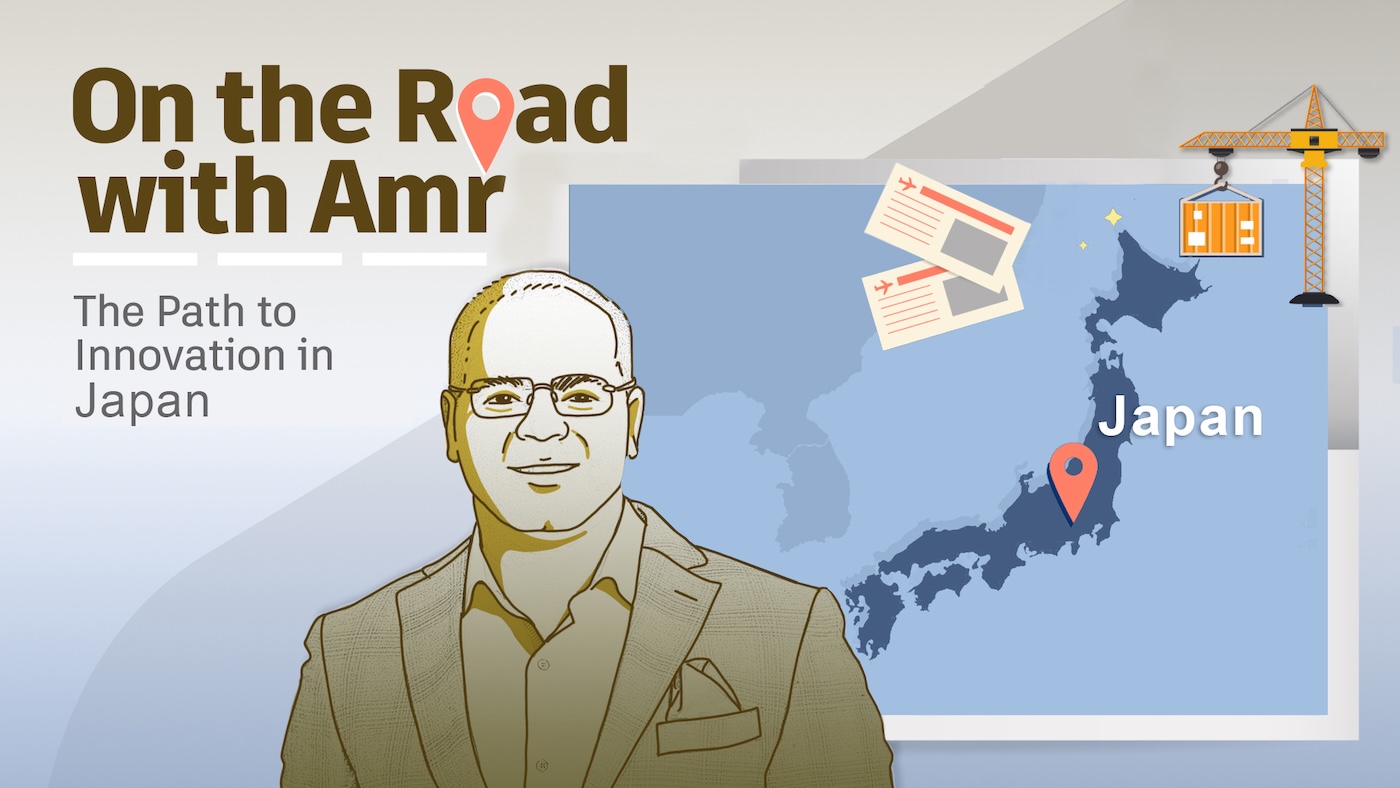
Walking through Tokyo’s bustling Shibuya district, Osaka’s colorful canal-side streets, or the historic temples of Kyoto, I quickly realized that Japan’s built environment is more than concrete, wood, stone, glass, and steel. It is a living demonstration of how technology and tradition can coexist and strengthen one another.
Kyoto, with its centuries-old shrines and wooden townhouses, shows that durability and respect for craft are not abstract ideals but daily practices. Meanwhile, Tokyo and Osaka together reveal how those principles can evolve into digital futures. They form the backdrop for my latest On the Road with Amr, conversations with leaders from three of Japan’s most influential construction firms: Takenaka Corporation, Shimizu Corporation, and Daiwa House.
At Shimizu Corporation, Jun Okoshi, Section Chief of BIM Engineering–Digital Construction, describes a future defined not by flashy breakthroughs but by removing what slows construction down. “Ultimately the goal is to reduce 50% of routine tasks at construction sites,” Jun said.
Robotics and automation are part of the answer, though Okoshi noted they are “still in the middle stages.” The bigger change is cultural, a willingness to embrace innovation. Digital tools woven into long-standing analog practices are beginning to reshape mindsets. Where teams once bounced between paper and software, BIM now integrates processes across design and fieldwork. “With the emergence of BIM, it has become possible to integrate with various tools… BIM has indeed changed the world,” Okoshi reflected.
Watch the interview with Jun Okoshi, Shimizu Corporation
Takenaka Corporation speaks the same language of connected workflows but approaches it differently. Hideaki Takimoto, BIM Group Leader, explained that the strength of tools like Autodesk Construction Cloud (ACC) lies not in a single feature but in their ability “to integrate and streamline with various tools within one source of truth. Schedules, issues, RFIs, and model coordination are all areas where strong collaboration is essential.” The goal is to make data flow, not pile up. “To connect data is the key,” Takimoto said, pointing to new pipelines between ACC and platforms like Power BI that let everyone from site managers to executives make decisions from the same dashboard.
Takenaka’s BIM Secretary, Tsuyumine Momoe, added that innovation comes from listening to onsite teams and using AI to support areas that need help. This creates a cycle of documenting lessons, learning from them, and digitizing knowledge so the next person can build on it.
Watch the interviews with Hideaki Takimoto and Momoe Tsuyumine, Takenaka Corporation
At Daiwa House, Japan’s largest homebuilder, the challenge is scale. Team Leader Kohtaro Kawakatsu said the company has “fully adopted BIM during the design stage” and is now extending it into construction and handover to unlock the benefits of digital twins. The results are already visible. “By visualizing workflows, the speed and precision of information between the office and the field have improved,” Kawakatsu said. Redundant data exchanges, once a drag on projects, have been “reduced by about 70%.”
BIM Manager Yoshinori Shimizu calls BIM “a common language that connects design, procurement, and the construction site.” Successful pilot projects are being turned into company standards, converting site-level wins into everyday practice. According to Kawakatsu, the past five years were about preparation. The next five will be about integration, embedding accountability, transparency, and collaboration into daily operations.
Watch the interviews with Kohtaro Kawakatsu and Yoshinori Shimizu, Daiwa House Industry
Across these conversations, the themes are clear. Reduce routine tasks. Connect data. Listen to the site. Record both failures and fixes as lessons learned. Use BIM not just as siloed files or a tool, but as a hub for communication. Treat platforms like ACC as a single source of truth. And above all, ensure innovation serves the people who build to tackle real challenges on real projects.
For these powerhouse firms, keeping BIM innovations practical leads to less rework, fewer delays, and fewer blind spots between office and field. The deeper ambition is cultural, changing the industry’s mindset as much as its toolset.
“Construction is a truly enjoyable field,” Daiwa House leader, Kawakatsu, reflected. “Making things is inspiring. But on-site workers are always busy, pressured by deadlines and costs. Under all those constraints, people can’t think freely or creatively. What we need is to improve that, to create a culture, and build people, so we can drive transformation.”
Together, these conversations reveal a unifying philosophy: innovation in Japan’s AEC industry is not a break from tradition but a continuation of it. The unwavering work ethic, respect for detail, and commitment to building for generations are being accelerated, not diminished, by advanced technologies. Kyoto’s temples endure as reminders of longevity and craftsmanship. Shimizu channels that spirit into data-driven workflows. Takenaka advances by tackling real-life challenges onsite and streamlining communication between the office and the field. Daiwa ensures that industrialized methods and innovative workflows at scale enhance human well-being rather than diminish it.
What I find fascinating is not only the leading-edge use of technology, digital twins, IoT sensors, generative design, or modular systems, but also the philosophy guiding their use. Excellence is treated as a duty. Buildings are envisioned to endure for generations, carrying forward the values of their builders. Innovation is measured by how well it serves people, not just the success of the project.
This is the lesson Japan offers the global AEC community: measure success not only by budgets or schedules, but by legacies. Build not just for today, but for generations to come.