Data centers are an integral part of today’s technology infrastructure housing the vital systems and data storage facilities which provide many digital services which most people now take for granted. They’re also a huge undertaking – data center construction requires proper planning, design, and resources.
Globally, demand for data centers is increasing, thanks in large part to the popularity of cloud computing and the rise of artificial intelligence services, and the substantial increase in data consumption as a result.
According to Oxford Economics, the construction of data centers only accounted for 5% of office construction spending in 2014, but by 2024 this had risen to 32%, and is predicted to grow further to a considerable 40% of office construction by 2028. The report notes that some of the main commercial drivers for this rise in the number of data centers come from the information, professional, and financial services sectors.
Additionally, energy consumption has risen in correlation with this demand highlighting the need for even more sustainable construction processes for data centers.
In this guide to data center construction, we’ll take a look at the following:
Table of contents:
A data center is a building which is dedicated to housing the computer systems and related hardware (particularly storage systems and networking infrastructure like servers, routers and switches). The primary purposes of these often substantial facilities are to house the data, applications, and infrastructure needed by an organization for their operations.
The internal construction of a data center is made up of a variety of key components. The most important are the servers, which are responsible for network connectivity, running applications and handling data. Storage systems, meanwhile, like hard drives, are essential for storing the considerable amounts of data used. Communication between these components and with external users is handled by networking equipment like routers, switches, network cables and firewalls.
In addition to these core components, robust power supplies and distribution units are needed, including backups to ensure an uninterrupted supply to vital data infrastructure. This generates a lot of heat, so adequate cooling systems are essential. Finally, physical and cybersecurity measures are required to prevent unauthorized access to sensitive systems.
There are several key types of data centers:
This type of data center is owned by a single organization and fulfills their internal IT infrastructure and application requirements.
These are responsible for providing cloud services (including storage and computing) to many different customers and are owned by cloud providers like Google Cloud Platform and Amazon Web Services.
Colocation data centers provide a space where multiple businesses can house their servers and networking equipment.
Edge data centers are situated near the edge of a network, these smaller data centers provide faster services to end users and reduce latency (telecommunications delay).
These are particularly large facilities which are built to handle immense needs for data processing by cloud and tech providers.
Building a data center is a considerable undertaking and requires careful planning and design to start.
Often the first step is site selection. As a best practice, evaluating multiple potential locations and following established guidelines is essential to ensure optimal site choice and subsequent planning processes. A systematic practice in site selection and infrastructure planning helps ensure operational efficiency and long-term success.
The choice of location must consider the availability of sufficient power in the area, with data center power consumption ranging between several megawatts for a smaller facility to over 100MW for hyperscale data centers. The level of network connectivity locally is also a primary concern, with sites close to strong fiber infrastructure often chosen. The site’s proximity to end users is also important to reduce latency in services.
Locations that have a low risk of natural disasters should be chosen to ensure business continuity, while the amount of available land for current and future developments and the availability of a skilled local workforce are also important considerations when planning the construction of a data center. Even the local climate can be a factor when choosing a site, as this can impact the level of cooling needed for the data center.
Because of the considerable amount of power and other resources they consume, many local governments have specific zoning categories for data centers, while others may put them in the same category as light industrial developments. With the rapid expansion of data center construction across the country, the question of zoning and permits is an evolving one that varies geographically.
During the data center design process, there are a few key things to consider:
A company's current and future technology requirements play a critical role in determining the size and investment needed for a data center. Before finalizing the design, it is necessary to determine data security needs, server capacity, and physical space requirements to ensure the facility meets all operational demands.
Energy efficiency is more important than ever, and because of the significant energy grid demands of data centers, special care should be taken in their design. Regulatory pressure is also growing, with some states looking at bringing in measures to place additional environmental requirements on data centers.
Staying ahead of the curve by using sustainable materials, green energy sources and aiming for maximum efficiency can help future-proof data center construction designs. Innovations like liquid cooling can help make energy use more efficient, while the use of sustainable materials such as green concrete and cross-laminated timber can reduce the environmental footprint of building a data center. AI can also be deployed successfully to inform decisions-making when it comes to sustainability. According to Autodesk’s 2025 State of Design & Make: Spotlight on Construction report, 41% of construction professionals report they are using AI to optimize energy consumption and efficiency.
Ultimately, data center construction requires a holistic approach to the design process with close collaboration between stakeholders, architects, and engineers. There are many moving parts, alongside the need to communicate clearly, avoid silos and ensure that the ramifications of each part of the design are understood across the board.
The preconstruction planning process is a critical time in data center construction. Detailed cost estimations must be made of every aspect of construction, from land acquisition, architectural design, and materials to labor, material and equipment costs. For capacity planning, estimating costs per square foot is essential to accurately forecast expenses and facility scale. Furthermore, a detailed project schedule should be created to break down the construction timeline into core tasks with realistic deadlines and milestones.
In preconstruction, choosing the right teams for the job is of utmost importance. To meet all quality, security, technical, and compliance requirements, only highly experienced contracting firms are capable of operating in such a fast paced, high stakes environment. Therefore, prequalification and leveraging existing relationships with contractors experienced in data center construction is critical to the success of a project.
With such a complex project, robust risk management planning is also essential, including assessing and mitigating the chance of supply chain disruptions for critical components, foreseeing potential delays, and considering possible environmental challenges on-site.
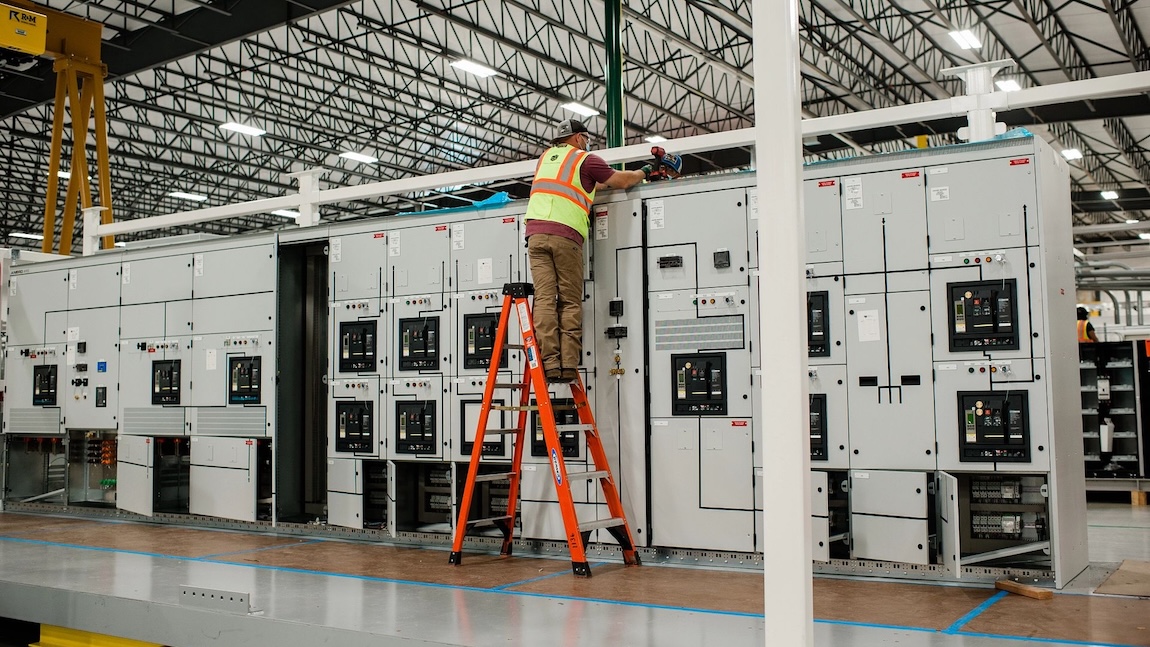
Typically, the construction process for data centers is fast-paced and high stakes especially when it comes to logistics and supply chain management. Data centers generally use highly specialized equipment with long lead times, so proactive procurement is important.
Construction for data centers can be broken down into three building phases:
Depending on the scale of the facility, this can be a considerable undertaking in itself. The site is levelled and cleared to prepare it for construction, then excavations for footings, utility and infrastructure placement begin. Construction begins on sub-floors, and electrical grounding grids are laid to protect equipment.
The core of the building itself is constructed, encompassing the erection of the framework, the building of walls, floors and roofs, and everything else required to create the physical shell of the data center.
This phase is often more complex than other types of construction, with the installation of large amounts of electrical and network cabling, cooling systems, security infrastructure and more adding to the usual setup tasks like plumbing and light installation. The overall cooling system is essential for managing the significant heat generated by equipment. Cooling units, as critical components within the cooling system, ensure optimal environmental conditions and can automatically respond to cooling failures by switching to backup systems.
During the interior setup process, special care must also be taken to prevent static build-ups that could damage or interfere with sensitive data storage and processing equipment.
Once construction is complete, rigorous quality control and inspections are needed to ensure the long-term reliability and safety of the facility during project closeout. This is particularly important in data center construction, as faults can result in considerable loss of data and money.
Data center construction involves a high degree of complex infrastructure which sets it apart from many other construction projects of similar scale. Here are some examples of the technology used:
Data centers generally need phenomenally large amounts of power to run, and this usually comes from several sources. Most data centers draw power from the local electrical grid as a primary source, though some are considering future plans for on-site power generation to keep up with ever-increasing demands. In addition to grid power, data centers must have back-up power systems like diesel generators to keep everything up and running in the event of a power outage. Uninterruptible power supplies (UPS) are used to ensure that power is continuous, and are able to guard against voltage irregularities. HVAC systems are essential for the cooling of networked equipment, with air cooling being the most frequently used method. Liquid cooling, which uses water or other fluids to cool components directly, is gaining popularity for some applications.
A building management system (BMS) plays a crucial role in monitoring and automatically managing critical infrastructure components, including cooling units, to ensure environmental safety and operational efficiency. The BMS can alert responsible parties and automate responses during emergencies or system failures.
By its nature, data center construction involves the installation of large amounts of network infrastructure. There are core components which do the work, like servers, hard drives and other storage systems, and routers. In addition to these, massive amounts of fiber optic and network cabling, switches to connect devices, load balancers and other specialized network components are required.
Data centers usually contain everything from mission-critical corporate data and services to the personal data of millions of customers, so security is paramount in data center construction. Threats can come from the network in the form of cybersecurity threats, but they can also be physical threats like unauthorized access to restricted areas and systems. The former can be protected against with firewalls, data encryption, robust network practices and digital intrusion detection systems. Physical threats can be guarded against with video surveillance, access key cards and perimeter security like fences and barriers.
Data centers are at the cutting edge of computing, and as such there are many emerging technologies that are beginning to be used in their construction. Modular construction is one such innovation, in which pre-fabricated models are deployed on-site and used for scaling up where needed. The use of modular systems can reduce the amount of construction needed on-site and provide greater adaptability to changing needs.
One of the growing uses for data centers is for artificial intelligence, but AI is increasingly being used to optimize the design of data centers, particularly in terms of finding the most efficient layouts for cooling and power distribution.
Renewable energy sources are being widely considered for use in data centers at the moment, in response to their growing environmental footprint, collectively and individually. As already touched on meanwhile, edge computing (building smaller data centers closer to users) is being used to improve performance, and liquid cooling is being used to cool systems more efficiently.
Data centers are amongst the most complex facilities to build, and they require a dedicated and highly-skilled team to run successfully. At the top, the data center manager has ultimate responsibility for the infrastructure, services and staffing, while below them the facilities manager is responsible for ensuring the smooth running, maintenance and repair of the center’s physical infrastructure. Engineers oversee critical operations like adjusting, repairing or troubleshooting vital equipment, while technicians operate and monitor equipment on a day-to-day basis. System administrators configure servers, storage systems and software as needed, while security specialists are responsible for the digital and physical security of the center. Depending on the size of the facility the staff team may feature many other roles.
To ensure that services are always available and that no data is lost, regular proactive maintenance is required. Preventative maintenance is often carried out on key pieces of equipment, while AI-powered predictive maintenance is increasingly being used to identify and correct potential equipment failures before they happen. Redundant systems and components are often implemented to further safeguard against failures. The climate is often tightly controlled and monitored to keep systems operating efficiently and within safe limits, and operational areas are cleaned frequently to prevent build-up of dust and other environmental contaminants which could negatively impact systems.
Most facilities use specialized data center infrastructure management (DCIM) software that supplies an all-encompassing monitoring platform that gives real-time data and control over important aspects, like power, networking and the internal environment.
Because data storage and service needs are constantly growing, data centers need to keep an eye on the future. Modular designs mean the facility can physically grow and adapt when needed, while capacity planning helps to ensure that it has sufficient resources to meet future demand. The data center may be built with plenty of additional rack space left over from the start, or more can be added for expansion later on. Planning for new facilities is also important to accommodate future growth and technological upgrades. Planning for new facilities is also important to accommodate future growth and technological upgrades.
Standardized and carefully managed hardware and software can make scaling up a more straightforward process in data centers, while using scalable network architectures can help to ensure that things run smoothly as demands on bandwidth increase.
There are many challenges in data center construction, especially when it comes to complex problem-solving and addressing technical demands, but with proper planning and contingencies these can be overcome.
Cost overruns can be particularly challenging, and careful cost estimation from the outset can help to reduce this, while a contingency fund can prepare you for unexpected costs, and careful vetting of suppliers can also help.
The complexity of constructing a data center can also mean that there’s plenty of scope for substantial delays to occur due to things like supply chain disruptions and labor shortages. While there may be no way to prevent delays entirely, careful supply chain management and workforce planning can help.
Power distribution constraints can also be problematic, including the availability of sufficient power from the local grid, and the procurement of critical components like generators, switch gear and transformers, which can be hit by supply chain delays. The former issue can be tackled somewhat through careful site selection in areas with plenty of grid capacity, and by close collaboration with utility companies. The latter meanwhile can be offset by proactive procurement well in advance of construction to avoid bottlenecks.
For example, implementing modular construction techniques can help address the challenge of rapid expansion and reduce on-site labor requirements.
Case studies:
Because of the considerable demand on resources created by data center construction, it’s important for the industry to embrace sustainable construction practices that minimize impact on the environment and conserve resources. The use of renewable energy sources like solar and wind to power the facilities represents a major step forward, while utilizing energy-efficient designs can help to reduce power consumption from networks and cooling systems. During construction, a philosophy of reusing and recycling can help make the project more environmentally friendly, and sustainable building materials can be used wherever feasible.
The US Green Building Council has created a rating system specifically for the construction of data centers, known as LEED BD+C Data Centers, while there are a variety of ISO standards that relate to data centers.
Achieving net zero emissions is an emerging goal for many data center owners considering the rising global attention to their environmental impact. Carbon offsetting strategies are helping to reduce the overall impact of data center construction work. Post-construction into operations, more data centers are relying on environmentally friendly cooling strategies and careful temperature management to reduce environmental impact and improve operational efficiency.
Data centers are an ever-present and ever-growing part of modern life, and are used for everything from AI and cloud storage to financial services and e-commerce. The creation of such facilities is a considerable undertaking, but careful planning and management of the construction of data centers can help to ensure efficiency, success and sustainability. Emerging trends like edge data centers, liquid cooling, modular construction and AI-powered optimization are helping to drive the sector forward into the future. As data center construction rapidly evolves, it’s a good idea to stay updated on industry developments and talk to experts who can guide you in the right direction.
With Autodesk Forma (formerly Autodesk Construction Cloud), data center construction can be more efficient, sustainable, and forward-thinking. Harness the power of Autodesk's tools to plan, design, build, and operate state-of-the-art data centers.