Designing the future of work: Skyy Skill Academy’s blueprint for job-ready engineers
Skyy Skill Academy is redesigning engineering education in India with hands-on, industry-aligned training that prepares students for real jobs and the future of work.

Mouncey Ferguson
11 min read
After designing his own education in robotics and drones, Himansu Sekhar Panda founded Skyy Skill Academy to close the gap between traditional engineering degrees and real-world industry needs.
Through live instruction, hands-on bootcamps, and industry-aligned curricula—spanning EVs, automation, and advanced manufacturing—Skyy Skill has trained more than 200,000 learners and helped build 300+ centers of excellence across India.
By emphasizing practical design workflows with tools like Autodesk Fusion, alongside EV, AI, and systems-level thinking, Skyy Skill prepares engineers to contribute immediately to emerging industries and long-term sustainable growth.
In 2010, a mechanical engineering student in eastern India realized he’d have to design his own education. At Centurion University in Odisha—then considered one of India’s poorest states—Himansu Sekhar Panda was fascinated by robotics and drones. But his mechanical engineering program offered no courses in these areas, and online learning was still rare. If he wanted to build advanced systems, he’d have to build his own learning path first.
So he took his education on the road.
Panda traveled to different Indian Institutes of Technology (IITs), sought out professors and professionals working on robotics and control systems, and pieced together a curriculum from conversations and borrowed lab time. Back on campus, he applied what he’d learned—designing drones and other robotic projects that began winning prizes at national events.
Then he did something that quietly changed the direction of his life: he started teaching what he’d learned to others. By his final year, Panda had trained close to a thousand students at his university.
Then the calls started coming. “I used to get calls from different colleges saying, ‘we heard you’re doing workshops and bootcamps—why don't you do one at our college?’” Panda says. “I visited Delhi, Punjab, parts of Andhra Pradesh. I didn’t know exactly what I was trying to do, but I was really passionate about it.”
That early effort eventually became Skyy Skill Academy: a hybrid training program that helps students and emerging professionals build the skills industry actually needs—especially in fast-moving areas like electric vehicles (EVs), automation, and advanced manufacturing. As of 2025, more than 200,000 students have gone through their programs.
Panda set out to teach himself drone design, and in the process, he helped reimagine technical education in India.
A gap between degrees and real jobs
After graduating, Panda joined Triveni Turbines. It was the kind of job engineering students aspire to: stable, respected, and well-paid. But he saw a troubling pattern.
“Hardly 10–12% of people in my class could really get jobs with their degree,” he says. “Friends struggled for years to get a proper job.” Many came from families who had made huge sacrifices to send them to university. Waiting years for a paycheck didn’t just cause frustration—it caused financial hardship.
The problem wasn’t talent or a lack of jobs. It was a disconnect between university curricula and industry needs. Companies wanted people who could work with real machines, tools, code, and systems. Universities were still focused on decades-old theoretical syllabi.
“On one side, institutions kept saying they couldn’t place their students,” Panda explains. “On the other side, companies were saying they couldn’t find suitable candidates.”
In 2018, he left his corporate role and launched Skyrider Institutions—rebranded as Skyy Skill Academy in 2023—to close that gap. The goal: build an agile, industry-aligned training program that could plug directly into India’s technical education ecosystem—and into the country’s fast-evolving industrial landscape.
From local bootcamp to national training model
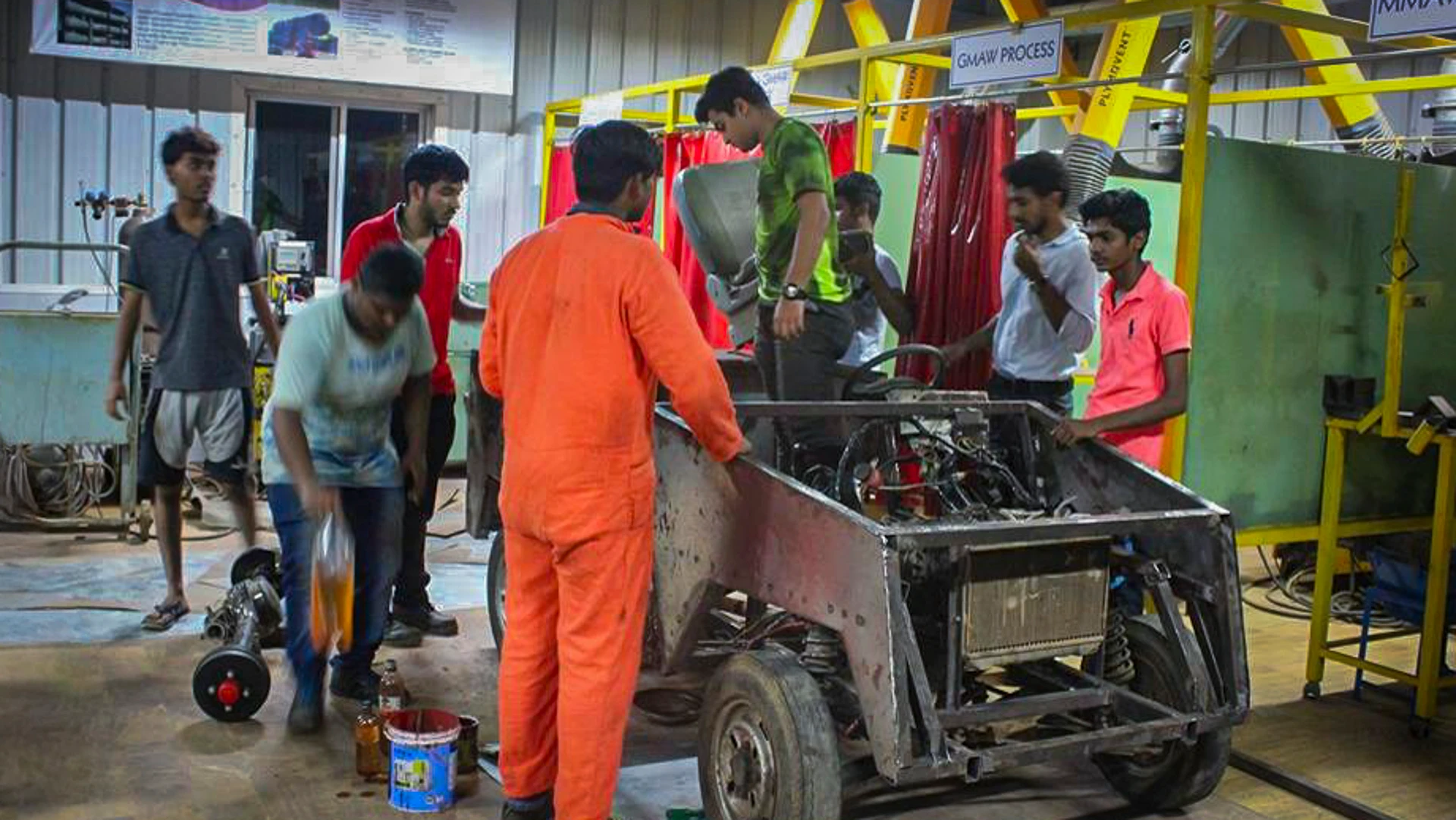
Skyy Skill Academy’s earliest programs focused on automotive design and manufacturing. Students learned to create 2D drawings in AutoCAD, then transform those drawings into real parts and assemblies. The emphasis was on the full design/test/iteration cycle—central to modern engineering but often missing from traditional coursework.
The model quickly gained traction. By 2019, more than 600 students from across India were traveling to Odisha for hands-on training. The team opened a second center in Hyderabad in partnership with GRIET, one of the region’s top engineering colleges.
Then the pandemic forced a sudden pivot. Skyy Skill moved programs online, built virtual labs, and experimented with remote demonstrations. Not everything worked, but one lesson stuck: digital delivery could scale access—if the experience remained live and interactive.
When in-person instruction returned, Skyy Skill combined both modes. Today, 70–80% of learning happens through live online classes, with 20–30% delivered as short, intensive in-person bootcamps at partner institutions in cities including Hyderabad and Mumbai. This hybrid model makes advanced training accessible to learners who cannot relocate or afford long-term residential programs.
Along the way, something unexpected happened: colleges throughout India started asking not just for the curriculum, but for the equipment.
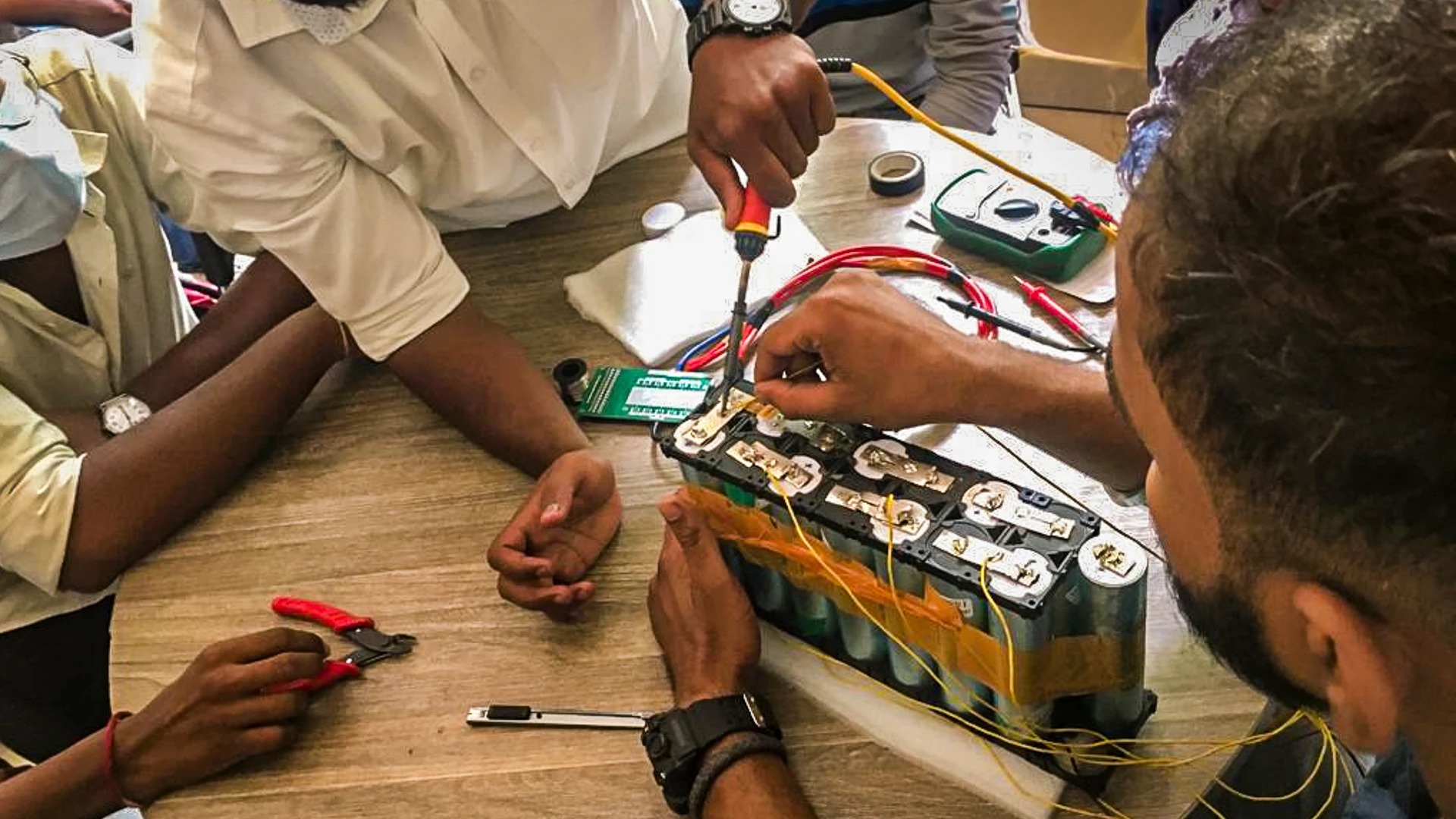
To give students realistic exposure, Skyy Skill had designed its own training rigs and lab setups—especially for electric vehicles and advanced automotive systems. When faculty saw these teaching tools in action, they began asking for permanent installations.
In response, Skyy Skill launched Skyy Skill Labs, a parallel vertical that designs and manufactures industry-standard lab equipment and turnkey training centers. To date, they’ve helped establish more than 300 centers of excellence across India, enabling colleges to deliver hands-on, future-ready education without building everything from scratch.
In both cases—training and labs—the “product” is the same: skills that match what industry will demand next.
Skyy Skill programs today
Skyy Skill Academy now offers programs ranging from short self-paced courses to intensive, job-oriented tracks lasting up to 10 months. Curricula cover automotive and EV technology, embedded systems and IoT, and CAD/CAM and engineering design using tools like Autodesk Fusion.
Some programs are delivered with institutions such as IIT Guwahati and IIT Kanpur, and many include recognized sector skill certifications. But the differentiator isn’t just the content—it’s the structure that surrounds it.
Placement as a design constraint
For Skyy Skill, employability isn’t a side outcome, it’s part of the brief.
Students in job-oriented programs receive unlimited interview opportunities until they secure a role, and tuition isn’t charged until they do. That model creates strong shared incentives: the Academy only wins if its learners get hired.
Enrollment isn’t open to everyone, of course. Applicants must meet a minimum academic threshold (such as 6 CGPA / 60% or above), demonstrate basic domain knowledge for their chosen track, and, importantly, possess foundational communication skills, including English.
Skyy Skill also runs programs for learners who left formal education after 10th or 12th grade—a common path in many Indian villages. These candidates can still gain industry-recognized skills and credentials that make them employable, especially in technician and operator roles.
Live instruction, seasoned faculty
Unlike many ed-tech platforms built around recorded videos, Skyy Skill delivers all training through live, instructor-led classes.
Faculty are selected for real industry experience—typically three to five years or more. Many active professionals teach on weekends or evenings, bringing real-world tools and examples into the classroom. Recorded content supports revision, but live participation is mandatory.
“At Skyy Skill, everything is built around real projects, industry mentorship, and technologies like EVs, IoT, CAD/CAM, and embedded systems,” says instructor Sibasish Panda. “We’re not just preparing students for their first job—we’re helping them build a foundation for long-term careers.”
For graduate Samriddhi Shukla, who got a degree in electronics engineering before attending Skyy Skill, the impact was clear. “My undergraduate program gave me a solid theoretical base, but something was missing on the practical side,” she says. “At Skyy Skill Academy, I learned how to turn those theories into real systems and projects. That hands-on practice was a game-changer.”
Shukla now works as a Sales and Project Manager at Bosch India, applying technical and communication skills honed during the Academy’s hybrid electric vehicle program, where she developed her skills with intelligent modeling and simulation in Fusion, as well as 2D design in AutoCAD. For her, the transition from education to employment felt “surprisingly smooth”—a phrase not often associated with the journey from engineering college to industry in India.
EVs, sustainability, and the future of work
One of Skyy Skill’s most strategic decisions was to prioritize training related to EVs.
India is still in the early stages of EV adoption, but growth is accelerating. Government targets call for a major share of vehicles—especially two-wheelers and commercial fleets—to be electric within the next decade. The market is expanding quickly, but one resource is already in short supply: people who know how to design, build, and service EV systems.
“Even with today’s relatively low penetration, companies are struggling to find trained technicians and engineers,” Panda notes. “If we don’t fix this gap, scaling to the 2030 targets will be extremely difficult.”
Skyy Skill’s EV programs are designed with that entire ecosystem in mind:
Technician-level training for learners after 10th, 12th, or with IIT diplomas covering roles like assembly, battery maintenance, and repair.
Engineering-level programs for mechanical, electrical, and electronics graduates—focused on advanced topics like vehicle simulation and system-level design.
Specialized programs such as EV design and analysis created in collaboration with IITs.
Autodesk tools are central to hands-on learning. “Students use Autodesk Fusion and AutoCAD for 3D modeling, component design, system layout, and simulation,” Panda says. “They sketch, model, analyze, and then translate those designs into physical prototypes during hands-on lab sessions.”
“If India is to meet its electric mobility and emissions goals, it needs more than policy and manufacturing capacity. It needs people who understand batteries, powertrains, controls, and thermal management.”
Through Autodesk education access, students can use Fusion and other Autodesk tools for free during training, making advanced design workflows accessible to students from diverse backgrounds. “This aligns perfectly with our mission of democratizing engineering and education,” Panda says.
“Everything was framed around real-world applications,” says Pramod Tate, who completed the hybrid EV program in 2025. “Working on live projects and simulations gave me the confidence to see EVs as a space where I can build a sustainable career.”
For Panda, EV education isn’t just about jobs—it’s about sustainability and national capability. “If India is to meet its electric mobility and emissions goals, it needs more than policy and manufacturing capacity,” he says. “It needs people who understand batteries, powertrains, controls, and thermal management.”
“When we teach EV technology, sustainability isn’t an add-on—it’s at the core,” Panda continues. “Students need to understand that an electric vehicle’s impact goes far beyond reducing emissions. It includes the materials we choose, how batteries are sourced, how efficiently systems are designed, and what happens at the end of a vehicle’s life.”
“When learners see the full picture, they make better engineering decisions and contribute to an ecosystem that is genuinely sustainable—not just electric.”
Designing in Fusion: Skills that travel across industries
While EVs are a major focus, Skyy Skill training focuses on tools that open doors across sectors.
Autodesk Fusion and AutoCAD anchor many of the Academy’s design and simulation tracks. Students model components and assemblies, run motion and stress analyses, and explore optimization-based workflows. Before software is introduced, instructors emphasize fundamentals like machine design and material characteristics so students understand how analyses translate into real-world decisions.
“The advantage of learning tools like AutoCAD and Fusion is that they’re not limited to one niche,” Panda explains. “Those skills stay valuable across many sectors.”
That blend of fundamentals and software fluency helps early-career engineers contribute quickly, troubleshoot issues, and design more efficient, durable systems—advancing both productivity and sustainability.
Teaching AI as a tool, not a threat
Skyy Skill doesn’t treat AI as an optional add-on. It’s woven into almost every advanced program.
“AI is transforming the nature of work in every field,” Panda says. “In software, it’s relatively straightforward to integrate. In core engineering, it’s more complex—but just as important.”
Students learn to use AI tools to accelerate design and analysis tasks, build simple custom GPT-style assistants to support engineering workflows, and work with early-stage digital twin platforms for EVs—cloud-based models that learn from real data and support research, diagnostics, and insight.
The message is consistent: AI is a capability that engineers must know how to wield. “Our students graduate ready to work with AI,” Panda says. “That’s going to be a key differentiator in the coming years.”
A glimpse of what the future of education could look like
Technology is evolving faster than any static syllabus can keep pace with. Traditional degrees still matter, but they can’t carry the full load of preparing students for fast-moving industries.
Programs like Skyy Skill Academy point to a complementary future: agile, industry-linked institutions that adapt quickly to new technologies, teach the latest tools and workflows, and measure success through employability.
For India, this skilling infrastructure is essential—not only to meet EV and sustainability targets, but to ensure millions of young people can participate in the modern economy.
For the global engineering community, it’s a reminder that the future of work will be shaped as much by how we train people as by the technologies we deploy.
Skyy Skill Academy is still early in its journey. But with each new cohort, each lab it helps build, and each partnership across academia and industry, it contributes to something larger: a workforce ready to design and maintain the sustainable systems the world needs.
“At Skyy Skill, the real product isn’t a course or a lab setup—it’s possibility,” Panda says. “We’re helping young people step into careers that didn’t exist a decade ago, in industries that are being built in real time.”
“When a learner can design, build, and sustain the technologies of the future, they don’t just adapt to change—they shape it,” he continues. “That’s the true measure of impact for us.”
About the author

Mouncey Ferguson
Mouncey Ferguson is a writer, video producer, and multimedia content strategist specializing in events and experiential content development. He’s also a husband and father, a great cook, a so-so rock climber, and an indie filmmaker with a feature still in distribution.