 Eddy Krygiel
The AECO industry has a data problem. The amount of information we need to complete a project – things like our file storage and model sizes continues to grow. We regularly add new data and file types requiring users to know a wider variety of tools to even access the information they need to make decisions on projects.
Why don’t we trust the data we have?
In fact, over a five-year span from 2018 to 2023, our industry’s data storage grew by 767%*. That’s a lot of additional information that our project teams need to digest, understand, and document. Finding the right file or drawing or model you are looking for can be a challenge. Maybe this challenge is why we don’t seem to trust the data we have – we are frequently copying files and deliverables to ensure we have the final or most current version stored in a trusted place.
This is the third article in our series on unpacking the value of a Common Data Environment (CDE), highlighting some of the challenges that face our industry today. In this blog post, we are going to focus on why data needs to be trustworthy. We will look to address the need for project data to be accurate and reliable for all project stakeholders.. All project teams face a critical need to trust in the accuracy of data. We need to know that the information we’re collecting comes from a reliable source with validated and accurate data.
Why data must be trustworthy
I don’t want to paint a bleak picture. There is a lot within our industry that we trust and rely on, but when it comes to consistent BIM data, our trust can begin to fade. And not without reason. There is still a large percentage of information in our documents that can be missing or incorrect – despite the fact that tools like Revit and workflows like clash detection have helped us improve model and drawings accuracy.
In fact, based on a report compiled over eleven years by the Texas DOT, 31% of all change orders are due to errors and omissions in drawing sets**. Basically, bad data. Trust within the model is imperative since most of us now use BIM to create those documents.
The top three things I tend not to trust:
- The ‘Special Offers’ I receive in my Spam email folder
- Paper handles on paper grocery bags
- Someone else’s BIM model
We tend to trust consistency and be wary of things that provide inconsistent results. Most of us visit the same grocery store and shop in the same pattern or drive to and from work or school the same way. We get frustrated when those processes are disrupted, for instance, road construction on our way home.
Design, engineering, and construction is a process of taking standardized elements – like a wall stud – to build unique structures in the world around us. We site adapt buildings and roads – even a spec home has variation from one to the next. We are in an industry where consistent information is hard to find.
Unfortunately, most BIM models fall into this category of inconsistency or distrust. While the tools used to create the models might be the same from one project to another, the projects can vary greatly. This means geometry and data structures within the models can be different from one project to another. Different project teams adhere (or don’t) to different company standards, project standards, and individual designer or engineer’s personal standards as they create content to personalize their workflows.
We need confidence that the data we’re using every day—data in models that we rely on to run analysis, assess the quality of a design, review for code compliance, or run engineering calculations — is reliable. We need to reduce the friction between project team members and the information they need to perform the tasks necessary for design, engineering, and construction.
At Autodesk, we are working on two ways to do this.
1.) One is by making data more granular. Granular data provides the ability to separate data from files when it makes sense, but still have the same data exposed within files when needed. We can allow more project stakeholders to access the information without needing to learn more authoring tools by making data more granular.
2.) The other way we can get to better trusted data is through better quality control workflows.
Granular data = trustworthy data
Let’s start with the idea that our data first needs to be more granular— and by making data more granular, data becomes more trustworthy. We explored the idea of granular data in our last blog post, Unlocking Project Potential: Why Access to Granular Data Is the Foundation for Better AECO Outcomes. The principle is to make information accessible outside of authoring tools.
Imagine that you could update the properties of an object – a fire rating on a door or the material of a curb – without needing to open Revit or Civil 3D. While accessing component data within a model is a compelling concept, how does it relate to trust?
The challenges of accessing a full BIM model
Many workflows in tools like Revit or Civil 3D require access to the design or engineering authoring models. This is necessary if you happen to be part of the architectural team and you’re working on the curtain wall design. However, for project stakeholders who simply need access to the information associated with the building geometry, access to the full model can be daunting.
Accessing the full BIM model is not only hard to navigate but also prone to mistakes depending on the user. Project stakeholders with a limited role in the project can accidentally make other changes to a project – like moving a grid line or a bearing wall.
In this scenario, stakeholders typically provide information in Excel or Word, which then must be re-entered into the model by someone more familiar with Revit and the model. This extra handoff—where model authors rely on others to input their data—not only increases the risk of errors, but also fosters distrust in the workflow, creating opportunities for inaccurate information to slip in. Even when the data is transcribed correctly, valuable time is lost with two people duplicating the same task.
Update model information—without opening Revit
One of the new features in the Autodesk Parameter Service tool aims to address this problem by providing access to select data properties via the Autodesk Construction Cloud’s (ACC) Model Coordination tool. By leveraging Parameter Services, parameters can be added to the model and data can be updated without the need to open Revit. This has the potential to be transformational to the industry. It means we can now expand the number of project team members working in BIM without all the stakeholders accessing the model or even knowing how to use Revit.
Take the example of a door hardware consultant – the consultant needs to add door hardware codes like kick plates and lock types – to a door schedule. Now that can be done outside of Revit through the Parameters Service, and the data can be visualized within Revit.
By leveraging tools like Parameter Service, this helps eliminate the need for a BIM author to replicate data. It also helps create a higher level of trust across project stakeholders by eliminating the opportunities for the accidental mis-entry of data. But getting good data is only one part of the solution. We also need to address the quality of the model itself.
Assessing model quality
We can begin to include more project stakeholders in the design process with less risk by using granular data. Granular data helps to incorporate more data into the model, but how can we address quality? How can we ensure the model is actually well built for the outcomes we want to use it for? Outcomes like daylighting analysis or carbon counting or takeoffs?
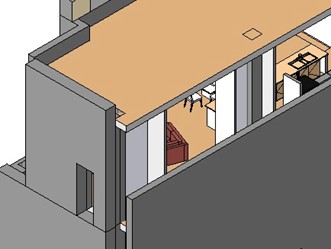
We need a well-built model for these outcomes to be accurately realized. In the example shown in Figure 1 above, these types of analysis will fail when the wall doesn’t stop at the intended roofline. We need better quality data and better trusted models. There are a lot of tools in the market to help drive model quality, but unfortunately, many of these tools suffer from two critical flaws:
- Organizing the model analysis workflows and checks requires specialized expertise – yet another tool to learn.
- Model reviews are performed based on the project schedule. This could mean weekly or bi-weekly model analysis which might not be frequent enough to avoid errors.
Regular model analysis is required to keep models reliable and trustworthy since the models are in a constant state of change throughout the life of a project. Regular analysis also has the additional benefit of helping project team members begin to correct poor modeling behaviors that can result in incorrect analysis or untrusted content.
Building trust in model data
Autodesk is launching the Autodesk Model Analytics tool (AMA) to help models become a more reliable source of truth for CDE data. The tool is designed to check model health and help users understand how to keep models optimized for performance with tooling built directly into Autodesk Construction Cloud’s (ACC) Insight tool. AMA can review models for most used families, errors and warnings, sync with central times, and other metrics that impact model performance.
AMA will also roll those metrics into a Model Health Score allowing BIM authors to quickly see if their models are experiencing any performance issues. Model health and performance metrics can be modified via sliders in a graphic interface – no longer requiring users to learn code or memorize APIs. Additionally, we are pushing to make model analytics more real-time by making the model dashboards update every time the model is saved to the cloud. Autodesk Model Analytics will be available via a public beta.
We want to build trust in project data. We can provide easier access to information and more real-time results by expanding the ways project stakeholders can access information through granularized data and regular model analytics. We can get closer to trusted data as the information gets refined more often by more project stakeholders.
Learn more about Parameters Service and the Autodesk Model Analytics beta.
*Egnyte AEC Data Insights Report, February 2024
**National Academies report: The Impacts of Design Errors and Omissions Change Orders on Highway Projects