 Virginia Senf

Exploring the past, present, and future of CDEs
Over the past 25 years, the AECO industry has undergone a remarkable digital transformation—from paper-based workflows to highly detailed 3D models and cloud-based collaboration. But with this evolution comes a new challenge: information overload.
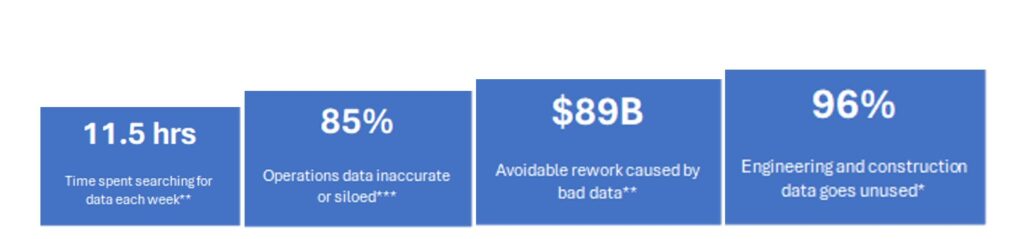
As project data has ballooned, much of the information remains trapped in bloated, inaccessible files. This data inaccessibility has resulted in 96% of available data going unused.* AECO firms’ data storage was six times higher in 2023 than in 2018, jumping to an average of 25.64 TB. That’s the data equivalent of watching high-definition movies for 1.5 years, nonstop. And the data surge only continues to accelerate.
This blog post explores a crucial shift: from cumbersome, file-based collaboration to granular, object-level data accessibility. At Autodesk, we believe that access to granular data is key to unlocking the full potential of AI, improving collaboration, and driving better decisions at every stage of the project lifecycle—from conceptual design to procurement to construction.
Real-world examples—from procurement chatbots to dynamic QA/QC dashboards—show how firms are already benefiting from more accessible data. Tools like the Autodesk AEC Data Model API and Autodesk Docs are helping bridge the gap between the unstructured collaboration necessary in the early stages of a project and the structured collaboration required as the project moves into construction and beyond.
When the right people have access to the right data at the right time—not just files—collaboration becomes more meaningful; decisions are better informed; and project outcomes improve. In this post, we present why improved data accessibility isn’t just a technical upgrade—it’s the foundation for a smarter, faster, and more collaborative future in AECO.
This multi-part blog series charts the history of CDEs, highlighting some of the data challenges the industry is facing, and exploring how CDEs must evolve as the industry shifts from files to granular data. Our goal? Delivering better project outcomes. In this second post of the series, we’ll explore why data ownership is important to all parties—and why information is not useful when the data is not accessible to the people making the decisions.
Today’s challenge – Golden needles of information lost in haystacks of data
The sheer volume of data produced in our industry is driving enormous excitement and hype around leveraging AI to transform the way our industry works. However, the overwhelming amount of digitized information remains a burden more than a blessing. The potential of that information driving better, more timely decisions remain largely untapped, with an estimated 96% of engineering and construction data remaining unused.*
Why isn’t this data accessed? Some of this waste is due to systemic challenges in the way our industry operates and manages risk, both contractual and cultural in nature. Sharing information with other partners on a project is commonly viewed as a liability within the industry.
This loss of information is also due to the profound technical limitations of today’s file-based workflows. We’ve spent the last 20 years pouring an increasing amount of detail into models and files. And the more bloated and unwieldly the files become, the more difficult it is to access the underlying, largely unstructured data trapped within them.
Today, project stakeholders spend hours waiting for bulky files to open and waste even more time searching for the tiny needle of information they need in a haystack of data. The constraints of this file-based paradigm keep valuable information from being found. File-based data trapped in files also threatens to block our industry’s ability to realize the full potential of the insights, automation, and analysis that AI will deliver.
Data accessibility – The foundational tenant of the next generation of CDEs
Since the advent of building information modeling (BIM) 25 years ago, there has been enormous progress in creating and generating detailed information for a built asset in one centralized location—the BIM model. Nearly every firm in the world now has a design technology or digital practice department that focuses on operationalizing those digital modelling workflows to ensure quality deliverables are produced.
That singular focus on the model has produced unintended consequences. Energy and information that design and preconstruction teams contribute to models becomes locked inside, largely inaccessible to any stakeholders who don’t have the expertise to navigate a model.
Deliverables generated from the model, such as views, sheets, drawings, and quantity takeoffs, represent different ways of viewing the same underlying data. These are often difficult to produce and nearly impossible to keep updated as the design evolves throughout the project lifecycle. That is why we believe data accessibility should be the foundational principle of the next generation of CDEs.
We must take the rich information generated and stored within the models and files we use and start to unlock granular, object-level information for all parties to access. For example, imagine if a general contractor on an office building refurbishment could easily isolate and view every building component that his or her subcontractors are responsible for installing on a given floor on a specific day.
The digital revolution: Unleashing data at a granular level
AECO must undergo a digital revolution to satisfy projected global demand—which will require professionals to design and build housing for a booming population, equivalent to adding 126 Tokyos over the next 25 years.**
The information stored in files must be unlocked and accessible to all stakeholders—not just the team members with expertise in using modeling tools. Despite the rising adoption of BIM, the gap is vast between project participants with experience leveraging these tools and the information within them, compared to users with no model access that are required to make decisions. Underlying data must become more accessible at a granular level to all project stakeholders—from the designers sketching out conceptual ideas, to the clients considering and paying for those proposals, to the project managers and subcontractors on the job site that will eventually transform those designs into a real building or bridge.

Accessing reusable and traceable designs for future projects
For example, imagine a world in which a window that is created during design—including location, geometry, and specification details—could be augmented throughout the project lifecycle with classification, object, asset IDs, serial numbers, install dates, and the warranty. That information shouldn’t be accessible only to the designer in Revit. Instead, the window’s data thread should be traceable and reusable for the next project.
The wide range of data associated with a single object—that window for instance—should be curated based on the needs of each stakeholder, so they view only the information required to get the job done. Imagine that a contractor could add costing information related to that window type from their proprietary cost database. That costing information would be accessible solely to the contractor’s team. However, the contractors will still be notified in near real-time when the architect makes a change to the design that impacts the dimensions of that window—and its potential cost and lead time impacts.
This approach will unlock more value from data today as well as the future with the help of new technologies, particularly AI. With granular data as the foundation, AI-enabled professionals will be able to work with astounding power and fluidity.
Workflows enabled by enhanced accessibility to granular data
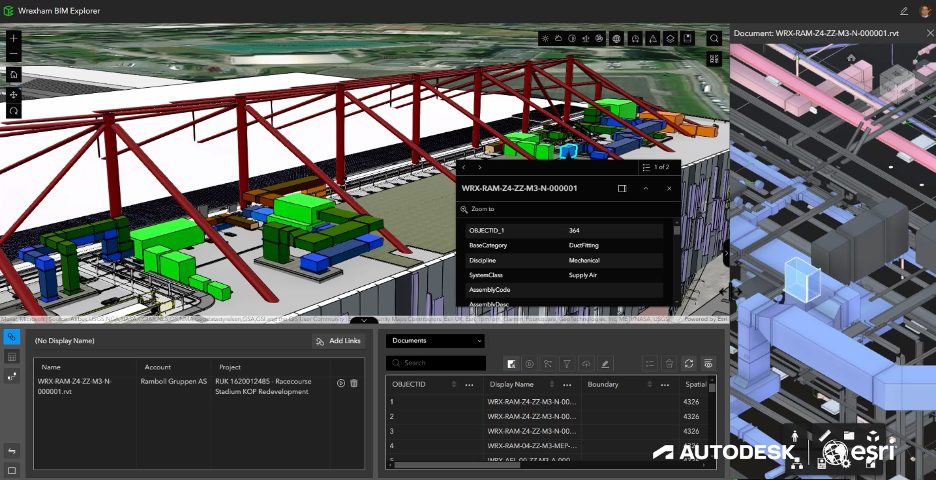
The most common applications we see customers building with the Autodesk AEC Data Model API are focused on unlocking object-level information for all relevant stakeholders. Customers are expanding model data access to more stakeholders to support better decisions.
For example, many procurement departments in AECO are now relying on conversational AI chatbots. QA/QC dashboards are helping project managers track design progress to gauge whether anything has changed in the underlying design that should be shared across the broader team before the wrong materials are delivered onsite.
AEC firms are already benefitting from this today. Goldbeck, a global design and construction firm, is enabling their procurement leads to query a live model to understand how many steel girders are required at a job site, including the dimensions, to ensure the right truck is used to bring the materials onsite.
Easily accessible data across all stakeholders, systems, and agents
Not all data needs to be stored in one place. For the foreseeable future, the essential systems of record that power businesses today will continue to exist: ERPs for cost and resourcing data, CRMs for customer information, GIS databases for site and geographical data, and CDEs like Autodesk Docs for project and model information.
These systems must make the data stored easier to access for all stakeholders, systems, and agents. We can free this information that is locked in files by expanding the powerful control and approval workflows of our version of CDE, Autodesk Docs, from file-based to object-level granularity. This data can then be standardized at the object-level and centralized in a hub connected to all the other tools storing project-related information.
The firms that own this data can share information with control, reaching the right project collaborators in the right places at the right time across every stage of the project lifecycle.
Improved granular data accessibility as the foundation to better collaboration
Collaboration is increasingly the theme of the moment in AECO technology. Systemic challenges around working and sharing information with other stakeholders have persisted, even as the industry has cautiously made its way to the cloud.
But what does collaboration really mean? Google offers two definitions, the second of which feels particularly relevant to AEC given the litigious nature of the industry:
- The action of working with someone to produce or create something.
- Traitorous cooperation with an enemy.
Many of the new tools that have entered the market over the past few years focus on the first definition of collaboration; the action of working with someone to produce or create something. During the pandemic, teams went from in-person design reviews on office whiteboards to attempting to recreate that fluid, in-person experience on online digital whiteboard platforms, like Miro or Mural. Translating real-world collaboration to a digital medium is a deceptively complex yet incredibly valuable pursuit for the tools that can be figured out.
What happens once brainstorming and ideation are done? What happens when a plan of action is mapped out and it’s time to execute? That information moves to other systems. Tasks are created and assigned in Jira, Trello, or Notion. The plan is moved to PowerPoint to be shared and presented. And that information begins to decouple as collaboration moves to action.
This collaboration process looks even more diffuse in AECO. The client may specify a common data environment (CDE) for the project, but each stakeholder inevitably already has an internal system used to manage information and deliverables.
Improving collaboration workflows
It’s extremely unlikely that we will all return to the office. However, the reality is that half of the AECO industry was never in an office. Those stakeholders were on the job site, stacking actual atoms into an actual building, road, or bridge.
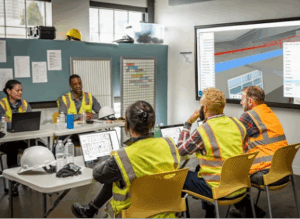
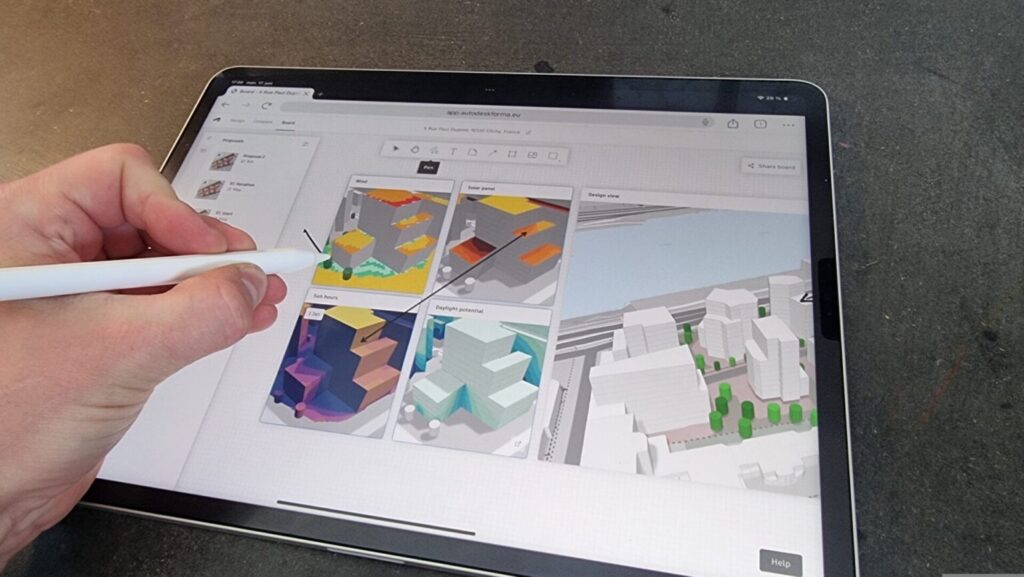
Many new AECO tools focus on improving collaboration workflows in the early stages of the design process. These tools facilitate an inclusive and nimble exchange and presentation of ideas in the conceptual phase of a project’s lifecycle—from sketching out an initial idea, to running initial site and environmental analysis, to sharing it with teammates or the client for design comments or markups.
At Autodesk, we couldn’t agree more that better workflows are needed in those early-stage conversations. We launched Forma Board and connected it to Autodesk Docs, our common data environment, to enable critical design review workflows. These fluid, collaborative ideas help stakeholders better establish design intent upfront in the project all the way through construction into operations.
Unstructured, creative collaboration versus control
The challenging aspects of collaborating in the AECO industry include reconciling unstructured, creative collaboration in the pursuit of control. Yes, the architect can still experiment with different floor layouts for the client in the design authoring tool. However, the contractor has already placed an order and needs to know what’s changing so that they can accurately quote a change order. Collaboration is critical to any project’s success.
This is the complexity of our industry, the necessity for both high trust and low trust working environments for unstructured and structured collaboration. The two modalities of collaboration are completely intertwined. Technology providers must be able to navigate between the two.
That’s why Autodesk is addressing the AECO industry’s dire need for increased accessibility to information. Both new startups and Autodesk are working on this long-standing lack of accessibility using tools like Forma Board to help teams easily collaborate with minimal friction – all without congregating in the same room.
Navigating a high trust, low friction working environment
We’re also working to provide a bridge between the high trust, fluid collaboration needed in the early stages of project’s lifecycle through to the low trust, low friction environment required later in the lifecycle. The design and construction process is a series of iterations incorporating a high level of trust within teams early in the design process to establish delivery milestones in the later stages of the construction and delivery process.
At Autodesk, we’re continuously working to improve the flow of information and workflows across the entire project lifecycle. We must connect data and workflows across the entire project lifecycle to facilitate both unstructured and controlled collaboration. This will help users achieve better outcomes by making the right information more accessible.
No change is made without every relevant stakeholder either approving or being notified that a change has happened. This is what the future of collaboration looks like—when the relevant data is accessible to every stakeholder on a project. Not all the data; just the data that matters to them. Once that data is accessible, it becomes information that allows you to make better decisions. Say goodbye to noise and hours spent searching for the latest version of a file and hello to focused iteration, where the original design intent and project outcomes always carry through.
Data accessibility leads to more trust
Moving forward, CDEs must move beyond a file-based paradigm and empower users to access data at the most granular level so that each stakeholder can access just the right data when they need it. This leads to better decisions and even more sharing of information.
Granular data access means trades can access the portions of a building most relevant to them. Account executives and general contractors can share the necessary data in lieu of sharing everything and exposing themselves to potential litigation. Increased accessibility to the data and control over what gets shared means that stakeholders can be more confident that the information they’re receiving is right. This leads to increased trust in the data which we will explore in our next post. Stay tuned!
Explore Autodesk Docs and the Autodesk AEC Data Model API.
*Big Data = Big Questions for the Engineering and Construction Industry, FMI Report
** World population to reach 8 billion this year, as growth rate slows | UN News