Let there be innovation: How Mike Schultz’s determination led to better design
Team USA gold medalist in Para Snowboarding Mike Schultz reengineers what’s possible in performance prosthetics as he prepares for the 2026 Olympic and Paralympic Games in Italy.

5 min read
After losing his leg in a snowmobile accident, U.S. Paralympic Medalist in Para Snowboarding Mike Schultz turned challenge into innovation—creating high-performance prosthetics that redefined adaptive sports.
From his garage to the global stage, Schultz transformed adversity into technology that now powers 90% of Paralympic snowboarders.
When Mike Schultz lost his left leg in a snowmobile accident in 2008, it seemed like the end of his racing career. The crash left him with multiple compound fractures, and despite several surgeries, doctors had to amputate above the knee. For someone whose life revolved around speed, the future suddenly looked still.
But Mike Schultz wasn’t built to stay still.
“I've got two passions in my life,” says the U.S. Paralympic Medalist in Para Snowboarding. “One is being an athlete. That began with motorsports, motocross, and I became a professional snowmobile racer. That's how I got injured. But I didn't want to slow down. And so I really leaned back on my second passion in life: I'm a garage guy. I love to have ideas and create things in my shop.”
When he began his recovery process, Schultz tried every prosthetic he could find. None could handle the demands of racing. “Prosthetics at the time didn’t really have anything for action sports,” he says. “I didn’t want to give up the things I love most. So I put my mad scientist hat on and hit the drawing board to solve my own problem.”

For two years, Schultz designed, fabricated, and tested a prosthetic knee strong enough for motorsports. Using a patented linkage system and a mountain-bike shock, he created a leg that could absorb impacts and mimic the motion of a human knee. Paired with a custom foot system he designed, it became something the prosthetics world hadn’t seen before: a high-performance limb built for action.
Then came the turning point—other athletes started asking about it. “Originally, I just built one or two for myself,” he says. “But when I realized that so many other people could benefit from it, I decided to start my company to create the highest-performance lower-limb prosthetics for action sports.”
By 2010, he wasn’t just racing again—he was helping others do the same. A maker was born.
From the garage to the Games
“One of the coolest things was seeing somebody else use equipment that I built in my shop,” Schultz recalls. “The guy was a snowboarder, and to watch him bolt this prosthetic knee on and shred down the mountain—it was really mind-blowing.”
That moment inspired Schultz to learn snowboarding himself. Within a few years, he was competing at the highest level—and in 2018, he won gold and silver medals in Snowboard Cross and Banked Slalom at the Paralympic Winter Games PyeongChang 2018, just a decade after losing his leg.
Along the way, he’s earned multiple medals in snowboarding, snowcross, motocross, and snow bike racing at global action sports events. Meanwhile, his company’s technology has transformed adaptive sports. “Every one of my teammates who’s a lower-limb amputee, as well as athletes from around the world, show up to the start line wearing equipment I built in my shop,” he says. “And that's pretty awesome.”
Today, about 90% of Paralympic snowboarders compete using his designs.
“It’s a double-edged sword,” Schultz admits. “The technology I’m building to make myself faster is also helping my competitors. But in the big picture, it’s so rewarding to be part of the progression of adaptive and Paralympic sports.”
"I didn’t want to give up the things I love most. So I put my mad scientist hat on and hit the drawing board to solve my own problem."
Innovation in motion
Schultz splits his time between competing and innovating—using every run and race as real-world R&D. “Being my own test pilot is a lot of fun,” he says, adding: “I get to say I’m headed out for research and development when I’m really going out to ride.”
Every vibration in the suspension of his prosthetic is feedback. Every crash is data. Every redesign brings him closer to perfection.
For Schultz, progress—whether in the lab or on the mountain—comes down to breaking big goals into small, solvable pieces. “You have this big, complex challenge, and it can be overwhelming,” he says. “But it can be broken up into multiple bite-sized pieces, and you just do it one step at a time.”
At the end of the day, new possibilities keep him motivated. “I love the process of trying to be better at everything,” he says. “My career has stretched 27 years, and I've changed sports several times. It always comes back to: I enjoy the process of trying to become better.”
That mindset has carried him from his garage to the Paralympic podium—racing with one leg made by nature, and one that he engineered himself.
Let there be action. Let there be innovation. Let there be anything.
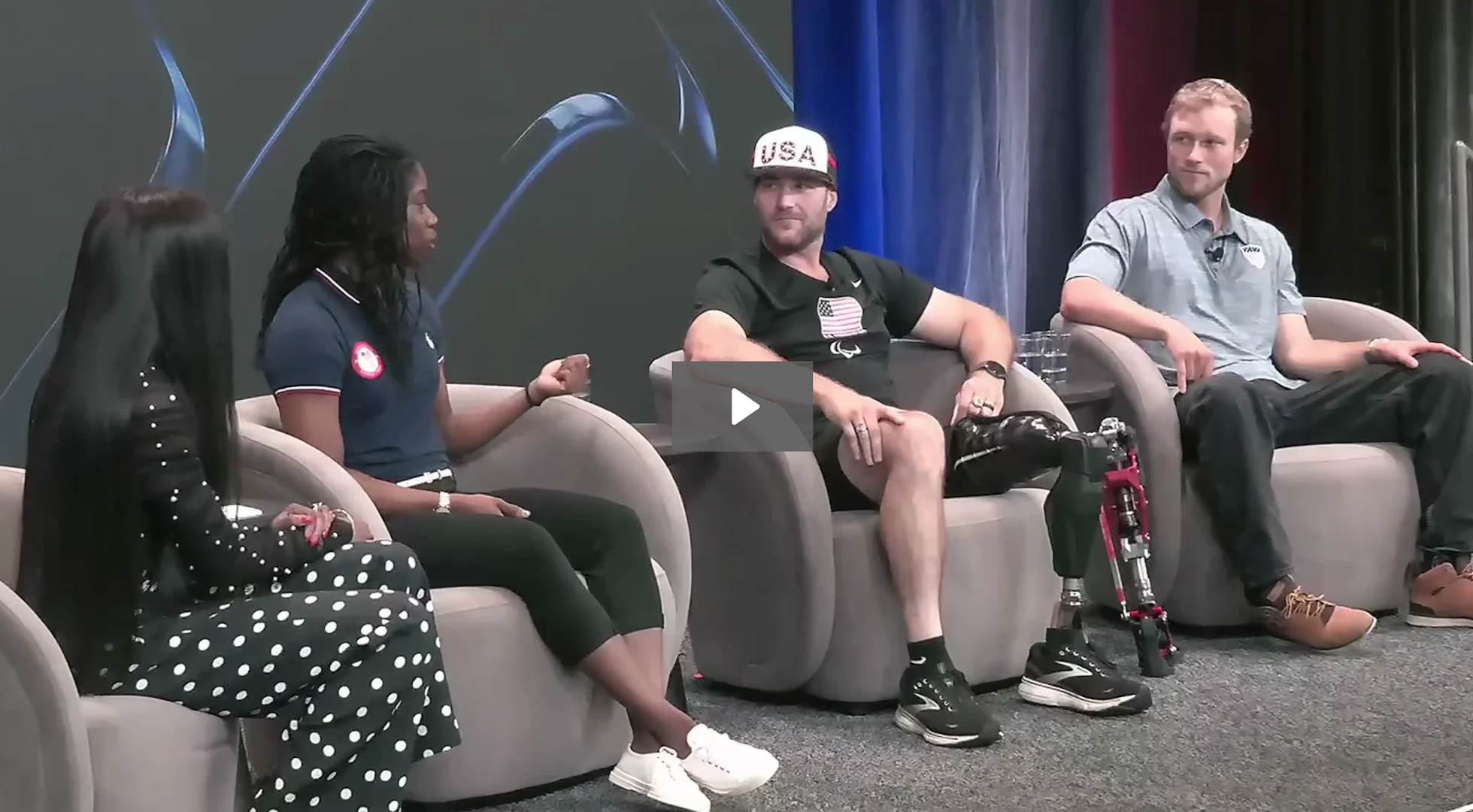
Watch Autodesk CMO Dara Treseader chat with Erin Jackson, Team USA, Speed Skating; Mike Schultz, Team USA, Para Snowboarding; and Colby Stevenson, Team USA, Freestyle Skiing at AU 2025.
Autodesk is the Official Design and Make Platform of the LA28 Olympic & Paralympic Games and Team USA. Learn more.